
A Louisiana divorce settlement agreement is a written document in which a couple records how they will divide community property and debts, and handle support and insurance, when a marriage ends. The community property laws in Louisiana, including La. Rev. Stat. § 9:2801, set how a couple divides what they own together.[1] The form you create here also covers children, support, the family home, debts, personal property and insurance.
Last Updated: October 2026. This guide is reviewed and updated regularly to reflect current Louisiana law. If you notice an error or outdated information, please contact us.
Build Your Document
Answer a few simple questions to make your document in minutes
Save and Print
Save progress and finish on any device, download and print anytime
Sign and Use
Your valid, lawyer-approved document is ready
Each spouse owns a present undivided one-half interest in the community property. When the marriage ends, the court divides the community assets and liabilities so that each spouse receives property of an equal net value.[1] A settlement is where a couple writes down its own plan for dividing community property.
The statute sets the basic rule for dividing community property:
The court shall divide the community assets and liabilities so that each spouse receives property of an equal net value.
The same statute adds three rules about how the court carries out that division:
While the community property regime exists, the spouses may, without court approval, voluntarily partition the community property in whole or in part. In that case, the things that each spouse acquires are separate property.[1]
A partition is effective toward third persons, meaning people outside the marriage, when it is filed for registry in the manner provided by Article 2332. Before the regime terminates, neither the community nor things of the community may be judicially partitioned, which means divided by a court order.[1]
Within forty-five days of service of a motion by either party, each party must file a sworn detailed descriptive list. Service means delivery of the court papers. The list must cover:[1]
Each party must also affirm under oath that the list contains all of the community assets and liabilities then known to that party.[1]
As between the spouses, the allocation of a debt to one spouse obligates that spouse to extinguish, or pay off, that debt.[1]
Splitting community debts in your settlement binds you and your spouse as between yourselves. The allocation in no way affects the rights of creditors.[1]
Popular Local Marital Settlement Agreement Forms
A marital settlement agreement, also referred to as a separation agreement, is a powerful tool that could help you work out the divorce and avoid unnecessary headache. Below are the states where people search for this form the most.

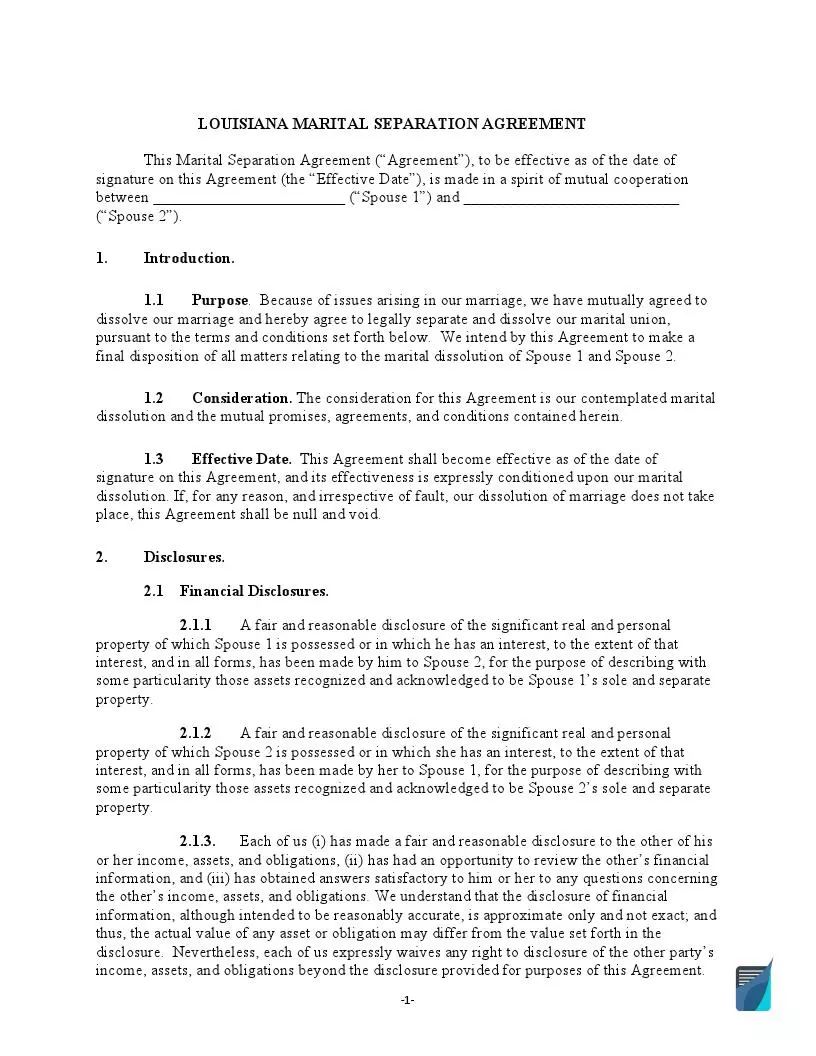
Use this Louisiana community property settlement form, to put your plan for property, debts, children, support and insurance in one place. The steps below are general practice, not Louisiana filing rules. Confirm court-specific details with your local court clerk.
The marital settlement agreement form has 18 numbered parts. The main ones are:
Sort your records by category, so you can determine what you own together and what each of you owes. For every item, note the owner, when it was purchased and its approximate value. These records are a good start:
Couples usually need to settle who stays in the family home, who pays each debt, how the personal property is divided and what support each person will give or receive. Writing down the plan for each point, even when you already agree, helps avoid confusion later. If you cannot agree on a point, a Louisiana family law attorney or a mediator can help.
These short answers explain three basics about community property in Louisiana, based on La. Rev. Stat. § 9:2801. They cover what community property is, how a court divides it, and how spouses may divide it on their own during the marriage.[1]
Each spouse owns a present undivided one-half interest in the community property, as La. Rev. Stat. § 9:2801 states. In plain words, neither spouse owns all of it, and each owns half of the whole.[1]
The court divides the community assets and liabilities so that each spouse receives property of an equal net value. If the division comes out unequal, the court orders the payment of an equalizing sum of money.[1]
While the community property regime exists, the spouses may, without court approval, voluntarily partition the community property in whole or in part.[1]

Other Marital Settlement Agreement Forms by State
General information, not legal or tax advice.
