
A Louisiana last will and testament is a written document under Louisiana law that names who receives the testator’s property, who serves as executor, and who cares for minor children after the testator dies. This Louisiana last will and testament template covers the state’s writing, signing, witness and notary rules.
Last Updated: September 2026. This guide is reviewed and updated regularly to reflect current Louisiana law. If you notice an error or outdated information, please contact us.
Build Your Document
Answer a few simple questions to make your document in minutes
Save and Print
Save progress and finish on any device, download and print anytime
Sign and Use
Your valid, lawyer-approved document is ready
A written will lets the testator control how property is divided and who raises their children, instead of leaving those decisions to the state’s default succession rules. Even a modest estate benefits from naming an executor and beneficiaries in writing.
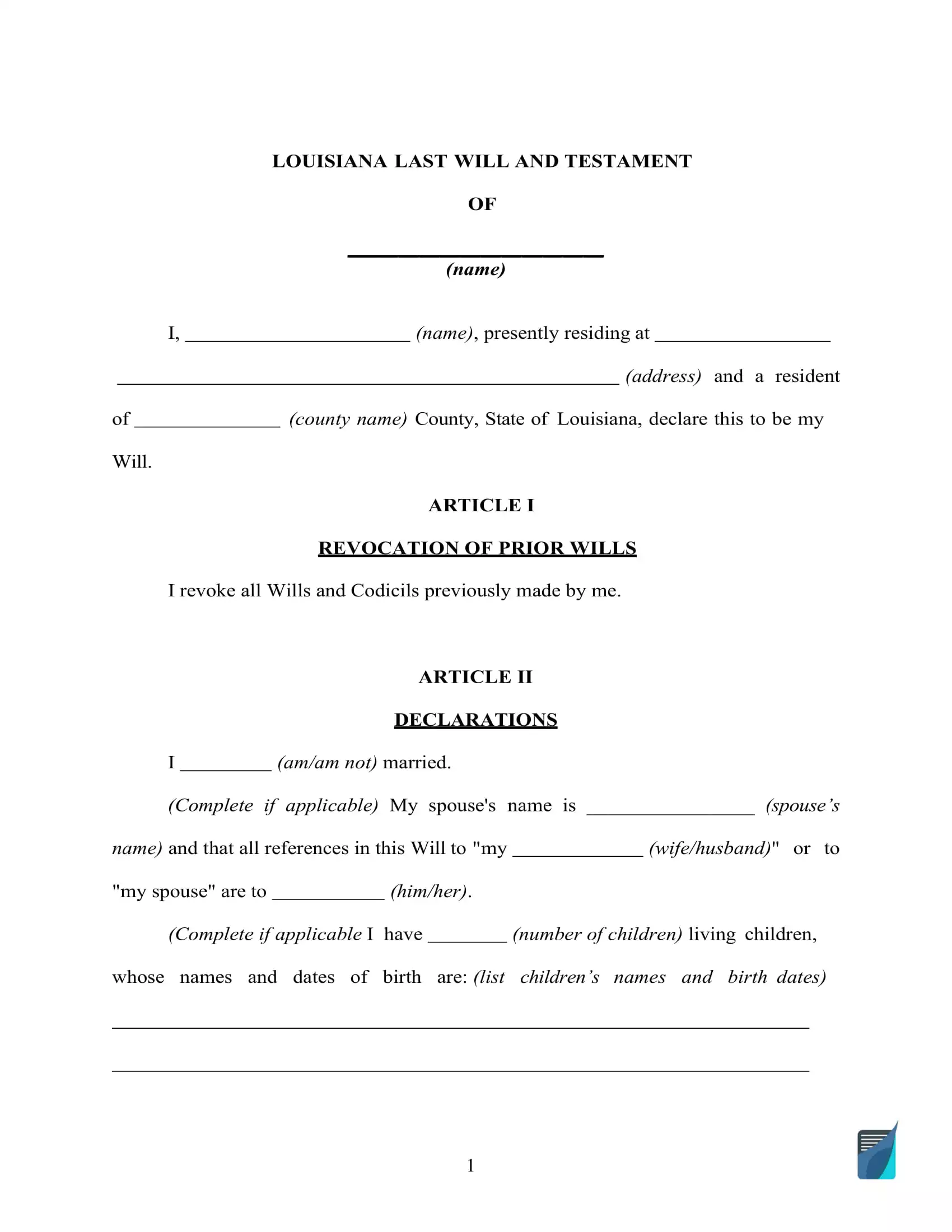
This page offers a free, fillable template to download and print, plus an online builder for a personalized version. Review the will requirements in the table below before you sign.
Louisiana law sets out the exact form a notarial testament must take: it must be in writing, dated, signed by the testator, and executed before a notary public with two witnesses present.[1] The table and notes below cover the signing and notarization rule this page’s template follows.
| Requirements | State laws | |
| Signing requirement | Two witnesses AND a notary public | SECTION 2 – FORMS OF TESTAMENTS |
| Registering a will | Optional, through the Secretary of State’s office |
A Louisiana notarial testament must meet four requirements to be valid.[1]
The testator’s signature may appear anywhere in the testament, as long as it identifies the testator and shows their intent to adopt the document as their will.[1]
A notarial testament (the form Louisiana recognizes for a typed will) needs the testator, both witnesses, and the notary to sign at the same execution. Missing any one of those signatures is the most common reason a will gets challenged later.
Louisiana has the equivalent of a self-proving will. A notarial testament that is signed on each separate page and carries the statutory declaration signed by the notary and the witnesses does not need to be proved, and the court orders it filed and executed without further proof (La. Code Civ. Proc. arts. 2887, 2891).[2]
Writing a Louisiana last will comes down to six steps: choosing a format, giving your details, naming an executor, naming a guardian if you have minor children, listing your beneficiaries, and signing it with two witnesses and a notary.

In practice, it is easier to choose an executor who lives in Louisiana. An executor who lives outside Louisiana can be confirmed only after appointing a Louisiana resident agent for service of process and filing that appointment in the succession proceeding (La. Code Civ. Proc. art. 3097). The executor also must be at least 18 and not a convicted felon.[3]
The main representative might not be able to execute your last will because of a health problem, death, unwillingness, or other reasons. Naming a second, backup executor with the same details as the main one helps avoid delay if that happens.


When you have an uneven asset distribution in mind, describe it here. Assets might include money for arrearage, realty, shares, company control, cash, and any material items of commercial worth you own. Some assets, such as jointly acquired property and life insurance, cannot be distributed through a will.


A Louisiana will can be held invalid for any of the reasons below, because each one fails a specific requirement of the same statute that governs the notarial testament.[1] Fixing the will’s format is easier before the testator dies than after, so check each item against the finished document.

These are the Louisiana last will questions readers ask most often, covering notarization, spousal disinheritance, lost wills, and signing when a testator cannot sign in the usual way. Each answer that states a specific state rule is cited to the statute.
Yes, a last will and testament document must be notarized in Louisiana and is not valid without a notary certification.[1]
If you wish to disinherit your marriage partner, it will most probably be unfeasible. Louisiana is a community property state (sometimes also called marital property). Half of all properties and assets (including arrears) of one spouse belong to another and remain such after divorce.
Well, before getting married to someone, you can also conclude a prenuptial agreement with your partner. It will allow you to redefine the way the community property will be allocated upon divorce or your demise. It is perhaps the sole plausible way to disinherit your spouse or limit her or his share. But, there’s also something called “marital portion,” which ensures the surviving spouse gets one-fourth of the testator’s estate if the testator died “rich.”
For any other members, it’s legal in Louisiana to disinherit them in your last will. Include disinheritance sections where you clearly state your intentions and attach a letter with some explanations to be sure there’s no misunderstanding.
Louisiana’s default succession rules take over when a will cannot be located, so it is common practice to register a will with the Louisiana Secretary of State to avoid disputes over whether it still exists (Will Registration Form).
If a testator is unable to sign, Louisiana law lets them make a mark instead, or direct another person to sign on their behalf, in their presence.[1]
| Related documents | Times when you might want to have one |
| Codicil | You want to slightly modify your last will without writing a new document from scratch. |
| Self-proving affidavit | You want to steer clear of possible complications in the probate court. |
| Living will | You would like to indicate precisely what health care you expect if you can’t communicate that yourself. |
| Living trust | You want to skip probate by placing your assets in a trust. |
A Louisiana will is valid when it is a notarial testament prepared in writing, dated, signed by the testator, and executed before a notary public with two witnesses present who also sign.[1] Each element works together. Missing the notary, either witness signature, or the testator’s own signature can make the document invalid.
The testator must be at least 16: a minor under 16 cannot make a testament except in favor of a spouse or children, and a minor who has reached 16 may make one (La. Civ. Code art. 1476). The testator must also be able to understand generally the nature and consequences of the disposition (art. 1477).[4]
A witness must be at least 16 and cannot be insane, blind, or unable to sign his or her name (La. Civ. Code art. 1581). A legacy to a witness is invalid, but the testament itself stands (art. 1582).[5]
Louisiana’s verified will law requires a notarial testament to be prepared in writing.[1] Louisiana also recognizes a handwritten will as an olographic testament when it is entirely written, dated, and signed in the testator's own handwriting. The signature and the date may appear anywhere in it, and it is subject to no other requirement as to form (La. Civ. Code art. 1575).[6]
Louisiana recognizes only two forms of testament, olographic and notarial, and both must be in writing, so an oral will is not recognized (La. Civ. Code art. 1574).[7]
General information, not legal or tax advice.
