
Updated:
A Louisiana bill of sale is a written receipt for private sales. For a used vehicle title, the Louisiana OMV asks for an original notarized bill of sale or invoice.[1] Private sellers and buyers need one, especially for a car, boat, trailer or firearm.
Key facts
Build Your Document
Answer a few simple questions to make your document in minutes
Save and Print
Save progress and finish on any device, download and print anytime
Sign and Use
Your valid, lawyer-approved document is ready
| Document Name | Louisiana Vehicle Bill of Sale Form |
| Other Names | Louisiana Car Bill of Sale, Louisiana Automobile Bill of Sale |
| DMV | Louisiana Office of Motor Vehicles |
| Bill of Sale Required? | Yes, for a used vehicle title: an original notarized bill of sale or invoice (Louisiana OMV, Used Title & Registration)[1] |
| Avg. Time to Fill Out | 7 minutes |
| # of Fillable Fields | 15 |
A Louisiana bill of sale takes the form that fits the property sold: motor vehicle, boat, firearm or general. Each form names the item, the parties, the price and the signatures it needs. The motor vehicle form follows the order of the official bill of sale that the Louisiana Office of Motor Vehicles provides for private sales.
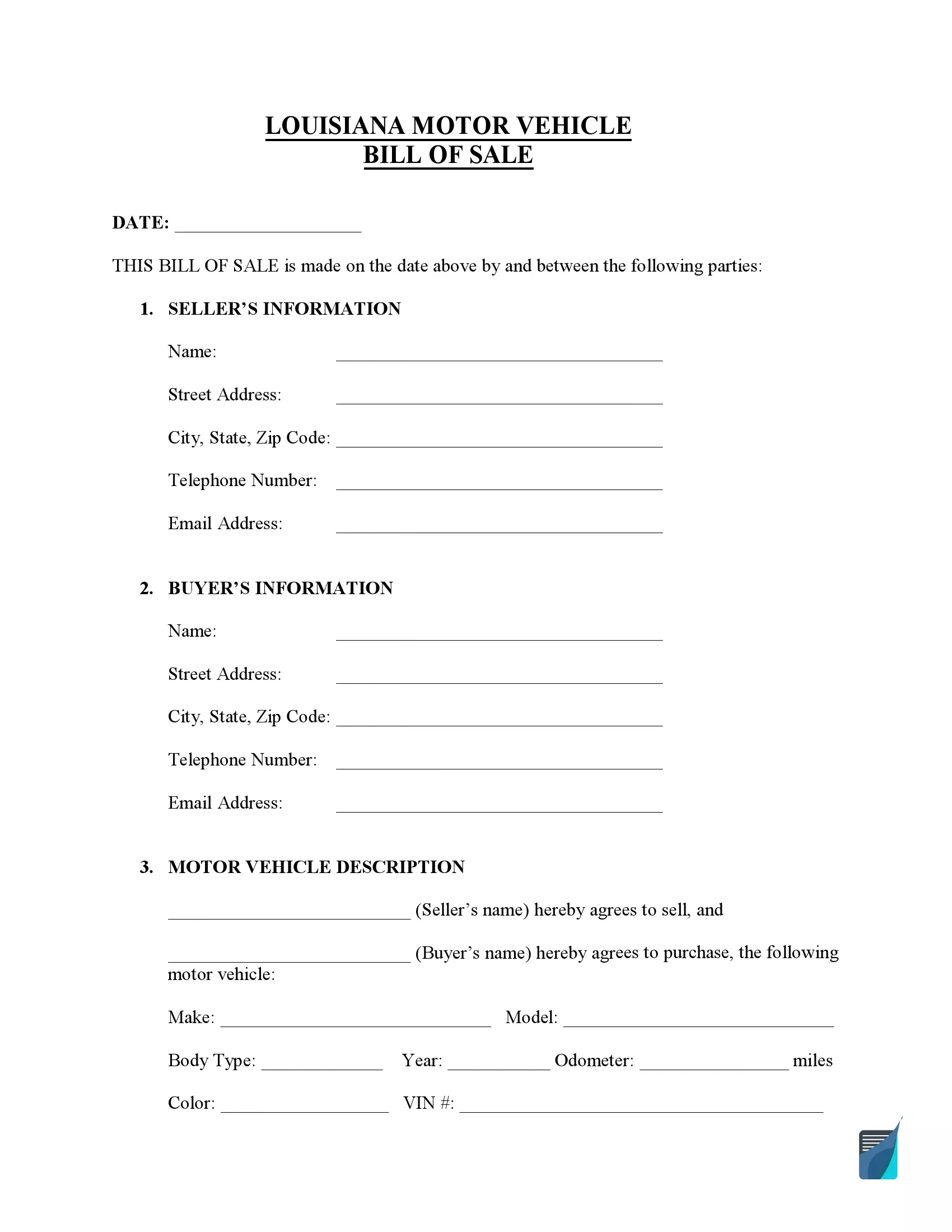
Louisiana bill of sale for a motor vehicle should contain the vehicle’s detailed description, including make, model, odometer reading, year, color, body type, and VIN. For a used vehicle title, the bill of sale is an original notarized copy that shows the actual price paid (Louisiana OMV, Used Title & Registration).[1] The buyer then files for a new certificate of title within five days of delivery of the previous title, or of the vehicle when no title was issued before (La. Rev. Stat. § 32:707).[2]
| Alternative Name | Car Bill of Sale |
| Seller’s Signature | Required |
| Buyer’s Signature | Required |
| Notarization | Required for a used vehicle title (Louisiana OMV, Used Title & Registration) |
| Download | PDF Template |

Louisiana boat bill of sale must include the registration number, HIN, make and model year, and the signatures of the seller and buyer, and the serial number of an outboard motor goes on the title application. LDWF requires registration of all motorized vessels, sailboats 12 feet or longer, and non-motorized houseboats used in Louisiana waters.[3]
| Alternative Name | Vessel Bill of Sale |
| Seller’s Signature | Required |
| Buyer’s Signature | Required |
| Download | PDF Template |

Louisiana bill of sale for a gun is a valuable document that includes identifying details about the firearm, buyer, and seller. In practice, both parties keep a copy as their record of the transfer.
| Alternative Name | Gun Bill of Sale |
| Seller’s Signature | Required |
| Buyer’s Signature | Optional |
| Notarization | Optional |
| Download | PDF Template |

In a general bill of sale, the parties can outline the transaction details involving any personal property type. All you need to do is to fill out the sections devoted to the parties’ personal information, property description, and selling price and place the parties’ signatures.
| Alternative Name | Generic Bill of Sale |
| Seller’s Signature | Required |
| Buyer’s Signature | Optional |
| Notarization | Optional |
| Download | PDF Template |
A Louisiana vehicle bill of sale meets the OMV's used title list when it is an original notarized copy that shows the actual price and fully describes the vehicle (Louisiana OMV, Used Title & Registration).[1] The same list accepts an invoice in place of a bill of sale.
The OMV list covers a vehicle title. The boat, trailer and firearm parts of this page cover those sales.
A Louisiana bill of sale lists the parties, the item, the price and the signatures, so either side can show the terms of the sale later. Each entry below is one line or box on the form.
The clause works best in plain words above the signatures, where the buyer reads it before signing. A seller who offers a warranty writes its terms in the same place instead.
The odometer reading is one of the vehicle details on the bill of sale. The OMV's Odometer Disclosure Statement (Form DPSMV 1606) appears under Relevant Official Forms below.
A Louisiana bill of sale for a used vehicle title needs a notary: the OMV asks for an original notarized bill of sale or invoice (Louisiana OMV, Used Title & Registration).[1] A copy of a notarized bill of sale falls short, because the list asks for the original (Louisiana OMV, Used Title & Registration).
The official vehicle form ends with an acknowledgment section. The seller and buyer sign it in front of a notary public, who fills in the parish and completes the notarization. The OMV list quoted here speaks only to vehicle titles.
The Louisiana vehicle bill of sale is completed in seven steps, in the order of the official form for private vehicle sales. Have the notary present before the parties sign.


A Louisiana trailer bill of sale shows the trailer sale with the trailer's VIN, make, model year and price, plus both parties' names, the date and the signatures.
The bill of sale goes with the buyer's application for a new certificate of title, due within five days after delivery of the previous title, or of the vehicle when no title was issued before (La. Rev. Stat. § 32:707).[2] That deadline excludes factory-built homes, which La. Rev. Stat. § 32:707 leaves out of the rule.
Registering typically means visiting the nearest Office of Motor Vehicles (OMV) office and bringing these documents:
The previous owner completes the assignment section on the back of the title to sign the vehicle over to the new owner.
A bill of sale does not show that a lien on the vehicle is gone. Ask the seller for the lienholder's proof of the release before paying.
The seller may also report the sale online through the OMV Notice of Vehicle Transfer, which flags the OMV record, although ownership on that record does not change until the buyer applies for title.[4] In Louisiana you may keep your plate when you sell the vehicle and transfer it to a replacement vehicle at an OMV office (La. R.S. 47:505(B)(1)).[5]
Form DPSMV 1799, the Vehicle Application, is the OMV's application form for a vehicle title and registration; a duplicate of a lost title is one of its uses.

Form DPSMV 1606, the Odometer Disclosure Statement, is the OMV's form for stating a vehicle's mileage at a change of ownership. Ask the OMV whether the vehicle in your sale needs one.

Notice of Vehicle Transfer (Form DPSMV 1697) is an optional form a seller may file to report the sale, donation, or trade of a vehicle to the Office of Motor Vehicles.

This Application should be used by the owners who want to register their boats at the Louisiana Department of Wildlife and Fisheries.

Affidavit for Boat Inspection is used if you have a homemade boat or the identification number of the boat is incorrect or hard to read.

Form DPSSP 4645 or Concealed Handgun Permit Application is used if a person wants to obtain a permit to carry a firearm in Louisiana.


Other Louisiana Forms
Yes, for a used vehicle title: the Louisiana OMV asks for an original notarized bill of sale or invoice that shows the actual price and fully describes the vehicle (Louisiana OMV, Used Title & Registration).[1] For other property, the bill of sale is the parties' own proof of the sale.
A bill of sale without notarization falls short of the OMV's used title list, which asks for an original notarized bill of sale or invoice (Louisiana OMV, Used Title & Registration). The buyer then lacks a listed document, which can push the title application past the five-day window of La. Rev. Stat. § 32:707.[2]
Yes, for a used vehicle title: the OMV list asks for an original notarized bill of sale or invoice that shows the actual price and fully describes the vehicle (Louisiana OMV, Used Title & Registration).[1]
An invoice can stand in for the bill of sale: the OMV list names an original notarized bill of sale or invoice that shows the actual consideration and a full description of the vehicle (Louisiana OMV, Used Title & Registration).[1]
The OMV list describes what the vehicle bill of sale shows, not how it is produced: an original, notarized, with the actual price and a full description of the vehicle (Louisiana OMV, Used Title & Registration). A handwritten bill of sale carries the same entries as the printed form.
A vehicle bill of sale misses the OMV's used title list when it is a copy, lacks notarization, leaves out the actual price or describes the vehicle only in part (Louisiana OMV, Used Title & Registration).[1]
General information, not legal or tax advice.

