
A Louisiana firearm bill of sale is a written record of a gun sale. It names the seller, the buyer, the firearm and the price, so it works as a receipt for the buyer and as proof of the transfer for the seller. You can create the form online in a few minutes or download the free printable PDF, then have both parties sign it.
Last Updated: October 2026. This guide is reviewed and updated regularly to reflect current Louisiana law. If you notice an error or outdated information, please contact us.
Build Your Document
Answer a few simple questions to make your document in minutes
Save and Print
Save progress and finish on any device, download and print anytime
Sign and Use
Your valid, lawyer-approved document is ready
Looking for other documents? Browse the Louisiana bill of sale templates, read our bill of sale guide for the basics, or see the Louisiana boat bill of sale.
A gun bill of sale is a short written contract that records who sold a firearm to whom. It lists the seller, the buyer, the make, model and serial number, the price and the date, and both people sign it. Think of it as a receipt for a private gun sale that either side can keep. For a shorter record, see our gun sale receipt template.
The FormsPal form has seven numbered parts, so it is easy to check that nothing is missing:
A gun sale in Louisiana is covered by both state and federal law. The three rules below come from the Louisiana statutes and from federal law. A bill of sale records the sale and does not replace any of them.
A person convicted of one of the felonies listed in La. R.S. 14:95.1, such as a crime of violence, burglary, a felony drug offense or a sex offense, may not possess a firearm or carry a concealed weapon for ten years after completing the sentence.[3.1]
A person 18 or older who is not barred from possessing a firearm may carry a concealed handgun without a permit (La. R.S. 14:95(M)). The optional state concealed handgun permit requires age 21 (La. R.S. 40:1379.3).[4.1]
Under 18 U.S.C. § 922(a)(1)(A), a person engaged in the business of dealing in firearms needs a federal firearms license. Occasional sales for a personal collection or hobby, or selling all or part of a personal collection, do not count as engaging in the business (18 U.S.C. § 921(a)(21)(C)).[2.3]
| Subject | Shotguns and Rifles | Handguns and Other Firearms |
| Minimum age to buy from a licensed seller | 18 years | 21 years[2.1] |
| Background check by a licensed seller | Required before the transfer is completed[2.2] | |
| Supplying a firearm to a known felon | Illegal under La. R.S. 14:95.1.1[1] | |
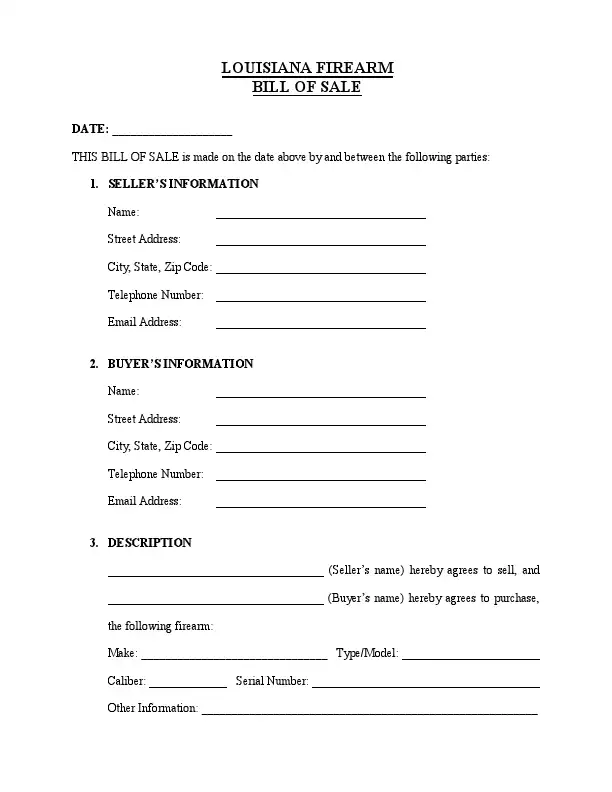
The free printable Louisiana gun bill of sale below has lines for the seller, the buyer, the firearm, the price and the signatures. Create it online in a few minutes, or download the PDF, print it and fill it in by hand. You can also complete the downloaded file on any device with our online PDF editor.
The steps below follow the FormsPal form, one numbered part at a time. Have the firearm and both parties' details in front of you before you start. Each step names the page of the form it is on, so you can check your work against the printout.
Step 1: Date (page 1).
Enter the date the bill of sale is made.

Step 2: Seller's and Buyer's Information (page 1).
Fill in the same lines for each side:

Step 3: Description (page 1).
Write the seller's and buyer's names, then describe the firearm:

Step 4: Purchase Date, Purchase Price and Method (page 2).
Enter the purchase date and the total price, then tick one way the price will be paid:
Next, tick one payment method:

Step 5: Buyer and Seller Disclosures and Miscellaneous Provisions (pages 2 to 4).
The seller reads the seller's statements and signs under them. The buyer reads the buyer's statements and signs under them. The miscellaneous provisions say the firearm is sold "as is", with no warranty, and there is nothing to fill in there.

Step 6: Signatures (page 4).
Enter the date, then the seller and the buyer sign and print their names. The form also has a line for a witness signature and printed name.

Step 7: Acknowledgment (page 5).
If you want the signing notarized (see our Louisiana notary acknowledgment page), sign in front of the notary public on this acknowledgment page. The notary fills in the county, the date and their own name and title, then signs and adds the seal. Each side should keep a signed copy of the finished bill of sale.

Part 3 of the form is where most people slow down, so here is how a finished firearm description can look. The values below are made up for illustration. Copy the real details from the firearm in your hands, not from memory or from an old receipt.
| Line on the form | Sample entry |
| Make | Remington |
| Type or model | Model 870 pump shotgun |
| Caliber | 12 gauge |
| Serial number | A123456M |
| Other information | Walnut stock, 28 inch barrel |
You can buy a gun from a store or from a private seller. A licensed importer, manufacturer or dealer must contact the national instant criminal background check system before completing the handover to someone who is not licensed.[2.2] In a private sale between two people, a signed bill of sale gives both sides a written record of what was sold, when and for how much.
Gun stores usually have their own sales paperwork, so a buyer at a store often does not need a separate bill of sale. In a private sale, the bill of sale works as a receipt for the buyer and as proof for the seller that the firearm changed hands. Our firearm bill of sale guide explains each line of the form.
Before you sign a private sale:
Most trouble with a bill of sale comes from small gaps on the page, not from the sale itself. A misread digit in the serial number or a blank signature line makes the record hard to rely on later. These are good habits rather than legal requirements, so check each line before the firearm changes hands. Our guide on how binding a bill of sale is covers the general idea.
Louisiana law makes it illegal to supply a felon with a firearm. In plain words, do not give, sell, lend or otherwise transfer a firearm to someone you know has a felony conviction.[1] The statute defines the offense in these words:
Illegally supplying a felon with a firearm is the intentional giving, selling, donating, providing, lending, delivering, or otherwise transferring a firearm to any person known by the offender to be a person convicted of a felony.
General information, not legal or tax advice.
