
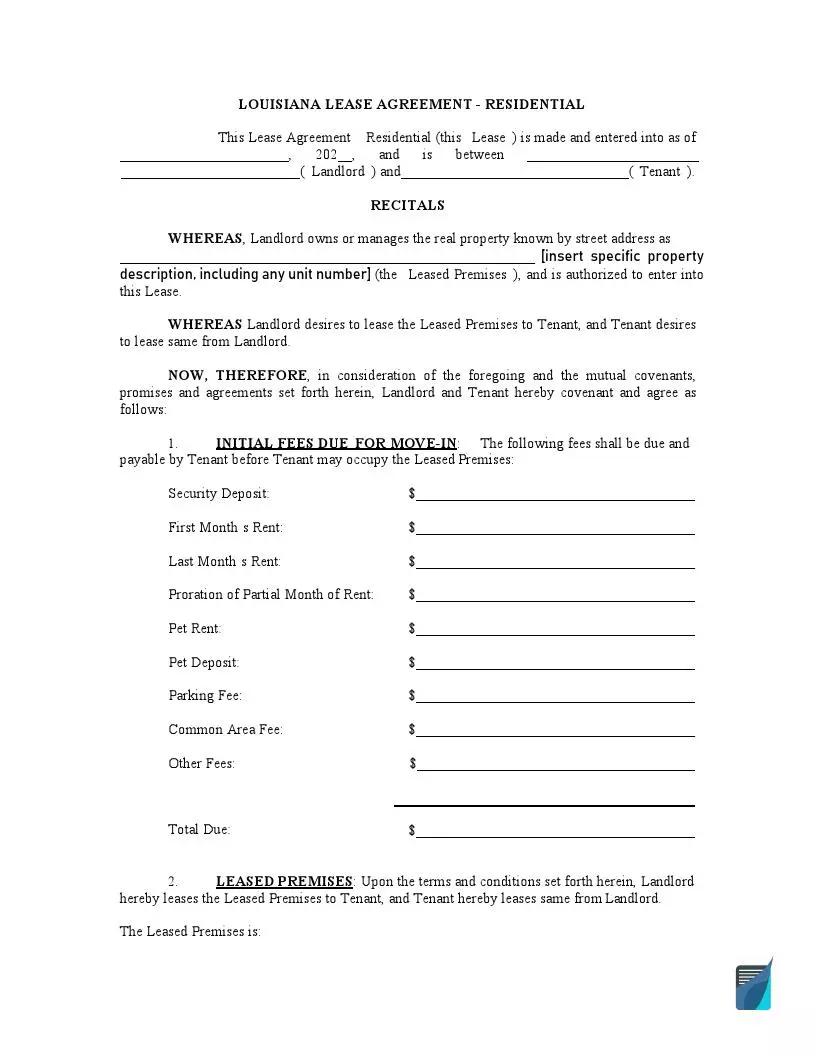
A Louisiana lease agreement is a written or oral contract that sets out the rent, the lease term, and each party’s responsibilities for the rented property. Rental agreements can run for a fixed term or month-to-month, and oral ones are hard to prove in court, so most landlords and tenants put the agreement in writing. Louisiana law sets the security deposit return deadline and the notice period for ending a lease, and you can build and print a free lease agreement online.
Last Updated: September 2026. This guide is reviewed and updated regularly to reflect current Louisiana law. If you notice an error or outdated information, please contact us.
Build Your Document
Answer a few simple questions to make your document in minutes
Save and Print
Save progress and finish on any device, download and print anytime
Sign and Use
Your valid, lawyer-approved document is ready
Keep a signed copy of your Louisiana lease and any move-in inspection notes. If a dispute over the deposit comes up later, this paperwork helps show the property’s condition when the rental began.
Louisiana lease agreements are governed mainly by the state’s Civil Code lease articles and by La. Rev. Stat. § 9:3251, which sets the rules for security deposits. These laws cover how much notice a landlord must give to end a lease and when a deposit must be returned. They also cover what happens to the deposit when the property changes owners.
In Louisiana, roommates can sign the same lease as co-tenants. Many leases used this way hold each co-tenant jointly responsible for rent and for damage to the property. It helps to agree in writing how the roommates will split those costs.
Many Louisiana leases specify a late fee amount and a grace period directly in the agreement, so both sides know what to expect if rent is paid late.
Louisiana leases generally take one of three forms: a fixed-term lease that ends on a stated date, a month-to-month lease that renews until either side gives notice, or a week-to-week lease, most common for short stays. A fixed-term lease often becomes month-to-month once the original term ends and the tenant stays on with the landlord’s consent. Which type applies to a given lease affects how much notice either side must give to end it, covered in the notice section below.
Security deposits protect the landlord against unpaid rent or damage beyond normal wear and tear. Normal wear and tear is the natural, gradual decline a property experiences from ordinary use. Louisiana law lets a landlord keep only what is reasonably necessary to cover unpaid rent or damage beyond that.[1]
Common examples of normal wear and tear include faded paint, worn carpet, or small nail holes from hanging pictures. Damage beyond that, such as a broken window or a large stain, can be deducted from the deposit.
A pet deposit is a specific kind of security deposit some landlords charge when a lease allows pets. It is common, though not universal, in leases that permit pets.
Under Louisiana law, the landlord must return the security deposit within one month after the lease terminates. The landlord may keep only the part that is reasonably necessary to cover unpaid rent or damage beyond normal wear and tear.[1]
If the landlord keeps any part of the deposit, state law requires a written, itemized statement explaining what was kept and why, sent within one month after the tenancy ends. To receive that statement and any refund, the tenant must give the landlord a forwarding address when the lease ends.[1]
This itemized-statement requirement does not apply if the tenant abandons the property, either without giving the required notice or before the lease ends.[1]
If the rental property is sold during the lease, the seller (transferor) must transfer the sum deposited as security for the lease to the buyer, the successor in interest. The buyer then takes over responsibility for the deposit, and the seller is relieved of further liability for it.[1]
“Any advance or deposit of money furnished by a tenant or lessee to a landlord or lessor to secure the performance of any part of a written or oral lease or rental agreement shall be returned to the tenant or lessee of residential or dwelling premises within one month after the lease shall terminate, except that the landlord or lessor may retain all or any portion of the advance or deposit which is reasonably necessary to remedy a default of the tenant or to remedy unreasonable wear to the premises.”
Louisiana law sets minimum advance notice for a landlord ending a periodic tenancy without cause, one with no fixed end date. The amount of notice depends on how the rent period is measured.[2]
| Lease period | Notice required to end the lease |
|---|---|
| Week-to-week | Five calendar days before the end of the period |
| Month-to-month | Ten calendar days before the end of the month |
| Year-to-year (or any period longer than a month) | Thirty calendar days before the end of the period |
A fixed-term lease that simply runs to its stated end date does not need this notice. These periods run on calendar days, not business days. Count them with our deadline calculator to find the exact date to send notice, since sending it late can push the lease into another rent period.
Entry by the landlord is a common point of disagreement between landlords and tenants. Many rental agreements include a clause that spells out when and how the landlord may enter the property, such as for repairs, inspections, or showings. As a general practice, giving reasonable advance notice and entering at a reasonable time helps avoid disputes, even when the agreement does not address the point directly.
Louisiana rental agreements commonly include several key terms beyond the deposit and notice rules above. Many rental agreements specify:
Beyond these core terms, many rental agreements also address whether the tenant may sublet the property, whether alterations are allowed, and how the landlord may enter for repairs or inspections.
Once you have downloaded the lease, you can fill it in, edit it, and sign it online with our PDF editor instead of printing and scanning each page.
For housing built before 1978, federal law (42 U.S.C. 4852d) requires the landlord to give the tenant an EPA-approved lead hazard pamphlet and to disclose any known lead-based paint or lead hazards before the tenant is bound by the lease.[3]
| Document Name | Louisiana Rental Lease Agreement Form |
| Other Names | LA Rental Lease, Louisiana Residential Lease Agreement |
| Relevant Laws | Louisiana Attorney General’s Guide to Landlord and Tenant Laws |
| Security Deposit Return | One month from the termination date[1] |
| Avg. Time to Fill Out | 18 minutes |
| # of Fillable Fields | 119 |
| Available Formats | Adobe PDF |
Louisiana tenants and landlords often have questions about security deposits and how a lease can end. The answer below is drawn from the same Louisiana statutes cited throughout this guide, so you can read the full legal text for yourself.
In Louisiana, a landlord must return a tenant’s security deposit within one month after the lease ends. The landlord may keep only the part that is reasonably necessary to cover unpaid rent or damage beyond normal wear and tear. The landlord must send an itemized statement for anything withheld.[1]

Other Rental Lease Agreement Forms by State
General information, not legal or tax advice.
The facts on this page come from Louisiana’s own statutes and civil code articles, cited throughout this guide with a bracketed number. Read the primary source below for the exact legal language behind each rule, rather than relying on a secondary summary.
