
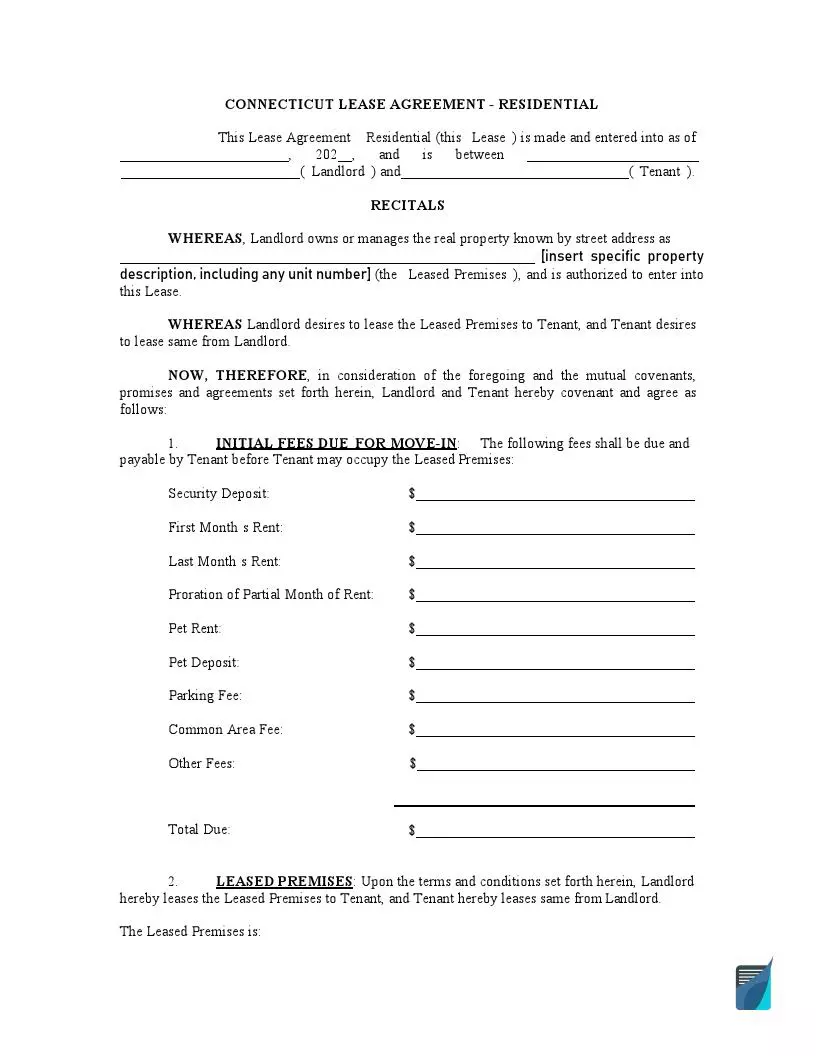
A Connecticut lease agreement is a written contract between a landlord and a tenant. It sets the rent, the term, and each party's duties for a residential rental property. State law caps the security deposit and sets rules for returning it. Use this residential lease agreement template for a year-long rental, a month-to-month arrangement, a room rental, or a sublease. Before signing, confirm the deposit size and the notice needed to end the tenancy.
Last Updated: September 2026. This guide is reviewed and updated regularly to reflect current Connecticut law. If you notice an error or outdated information, please contact us.
Build Your Document
Answer a few simple questions to make your document in minutes
Save and Print
Save progress and finish on any device, download and print anytime
Sign and Use
Your valid, lawyer-approved document is ready
A Connecticut lease agreement is a written contract that sets the rent, the term, and the duties of the landlord and tenant. A few state law rules apply no matter which of the eight formats below the parties choose. Those formats are listed first, followed by the security deposit, penalty, and notice rules that apply to all of them.
There are eight types of Connecticut Rental Lease Agreements:
Three of these formats are the most common:
Association of Realtors Residential Lease Agreement. This standard-form residential lease agreement template usually covers a term of one year or more. It lists the rights and duties of both parties for the rental property and takes effect once both sign it.
Month-to-Month Rental Agreement. This is one of the most common lease types. It renews automatically each month, and the tenant pays rent on a monthly basis.
Termination Letter. Either party uses this form to give written notice that the lease is ending. It gives the tenant time to find a new home and the landlord time to find a new tenant.
Popular Local Rental Lease Agreement Forms
Connecticut caps the security deposit on a residential lease agreement and sets rules for how it is held and returned. A landlord cannot demand more than two months' rent from a tenant under 62. The cap drops to one month's rent once the tenant turns 62. If a tenant turns 62 after paying a larger deposit, the landlord must return the extra amount on request.[2]
The landlord must deposit the money into an escrow account right away. The account must be at a Connecticut financial institution. The landlord must also tell the tenant in writing where it is held, within thirty days of receiving it. Interest is paid to the tenant each year, on the tenancy's anniversary date. No interest is owed for a month when the tenant paid rent more than ten days late.[2]
A landlord may not raise the rent to offset this interest cost. If the tenancy ends before its anniversary date, the landlord must pay the accrued interest within twenty-one days.[2]
Common mistake: Connecticut tenants and landlords often assume state law gives landlords a flat 30 days to return a security deposit. The real deadline is twenty-one days after the tenancy ends, or fifteen days after the landlord gets the tenant's forwarding address in writing, whichever is later.[2]
Connecticut fines landlords who violate the security deposit rules above. Some violations also carry jail time. The penalty depends on which rule is broken, as the table below shows.[2]
| Violation | Penalty |
|---|---|
| Wrongfully withholding all or part of a security deposit | Liable for twice the amount of the deposit |
| Failing only to deliver accrued interest | Ten dollars or twice the interest owed, whichever is greater |
| Knowingly and wilfully failing to pay a deposit when due | Fine of up to two hundred fifty dollars per offense |
| Knowingly and wilfully violating the escrow requirement | Fine of up to five hundred dollars, up to thirty days in jail, or both, per offense |
| Knowingly and wilfully violating the interest payment rule | Fine of up to one hundred dollars per offense |
A landlord must also answer a written request from the state commissioner for security deposit details. This includes the escrow account's financial institution and account number. The reply is due within seven days.[2]
These notice rules apply to every Connecticut lease agreement, whether it runs for a fixed term or month-to-month. Connecticut law also supplies a default term when the rental agreement does not state one. Count an exact notice deadline with FormsPal's deadline calculator.
The table below summarizes this Connecticut lease agreement template's key legal details, including the deposit limits and return deadline set by Conn. Gen. Stat. § 47a-21.
| Document Name | Connecticut Rental Lease Agreement Form |
| Other Names | CT Rental Lease, Connecticut Residential Lease Agreement |
| Relevant Laws | Connecticut Revised Statutes, Chapter 830 |
| Security Deposit Amount | One month’s rent (if 62 years or older), or two months’ rent (if younger) |
| Security Deposit Return | Twenty-one (21) days from move-out date, or fifteen (15) days from receiving tenant’s new address, whichever is later |
| Avg. Time to Fill Out | 18 minutes |
| # of Fillable Fields | 119 |
| Available Formats | Adobe PDF |

Other Rental Lease Agreement Forms by State
These are the questions Connecticut renters and landlords ask most about a residential lease agreement template, security deposits, and ending a tenancy. Each answer below comes from Connecticut statute and links to the legal source so you can read the exact text of the law.
Yes, for a tenant under 62. Connecticut law caps the deposit for that age group at two months' rent. A tenant who is 62 or older cannot be asked for more than one month's rent.[2]
The rule is the same for every landlord. Two months' rent is the maximum deposit Connecticut law allows for a tenant under 62. One month's rent is the maximum for a tenant 62 or older.[2]
Connecticut law requires written notice to end a tenancy. That notice must go out at least three days before the termination date.[3]
Connecticut's notice statute sets a minimum of three days' written notice before a tenancy ends.[3]
In practice, this usually depends on the lease's own early-termination clause, or on getting the landlord's written agreement. Without one of those, a tenant who leaves early can stay responsible for rent until the unit is re-rented. Review the lease's termination clause and talk to the landlord before moving out early.
General information, not legal or tax advice.
Unless noted otherwise, the sources below are from the Conn. Gen. Stat..
