
A Connecticut bill of sale is a written record of a private vehicle sale. It names the seller, the buyer, the vehicle, the price and the date. The Connecticut DMV bill of sale is Form H-31, which the DMV lists on its Get a bill of sale page.[1.2] You can also build a bill of sale online with our step-by-step maker or download a free template.
Last Updated: October 2026. This guide is reviewed and updated regularly to reflect current Connecticut law. If you notice an error or outdated information, please contact us.
Build Your Document
Answer a few simple questions to make your document in minutes
Save and Print
Save progress and finish on any device, download and print anytime
Sign and Use
Your valid, lawyer-approved document is ready
| Document Name | Connecticut Vehicle Bill of Sale Form |
| Other Names | Connecticut Car Bill of Sale, Connecticut Automobile Bill of Sale |
| DMV | Connecticut Department of Motor Vehicles |
| Avg. Time to Fill Out | 7 minutes |
Types of bills of sale forms in CT range according to the type of sale and terms of the transaction. Find a bill of sale form that suits your needs below and complete it accordingly. You can also browse our Connecticut PDF forms for other paperwork.
Use a Connecticut motor vehicle bill of sale when you sell a car, truck or other motor vehicle to a private buyer. It records the seller, the buyer, the vehicle, the price and the date of sale.
| Alternative Name | Car Bill of Sale |
| Seller’s Signature | Required |
| Buyer’s Signature | Required |
| Notarization | Not listed in the DMV requirements |
| Download | PDF Template |

Use a boat bill of sale template when you sell or buy a boat. It records the boat’s make, model, year, HIN and engine hours, along with the seller, the buyer and the price. Under Connecticut law every motorboat, and any other vessel 19.5 feet or longer that is not propelled solely by oar or paddle, must be registered to use the state’s waters (Sections 15-142 and 15-143).[3.1]
| Alternative Name | Vessel Bill of Sale |
| Seller’s Signature | Signature line |
| Buyer’s Signature | Signature line |
| Notarization | Not usually needed |
| Download | PDF Template |

A firearm bill of sale records each time a firearm changes hands. It lists the firearm, the seller, the buyer, the price and the date. Buying a firearm in Connecticut requires a permit to carry or an eligibility certificate (pistol or long gun) issued by the Department of Emergency Services and Public Protection (Sections 29-33(b) and 29-37a(c)).[4.1]
| Alternative Name | Gun Bill of Sale |
| Seller’s Signature | Seller signs |
| Buyer’s Signature | Buyer signs |
| Notarization | Not usually needed |
| Download | PDF Template |

If you want to use a bill of sale for something other than vehicles, watercraft, or firearms, this general form will suit your needs. It contains all of the purchase details such as the buyer’s and seller’s names, signatures, purchase price, and other relevant information.
| Alternative Name | Generic Bill of Sale |
| Seller’s Signature | Signature line |
| Buyer’s Signature | Signature line |
| Notarization | Not usually needed |
| Download | PDF Template |
A Connecticut bill of sale records who sold what to whom, for how much and on what date. For a private sale, the Connecticut DMV says you can draft your own bill of sale as long as it contains the required information.[1.3] The DMV’s published list for a bill of sale reads as follows.
It must contain the following information - name and address of purchaser; name and address of seller; description of vehicle (make, model, year, color, and vehicle identification number); sales price; date of sale; signature of seller
The DMV’s Form H-31 asks for the same details and adds the buyer’s signature and an odometer reading.[1.2] The form has these parts:
The DMV’s published requirements do not list notarization.[2] You can write the document by hand or type it, so long as it carries the details above.[1.3]
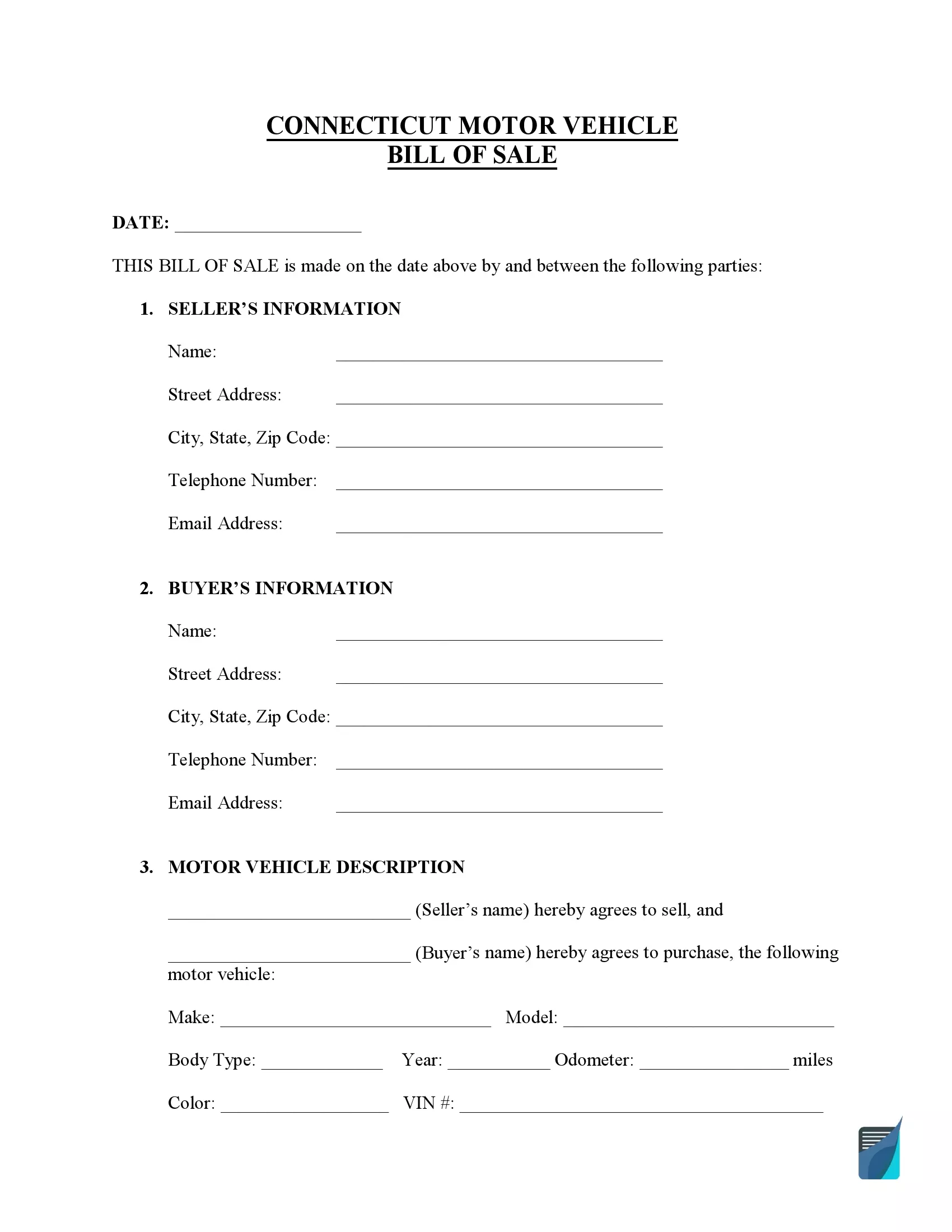
The steps below follow our Connecticut motor vehicle bill of sale template, from the date at the top to the signatures. Fill in each part in the order the form shows it. You can create the form online, print the PDF and write it by hand, or fill in the PDF with our PDF editor.
Step 1: Date and Seller’s Information
On page 1, enter the date at the top. Then add the seller’s details:

Step 2: Buyer’s Information
Still on page 1, enter the same details for the buyer: name, address, city, state, zip code, telephone number and email.

Step 3: Motor Vehicle Description
Write both names in the agreement line. Then fill in these fields:


Step 4: Purchase Date, Purchase Price and Method
On page 2, enter the purchase date and the total price. Check one payment option: all at once, trade-in, deposit with a balance date, or gift. Then select the payment type and the taxes box.

Step 5: Miscellaneous Provisions
On page 3, read this part before you sign. It has no fields to fill in. It covers the ownership statement, the as-is sale and the entire agreement.
Step 6: Signatures
The seller and the buyer each sign, date and print their name. The form also has a witness line.

Step 7: Acknowledgment
If you choose to notarize, sign before the notary in the acknowledgment on page 4. The county, date, officer and the person appearing are filled in, and the officer signs and seals.
For a non-titled vehicle, the Connecticut DMV says you need the registration from the last owner. You also need either a supplemental assignment of ownership (Form Q-1) or the bill of sale (Form H-31).[1.1] Whichever paper you use, fill it out completely and keep a signed copy.
The seller’s registration expires when ownership of the vehicle transfers, so register it before you drive (Section 14-16(a)). A vehicle validly registered in another state may be driven for 90 days after its owner establishes residence in Connecticut before it must be registered here (Section 14-12(a)).[5.1]
Buyers commonly bring a few more papers to the DMV. Requirements change, so check the DMV website before you go. The DMV also has a list of proof of ownership documents. Papers people often gather:
If someone else will handle the DMV visit for you, a Connecticut motor vehicle power of attorney is a separate document.
Connecticut requires a periodic emissions test, but vehicles four or fewer model years old are exempt from it (Section 14-164c), and the DMV asks you to clear any outdated emissions testing before you register.[7.1]
A bill of sale form provided by the Department of Motor Vehicles in the State of Connecticut.

Registration and Title Application with instructions is used to apply for a car title in CT.

Special power of attorney for a vehicle is used to authorize someone to work with DMV paperwork on your behalf.

Required during ownership transfer to confirm the vehicle mileage.

Application for Vessel Registration and Certificate of Number Decal with instructions.

Sales of Transfer of All Firearms is used as a bill of sale during private transfers.

Application to Purchase a Firearm must be kept for 20 years, no filing required.

The Connecticut DMV’s published requirements for a bill of sale do not list notarization.[2] Connecticut has no statute that requires a bill of sale to be notarized. Our template includes an acknowledgment page for people who want one.
Yes. The Connecticut DMV says that for a private sale you can draft your own bill of sale as long as it contains the required information.[1.3] A handwritten bill of sale works the same way when it carries the listed details.
Download the free Connecticut bill of sale template on this page, or fill one out online with our maker. The Connecticut DMV lists Form H-31 as its bill of sale.[1.2]

Other Connecticut Forms
General information, not legal or tax advice.

