
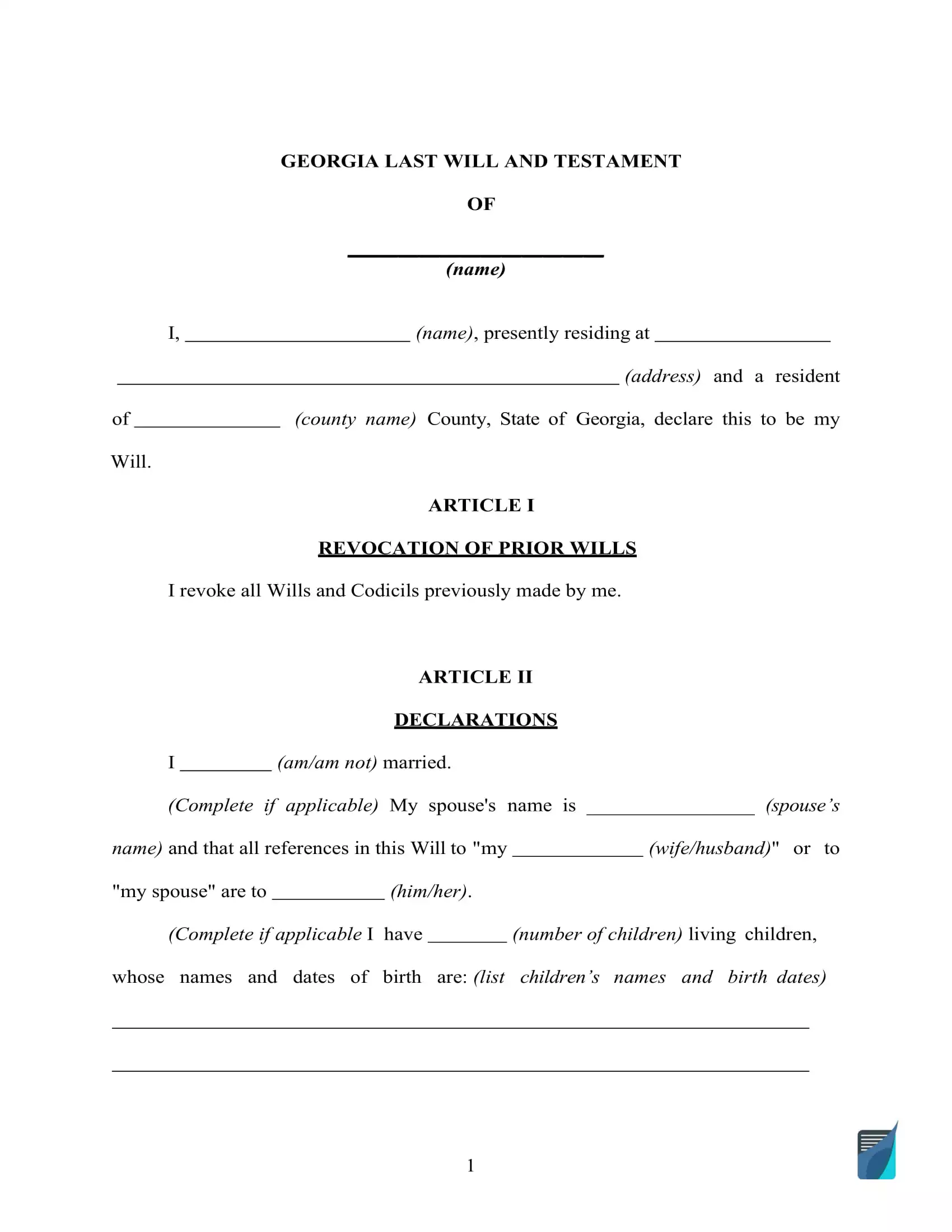
A Georgia last will and testament is a written document that lets a person, called the testator, say how their property should be divided after they die and who should raise any minor children. Georgia law requires the will to be in writing and signed by the testator, or by someone else acting at the testator’s direction and in the testator’s presence.
This page offers a free Georgia last will and testament sample in PDF and Word formats, plus answers to the questions people ask most about writing one. It is general information, not legal advice for your specific situation.
Build Your Document
Answer a few simple questions to make your document in minutes
Save and Print
Save progress and finish on any device, download and print anytime
Sign and Use
Your valid, lawyer-approved document is ready
Last Updated: September 2026. This guide is reviewed and updated regularly to reflect current Georgia law. If you notice an error or outdated information, please contact us.
Georgia last will law is set out in O.C.G.A. Title 53, Chapter 4. To be valid, a will must be in writing and signed by the testator, or by someone else acting at the testator’s direction and in the testator’s presence.[1.1] It must then be attested and signed by two competent witnesses in the testator’s presence.[1.2]
A will may also be made self-proved with a notarized affidavit, which lets the witnesses skip testifying in probate court.[1.4] Georgia law allows a will to be revoked either expressly or by an act the testator intends as revocation.[1.5]
| Requirements | State laws | |
| Statutes | Title 53 – Wills, Trusts, and Administration of Estates; Chapter 4 – Wills | |
| Signing requirement | Two witnesses | O.C.G.A. Section 53-4-20 [1.2] |
| Age of testator | 14 or older | O.C.G.A. Title 53, Chapter 4, Article 2 |
| Self-proving wills | Allowed | O.C.G.A. Section 53-4-24 [1.4] |
| Handwritten wills | Might be accepted if witnessed according to state law | O.C.G.A. Section 53-4-20 |
| Oral wills | Not recognized | |
| Holographic wills | Not recognized | |
| Revocation | Express or implied | O.C.G.A. Section 53-4-42 [1.5] |
1. Think about your possibilities. Determine whether you would like to hire attorneys or write your will yourself (either by handwriting it all or working with a free last will and testament form).
2. Indicate your details. The initial step is establishing the testator by entering their full legal name, as well as the residential information (city, county, and state). Go over the remaining part of the passage, including the details you’ve written and the “Expenses and Taxes” subsection.

3. Appoint the executor. In this passage, you define who is going to execute your will by filling in their full name, together with their city, county, and state of residence. The vast majority of states have special legislation concerning out-of-state representatives and executors, which usually means extra hassle and red tape.
That’s why it’s recommended to choose a person who lives in the same state as you. If your first choice cannot serve because of illness, death, or unwillingness, you can name an additional executor by giving the same information you did for the first one.

4. Choose the guardian (optional). If you have minor or dependent children, you can name a guardian to raise them instead of leaving that choice to the court. Enter the guardian’s full name and their city, county, and state of residence.

5. Establish your beneficiaries. This is where you indicate those who are going to inherit your estate. Fill in their full names, addresses, and your relationship to them (spouse, child, friend).
6. Allocate property. If you want to divide your property in a way other than equal shares, describe that division in this section. Property can include cash, shares, real estate, business ownership, money owed to you, and other items of value. Joint property, living trust assets, and life insurance proceeds generally cannot be put into your will.

7. Proceed with the witnesses signing the document. Under Georgia law, a last will and testament must be signed by at least two competent witnesses who watch the testator sign and then sign it themselves.[1.2]
After a complete revision of each passage in your will, all parties involved (you and the two witnesses) must write their names and full addresses and sign the document.

Choosing witnesses. A witness who is also named as a beneficiary can still sign your will, but Georgia law voids that witness’s gift under the will unless at least two other witnesses who are not beneficiaries also sign.[1.3] To avoid the issue, pick witnesses who do not inherit anything under your will.
These answers cover the questions people ask most about writing, signing, and updating a last will in Georgia. Each answer reflects the requirements set out in Georgia law so you know what your will needs to hold up in probate court.
A will in Georgia is valid without a notary certification. The minimum requirement is having the will signed by two credible witnesses.[1.2]
In Georgia, you must be of sound mind and at least 14 years old to write a valid will. Sound mind means you understand the effect of signing a will and are not affected by a mental disorder that stops you from grasping that decision.
It’s not possible. Only the testator can change their will. Someone else is only able to sign your last will in case you’re physically unable to do it. Georgia law allows another person to sign your last will and testament for you, providing that it is your directive and done in your presence.[1.1]
If a last will has been lost or damaged, a Georgia probate court can still accept it, though this is rare. In practice, a will that cannot be found after death is often treated as revoked, so keep the original safe. Here’s an example of a case involving a lost will – Westmoreland v. Tallent 549 S.E.2d 113 (2001).
| Related documents | When to create one |
| Codicil | Your last will requires one or several minor changes. |
| Self-proving affidavit | You would like to keep from possible complications in the probate court. |
| Living will | You want to ensure that, if you are incapacitated, you are treated how you’d want to. |
| Living trust | You want to think about an alternative to a will. |

If you are settling an estate in a different state or need a will for a relative who lives elsewhere, choose that state below for a free last will and testament template.
This page is general information about Georgia last wills, not legal advice. For advice on your situation, talk to a Georgia attorney.
