A Georgia small estate affidavit is a written petition that asks the probate court for an order that no administration is necessary for an estate. Under O.C.G.A. § 53-2-40, an heir of a person who died without a will can file it when no personal representative has been appointed in Georgia.[1] Download the free form as a PDF or fill it out online.
Last Updated: October 2026. This guide is reviewed and updated regularly to reflect current Georgia law. If you notice an error or outdated information, please contact us.
Create a free high quality Georgia Small Estate Affidavit online now!
Build Your Document
Answer a few simple questions to make your document in minutes
Save and Print
Save progress and finish on any device, download and print anytime
Sign and Use
Your valid, lawyer-approved document is ready
... or download your Georgia Small Estate Affidavit Form as a PDF file
Georgia handles a small estate through a petition to the probate court. Section 53-2-40 of the O.C.G.A. lets any heir, a person who inherits from the one who died, ask for an order that no administration is necessary. The person must have died intestate, which means without a will, and no personal representative may have been appointed in Georgia.[1]
Georgia’s court form for this process is titled Petition for Order Declaring No Administration Necessary. Use that title if a court clerk asks for the form by name.
The same section adds two more rules about the order and the cost:
Within 30 days of granting the petition, the court must file a certified copy of the order in each Georgia county where the decedent owned real property. Each county records it in its deed records and indexes it under the decedent’s name in the grantor index.[1]
The filing fee and any fee for recording the order are taxed as costs to the estate.[1]
Property with a security deed needs the holder’s consent. Property under an outstanding security deed or agreement can join this proceeding only if the holder consents, or is served and makes no objection.[1]
If there is no will and no surviving spouse, the children are the heirs and share the estate equally. The descendants of a child who has died take that child's share.[2]
A separate bank rule sits in O.C.G.A. Title 7, Chapter 1, Article 1, Part 12, Deposits of Deceased Depositors. When a person dies without a will, a bank may pay a deposit of up to $15,000 directly to the surviving spouse, or if there is none to the children, then the parents, then the brothers and sisters, on their affidavit (Section 7-1-239(b)). Section 7-1-239.1 lets a bank do the same for a check of up to $15,000. The bank is allowed to pay, not required to. This is not a limit on the petition, which sets no dollar limit.[3]
Other Georgia Forms
We offer a variety of important Georgia documents to anybody in quest of simplicity when filling out all sorts of agreements, contracts, and other paperwork.
Create a free high quality Georgia Small Estate Affidavit online now!
How to Fill Out the Georgia Small Estate Affidavit Form
The steps below follow the Georgia form on this page, from the court caption on page 3 to the notary block on page 7. Fill in each part in the order the form shows it. You can create the form online, print the PDF and write it by hand, or fill in the PDF with the FormsPal PDF editor.
The screenshots under each step show the FormsPal Georgia small estate affidavit template filled with sample entries in blue, so you can see where each answer goes. The names, addresses, dates and amounts are examples only.
Gather this information before you start. Each item has a place on the form.
The decedent’s full name, place of domicile and date of death
The name, age, address and relationship to the decedent of every heir
The legal description and street address of any real property, and account or serial numbers for personal property
The name and address, with zip code, of every creditor
Court county in the caption: Enter the Georgia county in the line “IN THE PROBATE COURT OF ____ COUNTY” at the top of the petition.Step 1: sample entries, not a real document.
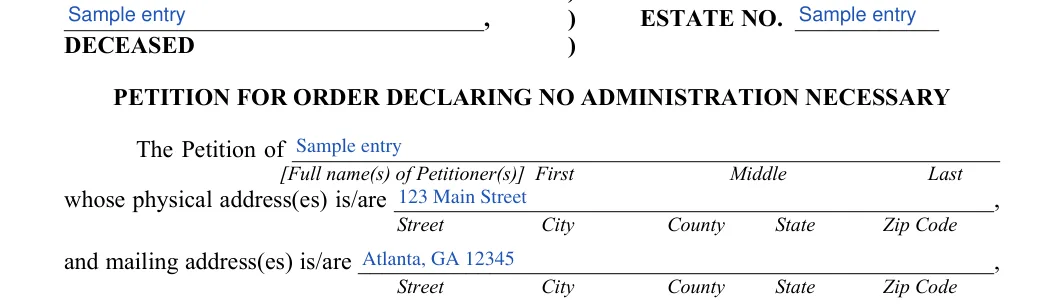
Estate caption (IN RE: ESTATE OF): Type the decedent’s name on the line above “DECEASED”, and the Estate No. beside it if you have one.Step 2: sample entries, not a real document.
Petitioner’s name and addresses: In “The Petition of”, enter the petitioner’s full name (first, middle, last), then the physical address and the mailing address (street, city, county, state, zip).Step 3: sample entries, not a real document.
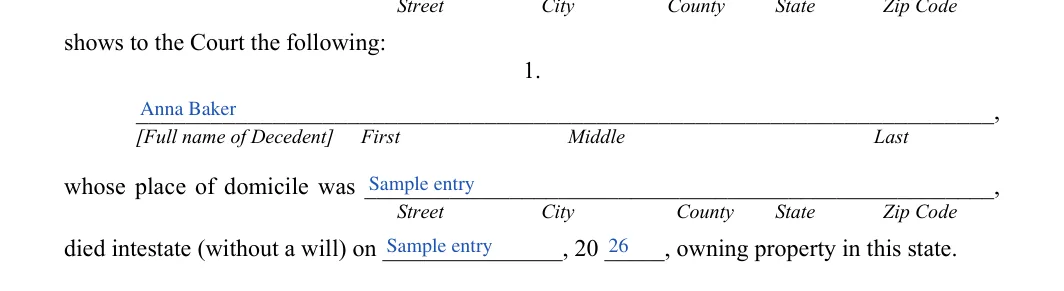
Paragraph 1: the decedent: Enter the decedent’s full name, the place of domicile (street, city, county, state, zip), and the date of death (day and year) on the “died intestate (without a will) on” line.Step 4: sample entries, not a real document.
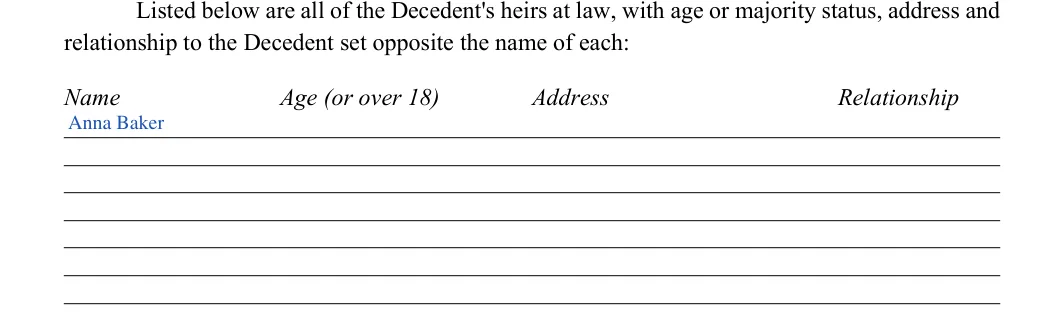
Paragraph 3: the heirs at law: List every heir at law on its own line with name, age (or “over 18”), address and relationship to the decedent, as the table headings on page 3 ask.Step 5: sample entries, not a real document.
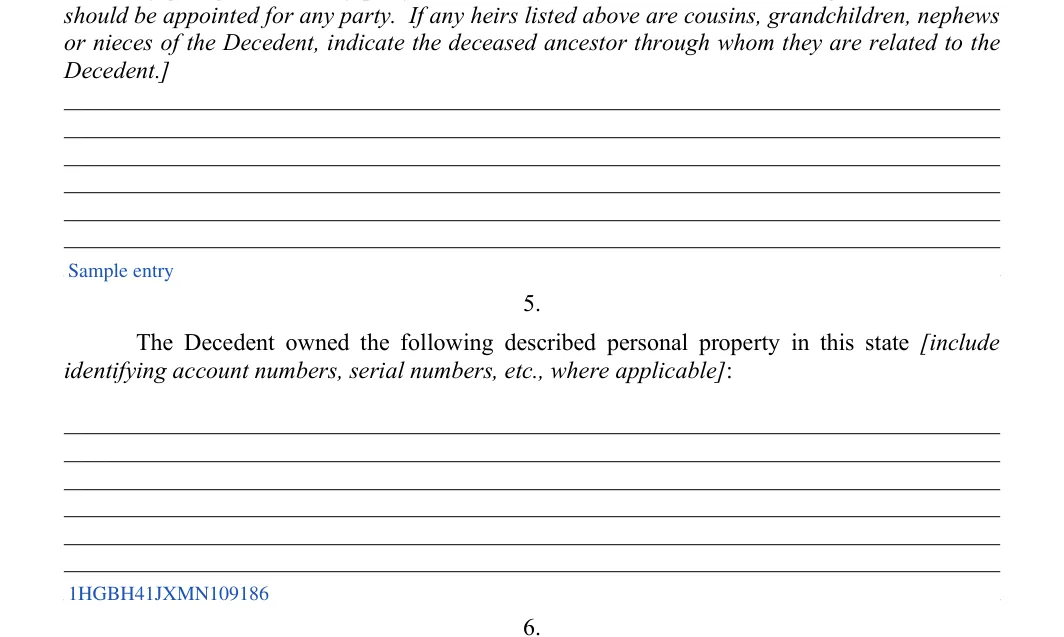
Paragraphs 4 and 5: heirs statement and personal property: Write the factual statement Paragraph 4 asks for (why the listed heirs are all the heirs, dates of death and personal representatives of any deceased heirs), then describe the personal property with account or serial numbers where they apply.Step 6: sample entries, not a real document.
Paragraph 6: real property: Enter the complete legal description and the street address, if any, of the real property the decedent owned in Georgia.Step 7: sample entries, not a real document.
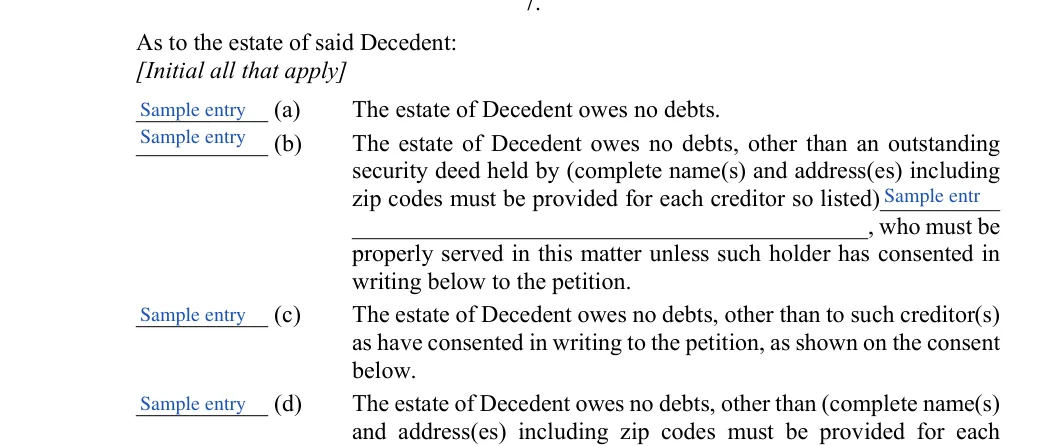
Paragraph 7: the estate’s debts: Initial each statement (a) to (d) that applies: no debts, a security deed holder, creditors who consented in writing, or creditors who have not consented. Where a statement asks for a creditor, give the name and address with zip code.Step 8: sample entries, not a real document.
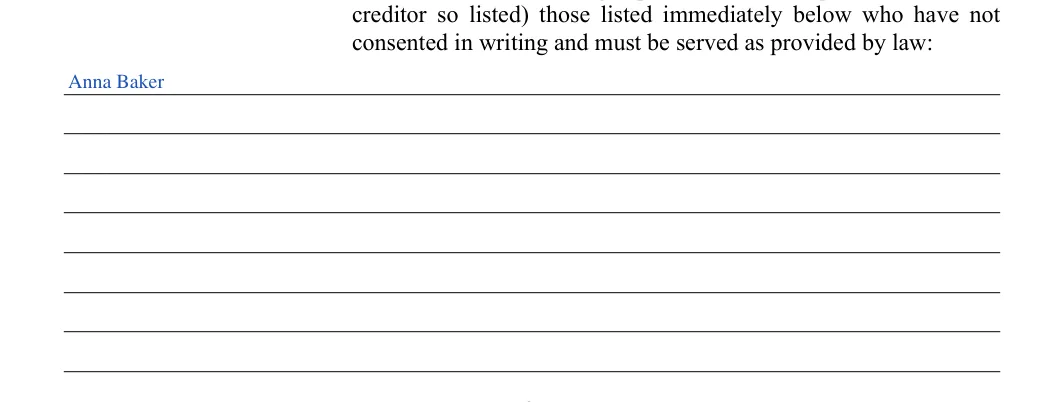
Creditors who have not consented: Under the last statement, list each creditor who has not consented in writing, with complete name and address including zip code, one per line.Step 9: sample entries, not a real document.
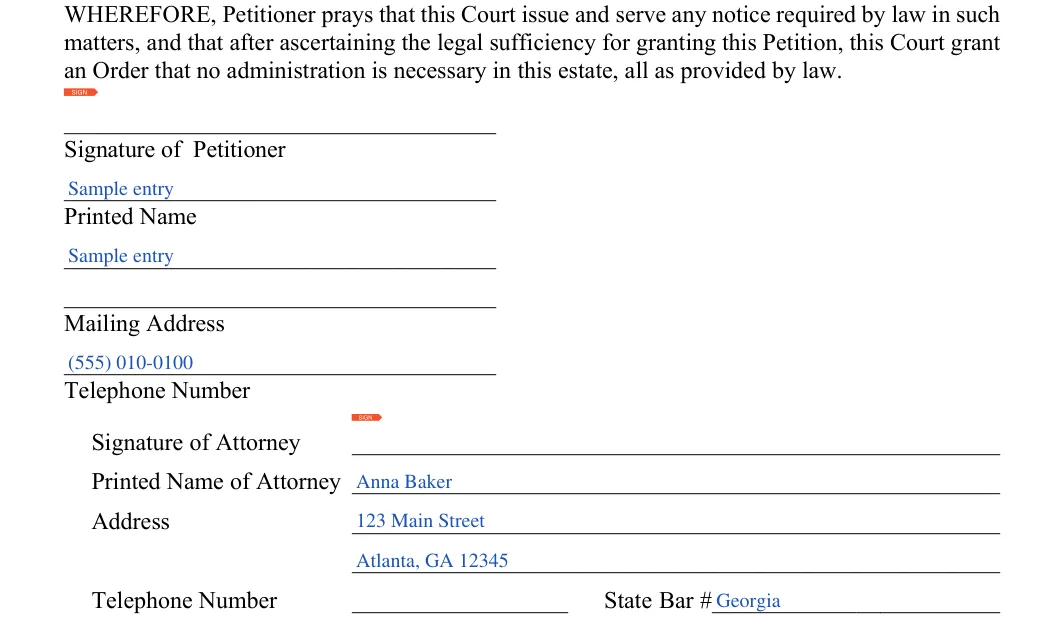
Petitioner and attorney signature lines: Sign as petitioner, print your name, and add your mailing address and telephone number. Fill the attorney lines (signature, printed name, address, telephone, State Bar #) only if an attorney signs the petition.Step 10: sample entries, not a real document.
Verification: county: On the page 7 verification, enter the county in “GEORGIA, ____ COUNTY”.Step 11: sample entries, not a real document.
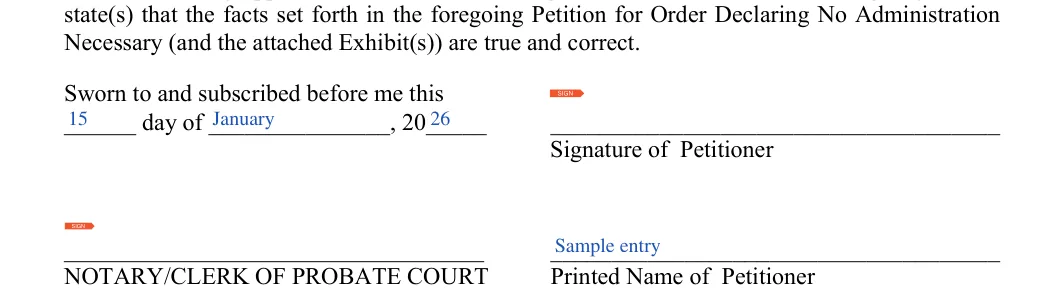
Verification: signature and sworn date: Sign and print your name as petitioner in the verification, and have the notary or Clerk of Probate Court sign the “Sworn to and subscribed before me” block. The day, month and year are filled at that signing.Step 12: sample entries, not a real document.
Notary/Clerk of Probate Court: commission expiry: The notary or clerk completes the “My Commission Expires” line under their signature on page 7.Step 13: sample entries, not a real document.
After you complete the petition, attach the heirs’ agreement and file everything with the probate court. Georgia law ties the order to a few conditions, so check each one before you go to the clerk.[1]
The heirs have agreed upon a division of the estate, and the agreement carries the original signature of every heir.[1]
A clerk of the probate court or a notary public attests to that agreement.[1]
The petition goes to the probate court of the county where the person who died was domiciled. If that person was not domiciled in Georgia, it goes to the county where the real property is located.[1]
The filing fee is taxed as costs to the estate.[1]
Once the court grants the petition, it must file a certified copy of the order in each Georgia county where the person owned real property. It has 30 days to do so. Each county records the order in its deed records and indexes it under that person’s name in the grantor index.[1] Keep a copy of the signed heirs’ agreement and the order for your own records.
Frequently Asked Questions
These answers cover what the Georgia petition must contain, which court receives it, and what the heirs must agree to and sign. Each answer comes from Section 53-2-40 of the O.C.G.A.[1]
What must a small estate petition contain in Georgia?
The petition must carry five items of information.[1]
The name and domicile of the person who died
The names, ages or majority status, and domiciles of the heirs
A description of the property in Georgia that the person owned
The state of the estate’s debts: none, or known debts whose creditors have consented or will be served
A statement that the heirs have agreed upon a division of the estate among themselves
Which court handles a small estate petition in Georgia?
File the petition in the probate court of the county of the decedent’s domicile, which is the county of the decedent’s legal home, if the decedent was domiciled in Georgia. If the decedent was not domiciled in Georgia, file it in the county where the decedent’s real property is located.[1]
Must the heirs agree on dividing the estate in Georgia?
Yes. The petition must state that the heirs have agreed upon a division of the estate among themselves.[1] Talk through who receives what before you start the form.
Must all the heirs sign the small estate petition in Georgia?
Yes. The agreement attached to the petition must carry the original signatures of all the heirs. A clerk of the probate court or a notary public must attest to it.[1]
What must the petition say about the estate’s debts in Georgia?
The petition must show that the estate owes no debts. It may instead show that there are known debts and all creditors have consented or will be served as provided in Chapter 11 of Title 53.[1] On the form, Paragraph 7 gives you four choices to initial, so pick the one that matches the estate.
Who pays the filing fee for a small estate petition in Georgia?
The filing fee and any fee for recording the order are taxed as costs to the estate. The probate court of your county can tell you the current amount.[1]
Mara has been practicing estate planning and trust law in California since 2003, taking pride in helping clients of all backgrounds and asset profiles form a complete and customized estate plan. Her specialties are: estate planning, wills and trusts, trust and probate administration.





![Georgia small estate affidavit: legal description and street address, if any], filled with sample entries](https://formspal.com/data/DHTMLImages/Image/621781.webp)