
A Georgia non-compete agreement is a contract in which an employee agrees not to compete with an employer after the job ends. Georgia law permits enforcement of a contract that restricts competition when the restrictions are reasonable in time, geographic area, and scope of prohibited activities.[1] This brief overview of the non-compete agreement in Georgia explains those limits, and the FormsPal builder below creates the document for free.
Last Updated: October 2026. This guide is reviewed and updated regularly to reflect current Georgia law. If you notice an error or outdated information, please contact us.
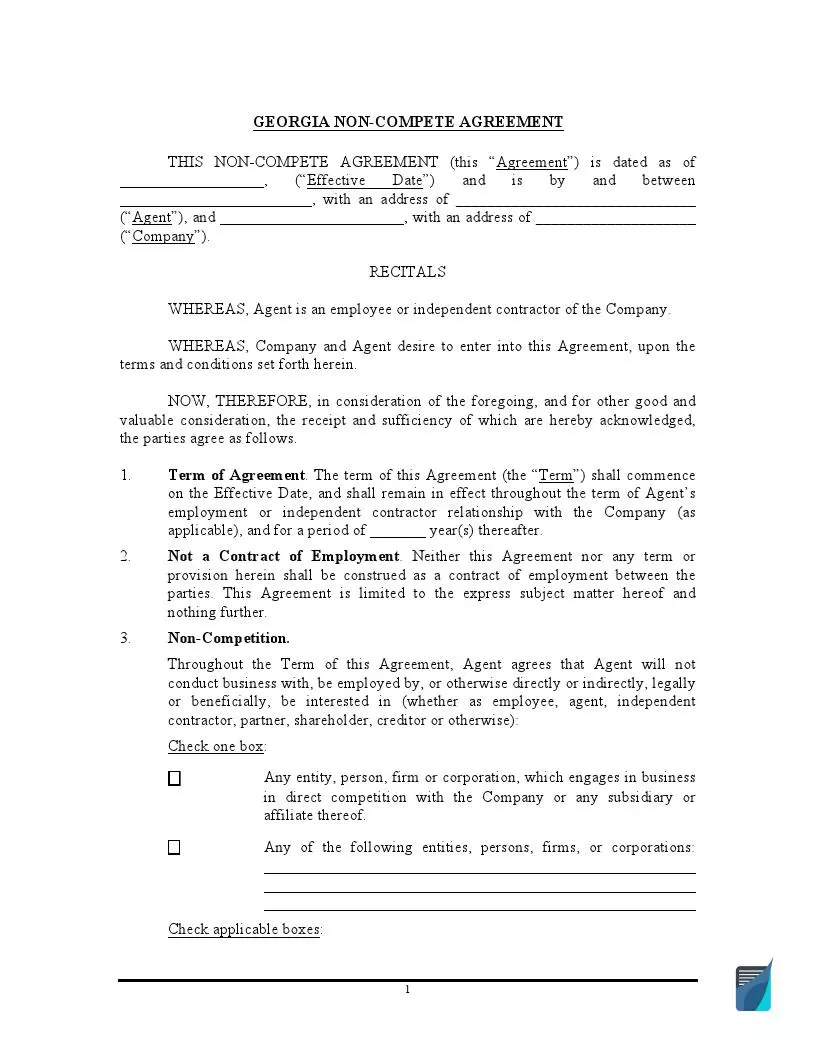
Build Your Document
Answer a few simple questions to make your document in minutes
Save and Print
Save progress and finish on any device, download and print anytime
Sign and Use
Your valid, lawyer-approved document is ready
Georgia's restrictive covenant law, O.C.G.A. § 13-8-53, decides how far a non-compete agreement can go. The statute sets the outer limits on time, place, and the work a covenant may cover. It also says what happens when a covenant goes past them.[1]
A Georgia non-compete describes what the employee may not do and where. Where the law requires such a description, any description that gives fair notice of the maximum reasonable scope of the restraint satisfies it. It can be generalized, or could have been stated more narrowly.[1]
The law also names wording that works:
These phrases are examples of wording the law accepts, not the only wording. Any other description passes if it gives fair notice of the maximum reasonable scope of the restraint.[1]
A clear agreement is easier to sign and easier to apply later. Most written non-compete agreements cover the same few topics. Gather these details before you fill in the form, so the document says exactly what the business and the employee intend.
Keep each item short. Use the same words for the same thing throughout the agreement. Three slips are easy to avoid:
Popular Local NCA Forms
Non-compete forms are accepted and enforced to some degree by the majority of states in the US, which makes them fairly popular amongst various firms. Read more about the most common states searched by our visitors concerning non-compete agreements.
A restrictive covenant that does not comply with the Georgia law is unlawful, void, and unenforceable. A court may still modify a covenant that would otherwise be void. The change cannot make the covenant more restrictive for the employee than the parties originally drafted it.[1]
Any restrictive covenant not in compliance with the provisions of this article is unlawful and is void and unenforceable.
A court that modifies a covenant can leave it as restrictive as the parties drafted it or less so, never more.[1] Draft only the limits you need.
Georgia's non-compete law does not limit how long a party may agree to maintain information as confidential or as a trade secret. It also does not limit the geographic area within which that information must be kept confidential. The protection can last for as long as the information remains confidential or a trade secret.[1]
Many business agreements pair a non-compete clause with a separate confidentiality clause, so each promise can be read on its own. Employees and employers both benefit from wording that is easy to find.
A business most often asks employees for a non-compete when their work gives them access to clients, pricing, or business plans. Under O.C.G.A. § 13-8-53(a), a non-compete that applies after the job ends can be enforced only against an employee who customarily and regularly solicits customers, customarily and regularly makes sales or obtains orders or contracts, has management duties (managing the business or a department, directing two or more employees, and hiring or firing authority or weight in those decisions), or is a key employee or professional. That limit does not cover a customer non-solicitation or nondisclosure clause.[1] Employees should read the agreement closely and ask about anything unclear before signing.
Before you sign, check these points:
Need a form for another state? Start from the main non-compete agreement template.
Yes, within limits. Georgia permits enforcement of contracts that restrict competition, as long as the restrictions are reasonable in time, geographic area, and scope of prohibited activities. A covenant has to stay within those limits to be covered.[1]
Yes. The law still permits a court to enforce a covenant that restricts competition when it stays within the limits above. A covenant outside the law is void and unenforceable, though a court may modify it.[1]
They can. A non-compete works when its limits are reasonable and its wording is clear. One that does not comply with the law is unlawful.[1]
A fair one can. If a covenant does not comply, a court may modify it, but not so that it becomes more restrictive for the employee than the parties wrote it.[1]
Georgia law ties a non-compete to reasonable limits and clear descriptions:
General information, not legal or tax advice.

