
A Virginia non-compete agreement is a written contract in which a worker promises not to compete with a company for a set time. State law limits these agreements. No employer may enter into, enforce, or threaten to enforce a covenant not to compete with a low-wage employee or health care professional.[1] Our free non compete agreement Virginia template lets you set the term, the businesses it covers, and the area, then download it as a PDF.
Last Updated: October 2026. This guide is reviewed and updated regularly to reflect current Virginia law. If you notice an error or outdated information, please contact us.
Build Your Document
Answer a few simple questions to make your document in minutes
Save and Print
Save progress and finish on any device, download and print anytime
Sign and Use
Your valid, lawyer-approved document is ready
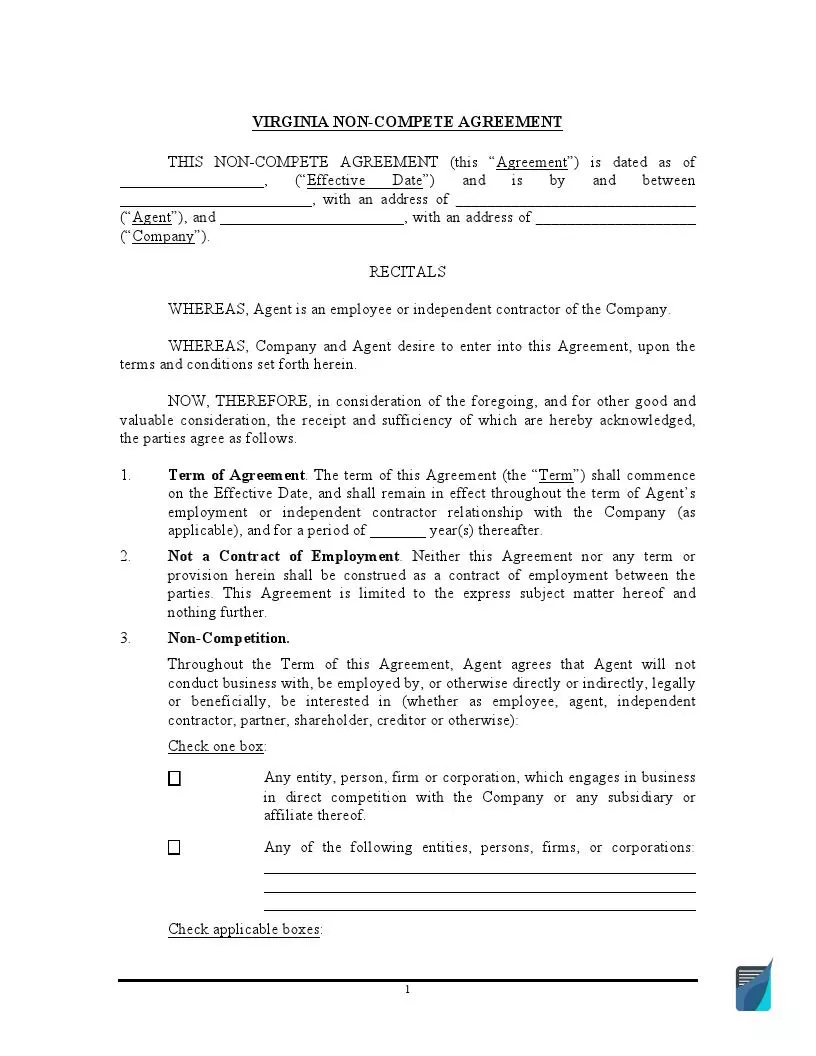
Our Virginia template is a short agreement between a company and an agent, who is an employee or independent contractor. Employers and employees alike can use it as a starting point. It starts with an effective date and the name and address of each party. Numbered sections then cover these points:
For a version that is not specific to Virginia, see our non-compete agreement template. You can also pick the non-compete template for employees or the non-compete template for independent contractors. After you download the PDF, you can fill it in with our PDF editor.
Signing the form does not guarantee that a court will enforce it. Have an employment attorney licensed in your state review the agreement before you rely on it.
The state limits non-compete agreements by statute, and the rules cover employers and employees alike. Under Section 40.1-28.7:8 of the Va. Code Ann., no employer may enter into, enforce, or threaten to enforce a covenant not to compete with any low-wage employee or health care professional.[1] A court can void an unlawful covenant not to compete with an employee or health care professional and order all appropriate relief.[1]
The statute also protects a worker's existing customer relationships. A covenant not to compete may not restrict an employee from providing a service to a customer or client of the employer. That holds if the employee does not initiate contact with or solicit that customer or client.[1]
Under subsection H of Section 40.1-28.7:8, nothing in the statute limits nondisclosure agreements that bar an employee from taking, misappropriating or sharing information the employee has access to, including trade secrets and proprietary or confidential information.[1]
The ban protects a low-wage employee, and the statute defines that term in two ways. Employers should check the test before they ask employees to sign. A worker qualifies by meeting either test in the table below. The first test looks at pay, and the second looks at overtime.[1]
| Test | What the statute says |
|---|---|
| Earnings | The employee's average weekly earnings are less than the average weekly wage of the Commonwealth, as determined under subsection B of § 65.2-500. The average is the employee's earnings during the 52 weeks before the date of termination of employment, divided by 52. If the employee worked fewer than 52 weeks, divide by the number of weeks the employee was actually paid. |
| Overtime | Regardless of average weekly earnings, the employee is entitled to overtime compensation under 29 U.S.C. § 207 for any hours worked in excess of 40 hours in any one workweek. |
One group is left out. A low-wage employee does not include an employee whose earnings come, in whole or in predominant part, from sales commissions, incentives, or bonuses paid by the employer.[1]
A worker bound by an unlawful covenant can ask a court for help. A court can void an unlawful covenant not to compete and order all appropriate relief. That relief includes:
If the court finds a violation, the plaintiff is entitled to recover reasonable costs and attorney fees. Costs include reasonable fees for expert witnesses. The money comes from the former employer or other person who attempts to enforce an unlawful covenant.[1]
You must bring an action within two years of the latest of four dates. The first is when the covenant was signed. The others are when the employee or health care professional learned of it, when the employment relationship ended, and when the employer took any step to enforce it.[1]
Employers cannot discharge, threaten, discriminate against, or retaliate against low-wage employees or health care professionals for bringing a civil action under the statute.[1]
Employers that violate the ban on these covenants, as determined by the Commissioner, are subject to a civil penalty of $10,000 for each violation. Every employer must also post a copy of the statute, or a summary approved by the Department. The notice goes in the same location where other employee notices required by state or federal law are posted.[1]
Employers that fail to post the notice face these consequences:
Not with low-wage employees or health care professionals. Under Section 40.1-28.7:8 of the Va. Code Ann., no employer may enter into, enforce, or threaten to enforce a covenant not to compete with any low-wage employee or health care professional.[1]
The state bans them for low-wage employees and health care professionals. No employer may enter into, enforce, or threaten to enforce a covenant not to compete with any low-wage employee or health care professional.[1]
Not when the law voids the restraint. A court has jurisdiction to void an unlawful covenant not to compete with an employee or health care professional. It can also order all appropriate relief, including liquidated damages and reasonable attorney fees and costs.[1]
A covenant not to compete has only the force the law gives it. Where the law voids the restraint, the agreement is unenforceable. Where the law permits it, the restraint is enforceable only on the conditions the law attaches.[1]
The line is set by earnings. A low-wage employee is one who meets either of these tests:
General information, not legal or tax advice.
Popular Local NCA Forms
After the relationship between an employee and employer concludes, the latter might want the former to agree to a non-compete contract, known as “covenant not to compete,” to keep their business practices from being being exposed to their competition. The following are the state-specific NCA templates our visitors research the most.

Other NCA Forms by State
