
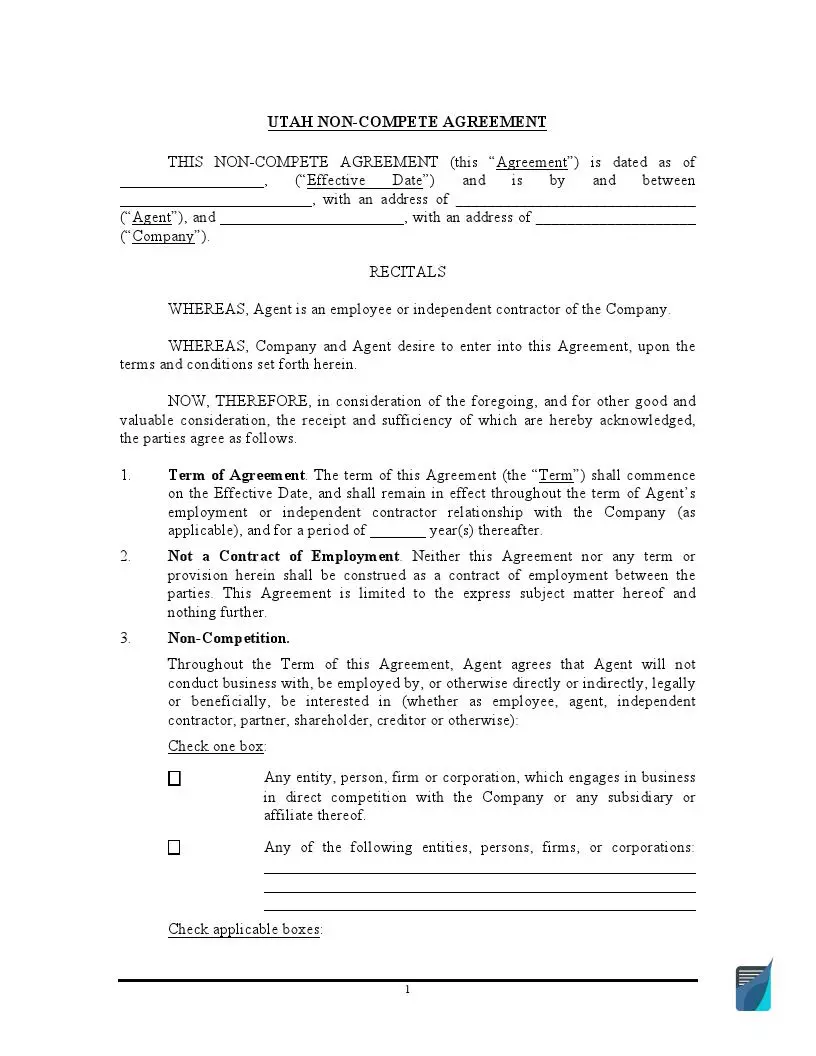
A Utah non-compete agreement is a written contract in which an employee agrees not to compete with an employer for a limited time after the job ends. Are non-compete agreements legal in Utah? Yes, within limits. A non-compete agreement that violates Utah's statute is void, and one entered into on or after May 10, 2016 cannot run more than one year after employment ends.[1.2]
Last Updated: October 2026. This guide is reviewed and updated regularly to reflect current Utah law. If you notice an error or outdated information, please contact us.
Build Your Document
Answer a few simple questions to make your document in minutes
Save and Print
Save progress and finish on any device, download and print anytime
Sign and Use
Your valid, lawyer-approved document is ready
The purpose of this type of non-compete agreement is to limit unfair competition between employers and former employees, or between two businesses. Employees should read it carefully and ask about anything unclear before signing.
A clear non-compete agreement spells out each term in writing, so employers and employees know what to expect. The points below describe what these agreements commonly include. Fit each one to the job and the business, and keep the time period within the limits explained further down this page.
Popular Local NCA Forms
Non-compete contracts are recognized and enforced to some degree by the majority of US states, which makes them fairly popular among many organizations. Read more about the most common states searched by our users concerning non-compete agreements.
The main limit is in Utah Code § 34-51-201. For a non-compete agreement entered into on or after May 10, 2016, an employer and an employee may not enter into a non-compete agreement for a period of more than one year. The year runs from the day on which the employee is no longer employed by the employer.[1.2] An agreement that violates the limit is void.
A non-compete agreement that violates this Subsection (1) is void.
A void agreement is unenforceable. Where the law permits a restraint, it is enforceable only on the conditions the law attaches.[1.2]
Write the restriction period into the agreement in plain words, such as a set number of months after the last day of work. Both employers and employees then know when the restriction ends. For advice on a specific agreement, a Utah non-compete lawyer can review it.
Under Utah Code § 34-51-202, the chapter does not prohibit a reasonable severance agreement or an agreement tied to the sale of a business. The conditions for each are listed below.[1.3]
Utah sets separate conditions for a non-compete agreement between a broadcasting company and a broadcasting employee. Such an agreement is valid only if it meets the conditions below. They cover the employee's pay level, the written employment contract, and how the job ended.[1.2]
An exempt broadcasting employee is compensated on a salary basis, as defined in 29 C.F.R. sec. 541.602. The rate must be equal to or greater than the greater of: $913 per week, or an equivalent amount if calculated for a period longer than one week.[1.1]
A valid broadcasting non-compete agreement is enforceable for no longer than the earlier of two dates. The first is one year after the day the broadcasting employee is no longer employed by the broadcasting company. The second is the day the original term of the employment contract containing the non-compete agreement ends.[1.2]
The table below lists the agreements Utah bars for healthcare workers and veterinarians on or after May 6, 2026. Each row names the worker and the agreement a person and that worker may not enter into.
| Worker | Agreements a person and the worker may not enter into |
|---|---|
| Healthcare worker | A healthcare non-compete agreement.[1.2] |
| Healthcare worker | A nonsolicitation agreement that prevents the healthcare worker from informing a patient of the worker's current place of employment or future place of employment.[1.4] |
| Veterinarian | A veterinarian non-compete agreement. This does not apply if the veterinarian has at least a 5% ownership interest in the person's business.[1.2] |
| Veterinarian | A nonsolicitation agreement.[1.6] |
| Veterinarian | A nondisclosure clause in which the veterinarian agrees not to disclose or discuss the veterinarian's experience working for or with the person.[1.5] |
A veterinarian non-compete agreement entered into on or after May 6, 2026 may require the parties to resolve a dispute in a forum outside of this state. That provision is void and unenforceable. It is also considered against the public policy of this state.[1.2]
An employer that tries to enforce an unenforceable restriction can owe the employee money. The rule covers a non-compete agreement, healthcare non-compete agreement, nondisclosure clause, or nonsolicitation agreement. It applies when the employer seeks enforcement through arbitration or by filing a civil action and the agreement is determined to be unenforceable.[1.7]
In that case, the employer is liable for the employee's:
Employers and employees can avoid most disputes by settling the terms before work starts. The checklist below is general practice, not a legal rule. Check each point against the Utah limits described on this page, and ask a Utah lawyer about any legal question you cannot resolve yourself.
A non-compete agreement that violates Utah's statute is void. The statute caps the period at one year from the day employment ends for agreements made on or after May 10, 2016. The answers below cover the legal status of these agreements in Utah and what happens when employers enforce an unenforceable agreement.[1.2][1.7]
Yes, within limits. These legal rules from the Utah statute apply:
Yes, but only on the conditions the statute attaches. An agreement that violates the statute is void, so it cannot be enforced. New limits for healthcare workers and veterinarians apply on or after May 6, 2026.[1.2]
They hold up only when they follow the statute. A non-compete agreement that violates Utah Code § 34-51-201 is void.[1.2] An employer that seeks to enforce an agreement determined to be unenforceable is liable for the employee's arbitration costs, attorney fees and court costs, and actual damages.[1.7]
This page covers Utah. In Utah, a non-compete agreement that violates the statute is void.[1.2] The statute also makes an employer liable for the employee's costs when an agreement the employer tries to enforce is determined to be unenforceable.[1.7]
The one-year limit applies to any agreement entered into on or after May 10, 2016, which includes agreements signed in 2024. An agreement that violates the statute is void.[1.2]

General information, not legal or tax advice.
