
A Utah small estate affidavit is a written statement made by, or on behalf of, the person who claims to be the successor of a decedent, the person who died. Shown to someone who owes the decedent money or holds the decedent's property, it is how the successor asks for it. Utah's small estate procedure is subject to a limit of $100,000.[1.1] You can fill out the form below online with FormsPal or download the PDF.
Last Updated: October 2026. This guide is reviewed and updated regularly to reflect current Utah law. If you notice an error or outdated information, please contact us.
Build Your Document
Answer a few simple questions to make your document in minutes
Save and Print
Save progress and finish on any device, download and print anytime
Sign and Use
Your valid, lawyer-approved document is ready
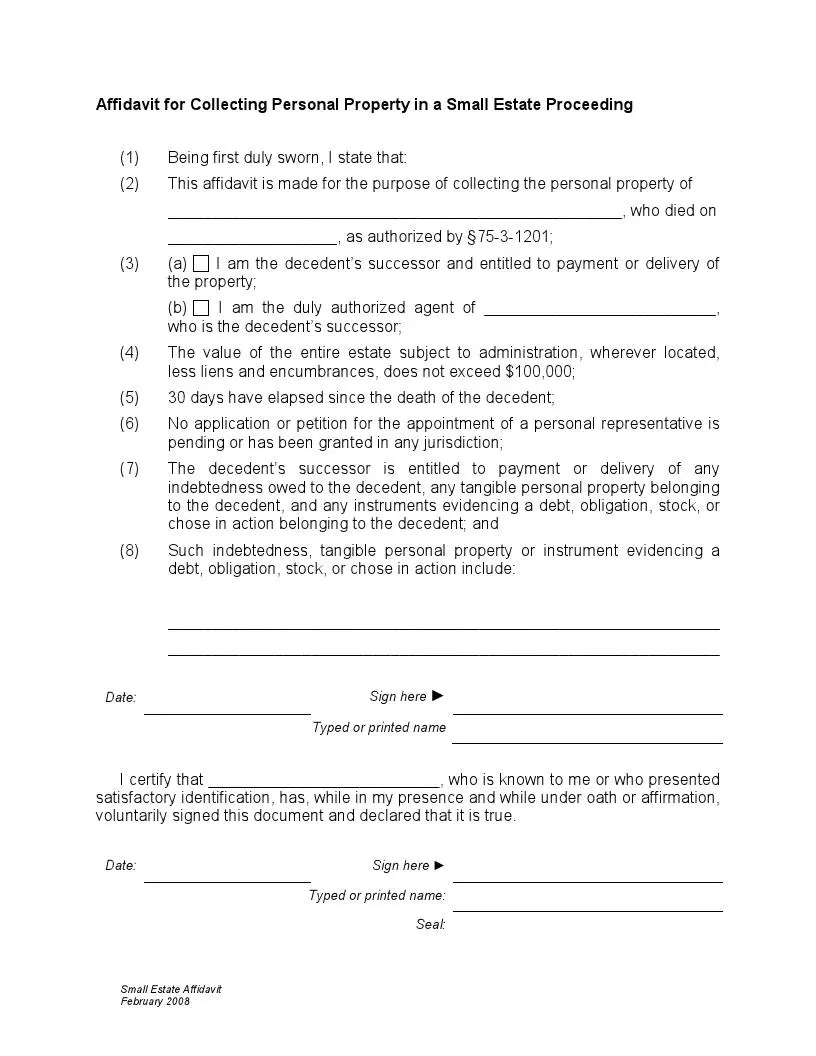
The heading printed on the form reads "Affidavit for Collecting Personal Property in a Small Estate Proceeding." It is the same document as the Utah small estate affidavit.
Utah's small estate procedure is subject to a limit of $100,000. The rules are in Sections 75-3-1201 to 75-3-1204 of the Utah Code. The limit is the value of the entire estate subject to administration, wherever located, less liens and encumbrances.[1.1]
Two more conditions apply before the affidavit does its job:
Once the affidavit is presented, the person who owes the decedent money or holds the decedent's tangible personal property must pay or deliver it to the one claiming to be the successor. The affidavit covers tangible personal property and debts owed to the decedent. Real property has its own rule under the small estate procedure.[1.1]
The Motor Vehicle Division of the State Tax Commission transfers title of not more than four boats, motor vehicles, trailers, or semitrailers from the decedent to the successor. These must be registered under Title 41, Motor Vehicles, or Title 73, Chapter 18, State Boating Act. The division acts when it is shown the affidavit and the necessary fees are paid.[1.1]
One kind of property is left out. Section 75-3-1201 says:
Shares of stock in a water company that are transferred under Section 73-1-10 or Title 70A, Chapter 8, Uniform Commercial Code - Investment Securities, are not eligible for transfer under this part.
In other words, those water company shares cannot be transferred with a small estate affidavit.
Count the 30 days first. The holder's duty to pay or deliver starts thirty days after the death, so count from the date of death.[1.1] You can count the days with our deadline calculator.
Section 75-1-201(59) of the Utah Code defines a successor as a person, other than a creditor, who is entitled to the decedent's property under the decedent's will or under Title 75 of the Utah Code.[2.1]
A transfer agent of any security must change the registered ownership on the corporation's books from the decedent to the successor when shown the affidavit and the security.[1.4]
Looking for another state? See our small estate affidavit page for the other states.
| Max. Estate | $100,000[1.1] |
| Min. Time to Wait After Death | 30 days[1.1] |
| State Laws | Utah Code, Sections 75-3-1201 to 75-3-1204 |

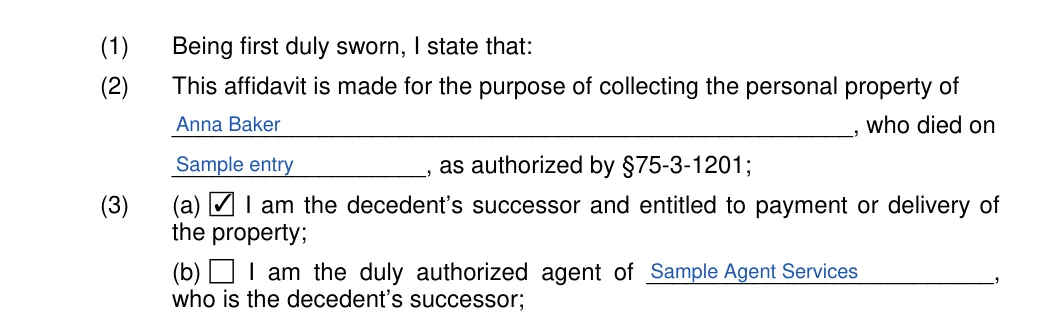
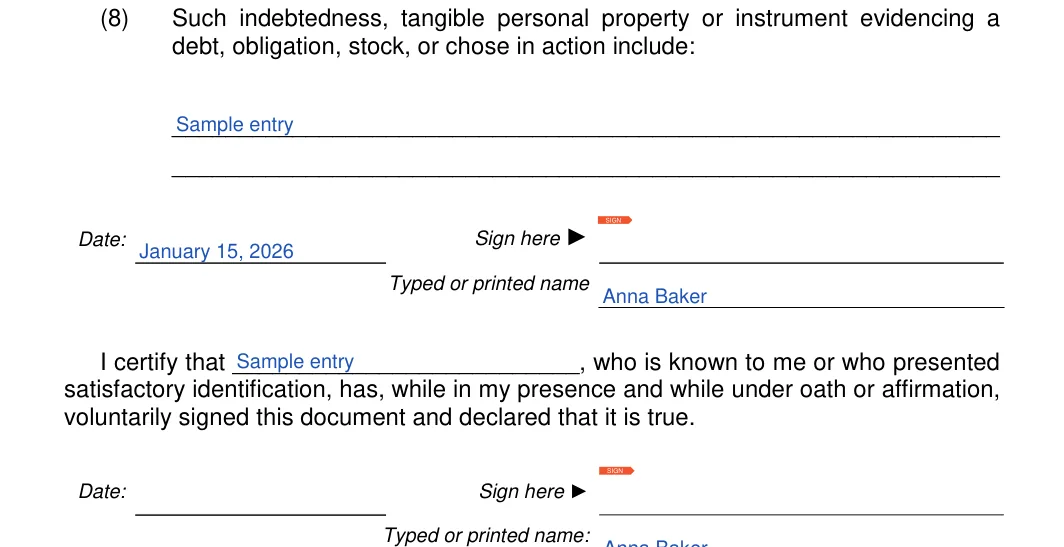
The Utah small estate affidavit PDF has one page to complete. It opens with sworn statements, asks for the decedent's name and date of death, and asks whether you are the successor or the successor's agent. It ends with a signature block and a final block for the person who sees you sign. The three steps below follow the form's order, and each shows sample entries.
The screenshots under each step show the FormsPal Utah small estate affidavit template filled with sample entries in blue, so you can see where each answer goes. The names, addresses, dates and amounts are examples only.
You can also fill in the downloaded PDF with our online PDF editor, then save a copy of the completed file for your own records.

The answers below cover the $100,000 limit, the 30-day wait, what a holder risks by refusing to hand over property, and when a personal representative's appointment ends. Each one follows Sections 75-3-1201 to 75-3-1204 of the Utah Code.
Utah's small estate procedure is subject to a limit of $100,000. That is the value of the entire estate subject to administration, wherever located, less liens and encumbrances.[1.1]
Thirty days after the death of the decedent.[1.1] From then on, the holder of the property must pay or deliver it once the successor presents the affidavit. Two points matter here:
The limit is $100,000, counted after liens and encumbrances.[1.1]
Section 75-3-1201 of the Utah Code sets the limit for the small estate procedure at $100,000.[1.1]
A holder who refuses to deliver property to a person entitled to it under the affidavit must still turn the property over. The court may also hold the holder liable for damages of up to three times the value of the personal property, plus costs of suit and reasonable attorney fees.[1.2]
If no proceedings involving the personal representative are pending in the court one year after the closing statement is filed, the appointment of the personal representative ends.[1.3]
General information, not legal or tax advice.
