
A Virginia power of attorney is a legal document that gives a person you trust, called your agent, certain powers to act for you. The limit of such powers is defined in the document and can be changed or revoked when needed. You might use one to have someone handle your tax or property matters.
Last Updated: October 2026. This guide is reviewed and updated regularly to reflect current Virginia law. If you notice an error or outdated information, please contact us.
Build Your Document
Answer a few simple questions to make your document in minutes
Save and Print
Save progress and finish on any device, download and print anytime
Sign and Use
Your valid, lawyer-approved document is ready
There are various POA forms to use depending on the limit of the authority provided and required conditions. The forms below are carefully crafted and revised by a professional attorney to meet various situations. In Virginia, the signature on a general, limited or real estate power of attorney is presumed to be genuine if you acknowledge it before a notary public.[1]
Governing Laws:
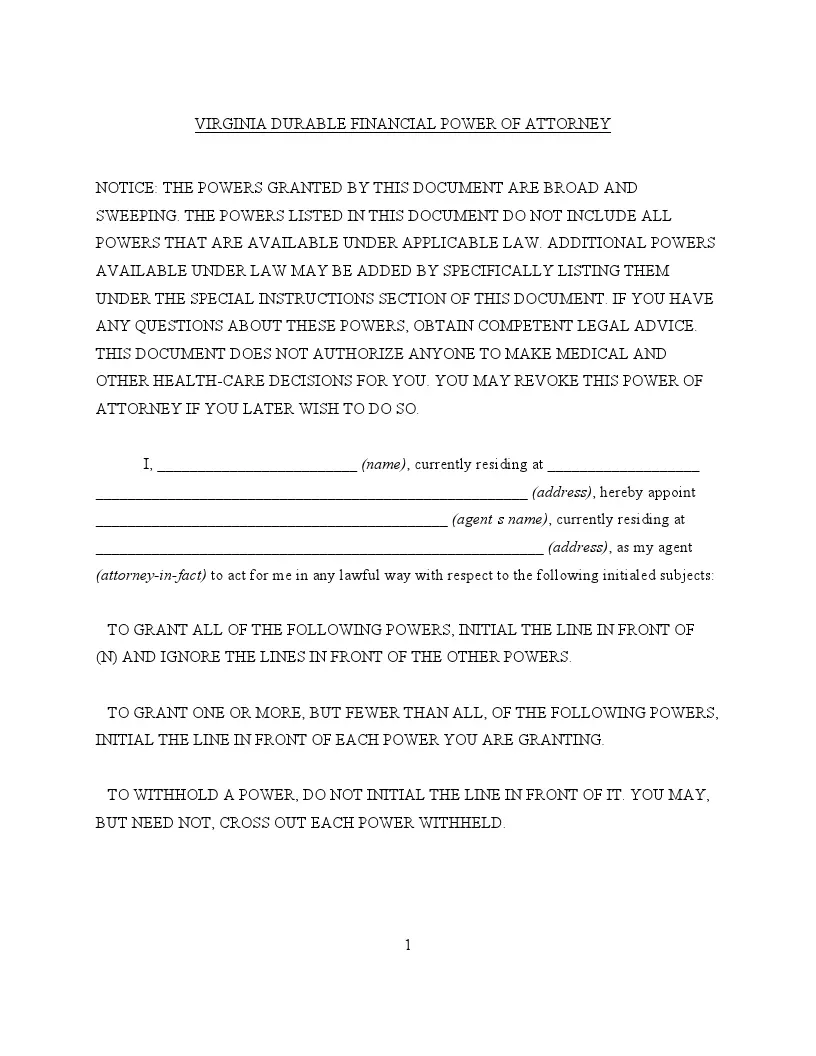
Virginia’s durable power of attorney ensures that all authority you provided to the assigned person will remain in action when you’re incapacitated unless you demand otherwise through revocation form or conducting a new durable POA.
| Also Known As | Virginia DPOA |
| Signing Requirements | Principal's signature (notary recommended) |
| Download | PDF Template | Statutory Form |

Virginia medical power of attorney or, in other words, an advanced medical directive is suggested when you risk being incapable of making health care decisions. Through this document, you will provide the right to a trustable person (family member, partner, or friend) to make medical decisions in your favor. Virginia law requires a written advance directive to be signed by you in the presence of two subscribing witnesses, meaning two witnesses who also sign it.[3]
| Also Known As | Health Care POA or MPOA |
| Signing Requirements | Two (2) Witnesses |
| Download | PDF Template | Durable POA for Health Care | Advance Medical Directive |

General power of attorney is used when you don’t have an intention to make the person’s authority over your financial or other matters be in action after you’re incapacitated. Once you cannot make decisions on your behalf, the general POA is annulated.
| Also Known As | General (Financial) POA |
| Signing Requirements | Principal's signature (notary recommended) |
| Download | PDF Template |

Limited power of attorney grants confined powers over your properties or financial authority to a person of your choice. It’s usually used to delegate a power to make decisions on your behalf in limited cases such as taxes, insurance, or real estate.
| Also Known As | Special POA |
| Signing Requirements | Principal's signature (notary recommended) |
| Download | PDF Template |

Child power of attorney is used when there is a need to delegate parental rights over the child to a trustworthy caregiver for a limited time (not to exceed 180 days). For example, when the parent goes on a long-term business trip or the child goes abroad. Under Virginia law, a power of attorney that delegates parental or legal custodial powers is legally sufficient if its wording substantially follows the statutory form, it is properly completed, and the signatures of the parties are acknowledged or verified before a notary public.[2]
| Also Known As | Minor POA |
| Signing Requirements | Notary |
| Download | PDF Template | POA to Delegate Parental Powers |

Virginia’s real estate power of attorney allows a landholder or business owner to delegate all paperwork related to real estate, including its lease, repair, and maintenance, to a trusted person.
| Also Known As | Limited Real Estate POA |
| Signing Requirements | Principal's signature (notary recommended) |
| Download | PDF Template |

Virginia state tax POA form is a handy document if you want someone to handle the operations you’re required to perform as a taxpayer. It includes the authority to sign consents or similar documents, submit income, employment, payroll reports and handle other tax matters.
| Also Known As | Virginia Comptroller POA |
| Signing Requirements | Notary |
| Download | Form 2848 |

Use a vehicle POA form when you need someone else to manage any operations or transactions regarding your vehicle, be it title registration or submitting a late penalty. You can use a specific form VSA-70 recognized in Virginia or make your template in our form-builder.
| Also Known As | DMV POA |
| Signing Requirements | Notirize |
| Download | PDF Template | Form VSA-70 |

Most of the power of attorney forms have their termination period indicated in the document. Durable POA is automatically terminated upon making a new POA form. If you want to terminate POA sooner than agreed, you can as well file a revocation form.
| Also Known As | POA Termination Form |
| Signing Requirements | Notarization is Advised |
| Download | PDF Template |
A Virginia power of attorney, often shortened to POA, is a document that lets one person act for another. The person who signs it is the principal. The person they name is the agent, also called an attorney-in-fact. The table below lists the main types and what each one is for.
| Form | Typical use |
|---|---|
| Durable power of attorney | Ongoing money and property matters |
| General power of attorney | Broad financial tasks |
| Limited power of attorney | One task, such as a single sale |
| Medical power of attorney | Health care decisions |
| Child power of attorney | Care of a child while you are away |
| Real estate power of attorney | Buying, selling, or renting property |
| Vehicle power of attorney | Registration and other vehicle matters |
| Tax power of attorney | State tax matters |
| Revocation of power of attorney | Ending an earlier document |
The right Virginia power of attorney depends on what you want your agent to handle. Some forms cover money and property, one covers health care decisions, and others fit a single task such as registering a car or filing state taxes. Match the job to the form first, then download it or create it online.
Signing a Virginia power of attorney takes four steps: fill in the form, sign it, acknowledge the signature, and give your agent the signed document. Follow them in order, and check the signing requirements shown with each template above for the form you picked.
Most problems with a power of attorney come from small oversights, not from the form itself. A few habits help you avoid them. Read this short list before you download a template, and again before you sign.
The principal is the person who creates the power of attorney and grants the authority. The agent, also called an attorney-in-fact, is the person the principal names to act for them. Choose an agent you trust, because the agent acts for you within the powers the document gives.
Yes. Choose a form, answer a few simple questions, and FormsPal builds the document for you. You can save your progress, finish on any device, and download and print the document when you are ready to sign it.
Keep the signed original in a safe place and give your agent a copy. Tell the people and organizations that will deal with your agent, such as your bank, that the document exists.
Many people complete the form on their own. If your situation is complicated, such as a large estate or a family disagreement, talk to a Virginia attorney before you sign.
POA forms are some of the most frequently downloaded ones in the United States. Listed here are some of the more requested power of attorney documents.

We provide a range of key Virginia forms to anyone looking for simplicity when handling various agreements, contracts, and other paperwork in the state.
General information, not legal or tax advice.
