
A Virginia vehicle bill of sale is a written record of a car, truck or other motor vehicle sale, with the price and the date. Virginia does not always require one, because the DMV also accepts a buyer’s order or the seller’s declared price on the title as proof of price.[1] Fill out our free form online or download the PDF. Forms for boats, firearms and other property are listed below.
Last Updated: October 2026. This guide is reviewed and updated regularly to reflect current Virginia law. If you notice an error or outdated information, please contact us.
Build Your Document
Answer a few simple questions to make your document in minutes
Save and Print
Save progress and finish on any device, download and print anytime
Sign and Use
Your valid, lawyer-approved document is ready
| Document Name | Virginia Vehicle Bill of Sale Form |
| Other Names | Virginia Car Bill of Sale, Virginia Automobile Bill of Sale |
| DMV | Virginia Department of Motor Vehicles |
| Bill of Sale Required? | Not when the DMV accepts other proof of the price[1] |
| Avg. Time to Fill Out | 7 minutes |
| # of Fillable Fields | 64 |
Virginia uses different bill of sale forms for different property. Pick the one that matches what you are buying or selling: a vehicle, a boat, a firearm or general personal property. Each card below lists the form’s signature lines and links to a free PDF template. Our guide compares bill of sale forms in more detail.
Virginia vehicle bill of sale records the transfer of a vehicle from the seller to the buyer. Our form has lines for the make, model, VIN and odometer reading.
| Alternative Name | Car Bill of Sale |
| Seller’s Signature | Signature line on the form |
| Buyer’s Signature | Signature line on the form |
| Notarization | Acknowledgment on page 4 |
| Download | PDF Template |

Virginia bill of sale for a vessel is a receipt for the sale of a boat. Use it to record who sold the boat, who bought it and the price paid.
| Alternative Name | Vessel Bill of Sale |
| Seller’s Signature | Recommended |
| Buyer’s Signature | Recommended |
| Notarization | Optional extra |
| Download | PDF Template |

This firearm bill of sale helps keep a record every time a gun changes hands in Virginia.
| Alternative Name | Gun Bill of Sale |
| Seller’s Signature | Recommended |
| Buyer’s Signature | Recommended |
| Notarization | Optional extra |
| Download | PDF Template |

Virginia general bill of sale fits most private sales, such as vehicle accessories, equipment, tools and appliances.
| Alternative Name | Generic Bill of Sale |
| Seller’s Signature | Recommended |
| Buyer’s Signature | Recommended |
| Notarization | Optional extra |
| Download | PDF Template |
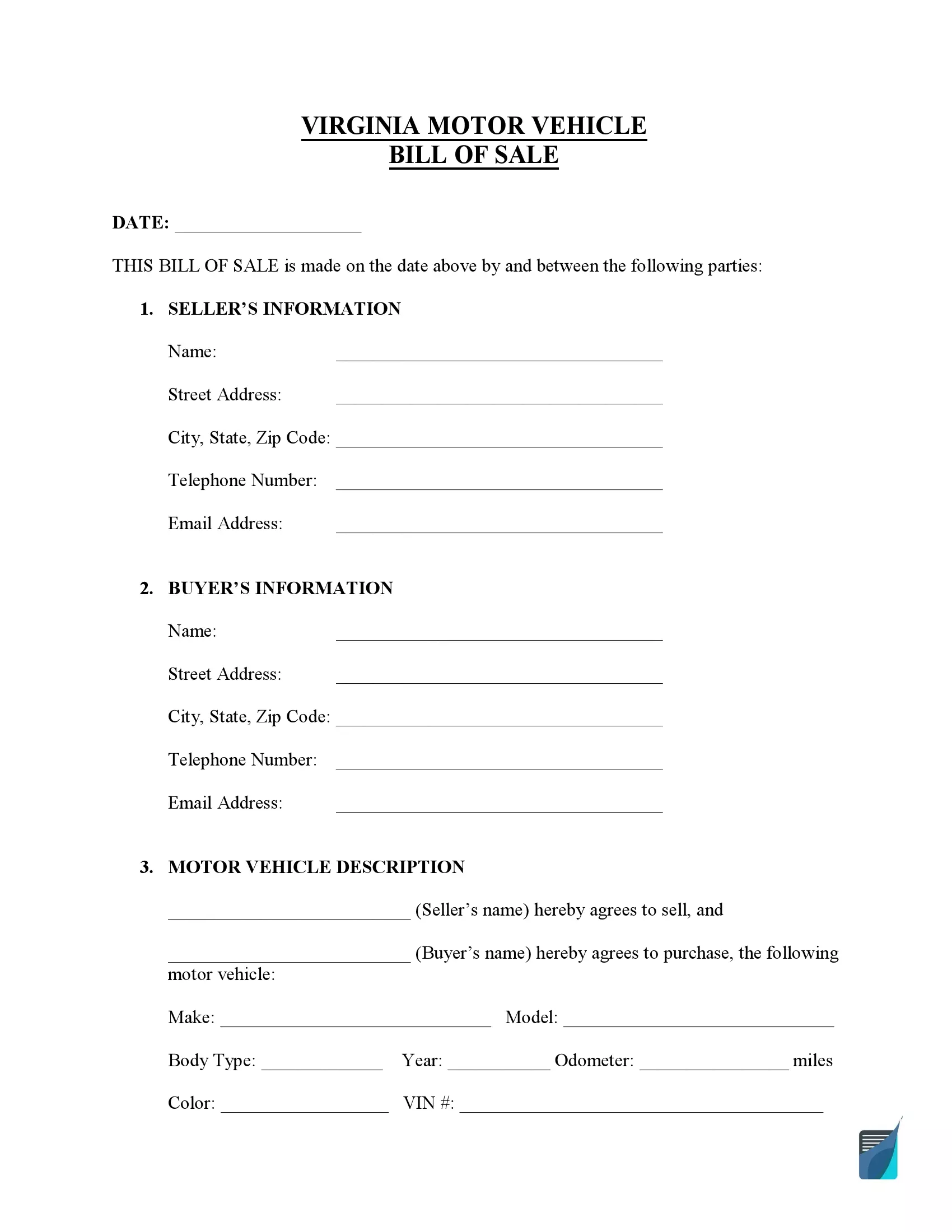
Our Virginia motor vehicle bill of sale has six numbered parts, a date line at the top and a notary acknowledgment on page 4. Fill in the blanks from top to bottom, then print the form to sign it. The steps below follow the form in order.
Step 1: DATE
Enter the date on the DATE line at the top of page 1.

Step 2: 1. Seller’s Information
Fill in the seller’s name, street address, city, state and zip code, telephone number and email address.
Step 3: 2. Buyer’s Information
Fill in the same lines for the buyer.

Step 4: 3. Motor Vehicle Description
Write the seller’s name and the buyer’s name in the two blanks. Then describe the vehicle: make, model, body type, year, odometer reading in miles, color and VIN.

Step 5: 4. Purchase Date, Purchase Price and Method
Enter the purchase date and the total price in U.S. dollars. Then check one way the price is paid:
Next, check how the buyer pays: cash, check (with the check number), cashier’s check or money order. Last, check whether taxes are included in the price.

Step 6: 5. Miscellaneous Provisions
Read this part before you sign. It says the seller owns the vehicle and that no liens are on it. It also says the vehicle is sold “as is” and that the bill of sale is the only agreement between the two sides. There is nothing to fill in.

Step 7: 6. Signatures
The seller, the buyer and a witness each sign their own line. Each also adds the date and a printed name.

Step 8: Acknowledgment
Page 4 holds a notary acknowledgment. If you use a notary, sign in front of them. The notary fills in the county, the date, the officer’s name, the name of the person who appeared, and the seal.

Have both the buyer and the seller sign. As proof of the purchase price, the DMV accepts a handwritten bill of sale signed by the seller and the purchaser.[1]
Two papers matter most when a Virginia vehicle changes hands: the certificate of title and a record of the price. The seller must endorse the title over to the buyer.[3] A signed bill of sale is one way to record the price. This section lists what the Virginia DMV and the Virginia Code say about both.
The DMV’s SUT-1 / SUT-1A guidance for a title application lists these items:[2]
The same guidance also describes a vehicle price certification signed by the seller or purchaser. It treats the seller’s information as part of the paperwork too.[2]
A bill of sale is not always required. For a used vehicle title application, the DMV accepts a buyer’s order, a bill of sale or the seller’s declared sale price on the title as proof of purchase price. The seller may also record the mileage on an odometer disclosure statement.[1]
Va. Code § 46.2-628 covers how a certificate of title is transferred. Its text reads:
The owner of a motor vehicle, trailer, or semitrailer registered under this chapter, when transferring or assigning his title or interest thereto, shall fully and correctly endorse the assignment and warranty of title on the certificate of title of the motor vehicle, trailer, or semitrailer to its purchaser, with a statement of all security interests on it, and shall deliver the certificate to the purchaser or transferee at the time of delivering the motor vehicle, trailer, or semitrailer.
In plain words, the owner signs over the title, lists every lien on it and hands the certificate to the buyer at delivery.[3]
In practice, many buyers bring the signed title, photo ID and a completed motor vehicle bill of sale template when they visit the DMV. If you only have a bill of sale and no title, read our guide to getting a vehicle title with a bill of sale.
To title and register the vehicle, the buyer uses Form VSA 17A, Application for Certificate of Title and Registration.[1]
An all-terrain vehicle or off-road motorcycle with a gasoline or diesel engine over 50 cc that was purchased new on or after July 1, 2006 must be titled (Va. Code § 46.2-644.1).[4]
A Virginia DMV vehicle form used in some transactions. For a title and registration, see Form VSA 17A.

Application for Certificate of Title and Registration (Form VSA 17A) is designed for vehicles that do not have Virginia title yet.

Form VSA 70 (Power of Attorney) is signed to appoint another person to register and/or transfer ownership of a motor vehicle for the owner.

Affidavit of Vehicle Purchase Price, known as Form SUT 1A, is used to certify the purchase price of a vehicle five years old or less in order to obtain a title.

Application for Watercraft Certificate of Title and Certificate of Number (Registration)

Statement for Registering and Titling a Motorboat (Form BRT-002) is used for previously not registered and/or titled motorboats. This form must be submitted with an Application for Certificate of Title and Certificate of Number.

Form BRT-010 or Notification of Change in Status of a Numbered Vessel reports the change of boat ownership.

Multiple Handgun Purchase Application (Form SP-207) is used to apply for multiple firearms purchase by the same purchaser within a specific period.

These short answers cover what buyers and sellers ask most often about a Virginia vehicle bill of sale. Where the Virginia DMV or the Virginia Code speaks to a question, the answer points to it in the Sources list below.
Virginia has no statute that requires a bill of sale to be notarized. Our template includes an acknowledgment on page 4 for people who choose to have a notary complete it. A notary does appear on one DMV title document, which is not a bill of sale: a completed, signed and notarized application in lieu of title certificate.[1]
For a title application, the DMV’s guidance calls for section A on the front of the title, including the signature of the vehicle owner or owners. It also describes a vehicle price certification signed by the seller or purchaser.[2] Our form has signature lines for the seller, the buyer and a witness.
The Virginia DMV says the seller may record the mileage on an odometer disclosure statement.[1] Our form also has an odometer line in the vehicle description, so you can write the mileage there too.
The DMV’s SUT-1 / SUT-1A guidance for a title application lists entering the correct sales price.[2] Our form has a line for the total purchase price and boxes for how it is paid.
Yes. Under Va. Code § 46.2-628, an owner who transfers a registered motor vehicle must fully and correctly endorse the assignment and warranty of title on the certificate of title, with a statement of all security interests. The owner delivers the certificate to the buyer at the time of delivery.[3]

Other Virginia Forms
General information, not legal or tax advice.


