
A Virginia firearm bill of sale, also called a gun bill of sale, is a written record of a gun sale between a seller and a buyer. It names both parties, describes the firearm by make, model, caliber, and serial number, and states the price. It does not replace the checks and age limits that apply to the sale. Build it online for free or download the blank PDF.
Last Updated: October 2026. This guide is reviewed and updated regularly to reflect current Virginia law. If you notice an error or outdated information, please contact us.
Build Your Document
Answer a few simple questions to make your document in minutes
Save and Print
Save progress and finish on any device, download and print anytime
Sign and Use
Your valid, lawyer-approved document is ready
Need something else? Browse our Virginia bill of sale forms or read the bill of sale basics first.
Selling a firearm in Virginia for value requires a check run through a licensed dealer, and buyers must meet age limits under state and federal law. This section covers the dealer check, the age limit, the dealer fee, and the people federal law bars you from selling to. The table below lists each rule and where it comes from.
| Subject | Rule | Source |
| Verification before a sale for value | The seller must first get verification from a licensed firearms dealer that the buyer's information was submitted for a criminal history record check | Va. Code Ann. § 18.2-308.2:5[3.1] |
| Buyer age for a handgun or assault firearm | Unlawful for anyone younger than 21 to knowingly and intentionally purchase one in Virginia | Va. Code Ann. § 18.2-308.7[3.2] |
| Dealer fee for the criminal history check | $2 for every transaction that requires a check, or $5 for every transaction with an out-of-state resident | Va. Code Ann. § 18.2-308.2:2[2] |
| Selling to a person under indictment for, or convicted of, a crime punishable by more than one year in prison | Unlawful when you know or have reasonable cause to believe it | 18 USC 922[1] |
Virginia ties a sale for value to a check run through a licensed dealer. The statute reads:
No person shall sell a firearm for money, goods, services or anything else of value unless he has obtained verification from a licensed dealer in firearms that information on the prospective purchaser has been submitted for a criminal history record information check as set out in § 18.2-308.2:2
In plain words, the dealer check comes first. Selling a firearm for money, goods, services, or anything else of value requires a licensed firearms dealer to confirm the buyer's information was submitted for a criminal history record check.[3.1] A licensed dealer collects a fee of $2 for every transaction that requires a check, and $5 for every transaction involving an out-of-state resident.[2]
Any firearm can be sold privately in Virginia, not only a handgun, but only to a Virginia resident and only after a licensed dealer confirms the buyer's information was submitted for a background check. Federal law bars an unlicensed seller from transferring a firearm to someone who does not live in the seller's state (18 U.S.C. § 922(a)(5)).[1.1]
The Virginia State Police run these checks through the Virginia Firearms Transaction Program, in operation since November 1, 1989, which gives the dealer a point-of-sale approval or delay decision based on the criminal history record check.[4.1]
Virginia sets an age floor for buying a handgun or assault firearm. The statute reads:
It is unlawful for any person younger than 21 years of age to knowingly and intentionally purchase a handgun or assault firearm anywhere in the commonwealth.
In plain words, a person younger than 21 cannot lawfully buy a handgun or assault firearm in Virginia.[3.2] Federal law adds its own limit for licensed dealers. A dealer may not sell a firearm to anyone the dealer knows or has reasonable cause to believe is under 18. For a firearm other than a shotgun or rifle, the limit is under 21.[1]
Federal law bars you from selling or otherwise disposing of a firearm or ammunition to anyone you know, or have reasonable cause to believe, is in one of these groups.[1]
Virginia law adds its own bars: a person convicted of a felony may not purchase or possess a firearm (Section 18.2-308.2), and neither may a person acquitted of a crime by reason of insanity (Section 18.2-308.1:1).[5.1]
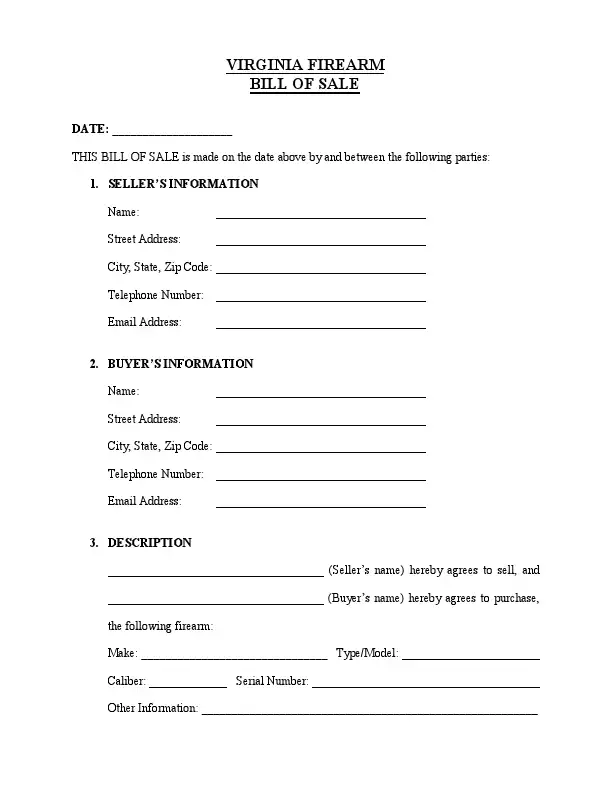
Work through the form from top to bottom. Each step below matches a part of the Virginia firearm bill of sale, from the date line on page 1 to the acknowledgment on page 5. Fill in the PDF by hand, use our online PDF editor, or answer the matching questions when you build it online.
Step 1: DATE
Write the date on the DATE line at the top of page 1.

Step 2: Seller's Information
Enter the seller's name, street address, city, state and zip code, telephone number, and email address.
Step 3: Buyer's Information
Enter the same five details for the buyer.

Step 4: Description
Print the seller's and the buyer's names in the opening sentence. Then list the firearm's make, type or model, caliber, serial number, and any other information.

Step 5: Purchase Date, Purchase Price and Method
On page 2, enter the purchase date and the total price. Then check one of the four options:
For a trade-in, also describe the buyer's firearm on the lines provided.
Step 6: Payment method
Check one: cash, check (add the check number), cashier's check, or money order.

Step 7: Seller Disclosures
The seller reads the statements that start on page 2. Then the seller signs the Seller's Signature line on page 3.
Step 8: Buyer Disclosures
The buyer reads the statements on page 3 and signs the Buyer's Signature line.
Step 9: Miscellaneous Provisions
Both parties read these terms on pages 3 and 4, including the as-is sale clause. There is nothing to fill in.

Step 10: Signatures
On page 4, fill in the three dates. The seller and the buyer each sign and print their name. The form also has a line for a witness signature and printed name.

Step 11: Acknowledgment
Page 5 holds the acknowledgment, the block a notary completes. If you have the document notarized, sign in front of the notary. You can also use our Virginia notary acknowledgment page.

For a version that is not specific to one state, see our firearm bill of sale guide.
Make two identical signed copies of the bill of sale so the seller and the buyer each keep one.
Sellers often ask what the law requires before a firearm changes hands. The answer below draws on Virginia state law and federal law, and each rule points to its source at the end of this page. Check the current statute text before you sell.
To sell a firearm in Virginia for money, goods, services, or anything else of value, you must first get verification from a licensed firearms dealer. The dealer confirms that the buyer's information was submitted for a criminal history record check.[3.1]
Age limits apply too:
General information, not legal or tax advice.
