
A marital settlement agreement Michigan spouses sign is a written record of how they will handle custody and visitation, child support, spousal support, the family home, debts, and personal property when the marriage ends. FormsPal's free Michigan Marital Separation Agreement template covers each of those topics. You can fill it out online or download the PDF.
Last Updated: October 2026. This guide is reviewed and updated regularly to reflect current Michigan law. If you notice an error or outdated information, please contact us.
Build Your Document
Answer a few simple questions to make your document in minutes
Save and Print
Save progress and finish on any device, download and print anytime
Sign and Use
Your valid, lawyer-approved document is ready
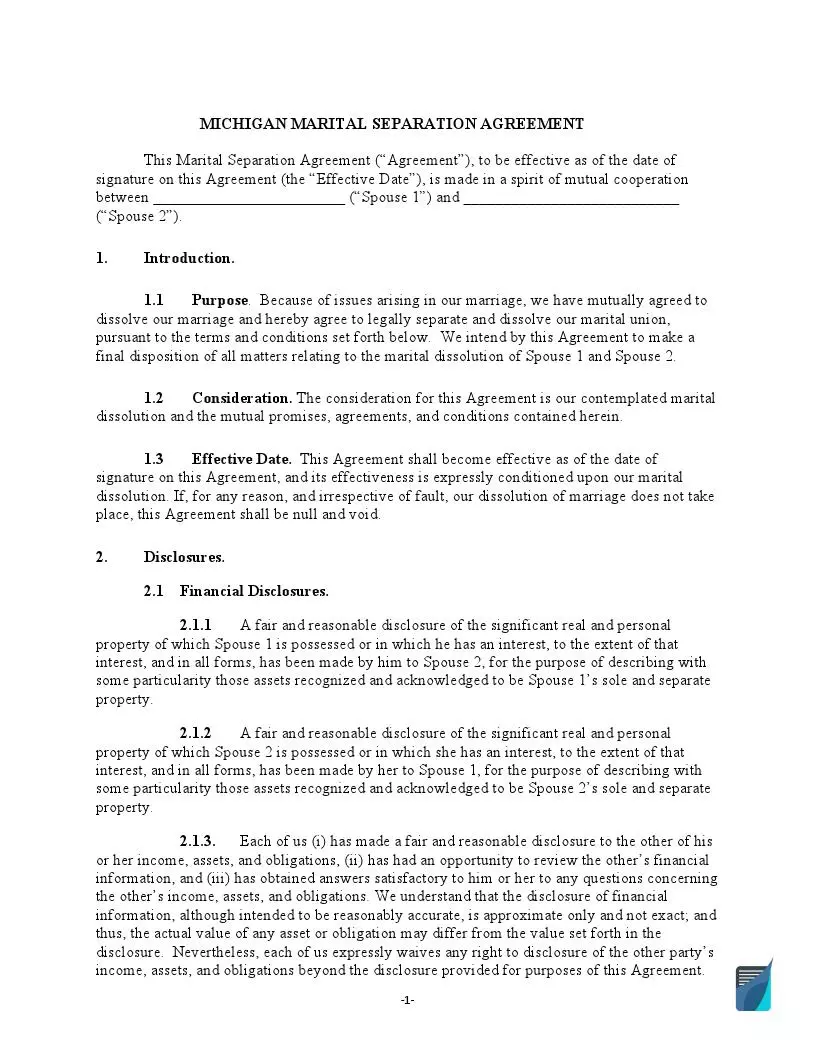
You decide what goes into your own Michigan marital settlement agreement. The FormsPal template, titled Michigan Marital Separation Agreement, runs eight pages and walks you through each topic in order. It has 18 numbered sections, signature pages for both spouses, and a notary section on the last page.
Every section of the template is a blank to fill in, so complete each one that applies to your marriage. You can fill in the downloaded PDF with our online PDF editor. Many couples make the agreement as detailed as they can, because a topic it does not cover is a topic the spouses have not settled. Many also have a lawyer read the finished agreement before they sign.
Read section 1.3 of the template before you sign. The agreement takes effect on the date of signature, but its effectiveness is conditioned on the dissolution of the marriage. If the dissolution does not take place, the agreement is null and void.
Two sections of the Michigan Compiled Laws bear on what a settlement agreement should cover, namely property and life insurance. Section 552.19 gives the court power over property when a marriage ends.[2] Section 552.101(1) requires the divorce judgment to settle life insurance rights.[1] The two subsections below explain each one in plain words.
A Michigan court grants a judgment of divorce only if the complainant or the defendant has lived in Michigan for 180 days immediately before the complaint is filed. The complainant or the defendant must also have lived in the county where the complaint is filed for 10 days immediately before filing (Section 552.9(1)).[3]
No proofs or testimony are taken in a divorce case until 60 days after the complaint is filed, except where the cause for divorce is desertion or when testimony is taken conditionally to preserve it. When there are dependent minor children under 18, the wait is 6 months from the day the complaint is filed (Section 552.9f).[4]
Section 552.19 applies upon the annulment of a marriage, a divorce from the bonds of matrimony, or a judgment of separate maintenance. In any of those cases, the court may enter a further judgment about property. It can restore to either spouse the whole, or the parts it deems just and reasonable, of the real and personal estate that came to that spouse by reason of the marriage. It can also award the value of that estate, to be paid in money.[2]
The statute puts it this way:
The court may make a further judgment for restoring to either party the whole, or such parts as it shall deem just and reasonable, of the real and personal estate that shall have come to either party by reason of the marriage, or for awarding to either party the value thereof, to be paid by either party in money.
The power belongs to the court and runs to either spouse. A settlement agreement is where you and your spouse can write down your own plan for the same property, such as the family home and personal belongings.
Section 552.101(1) says each divorce judgment must determine all rights of the wife in the proceeds of any life insurance, endowment, or annuity policy on the husband's life in which she was named as beneficiary. That includes a policy she became entitled to by assignment or change of beneficiary during the marriage or in anticipation of marriage.[1] The statute is written in terms of a wife and a husband.
Because the judgment must settle these rights, many couples list their life insurance policies and beneficiaries in the agreement. The FormsPal template has an insurance section (section 9) for the policies each spouse keeps in place.
Popular Local Marital Settlement Agreement Forms
Although it is not required to file a divorce settlement agreement, this document can give you particular perks: more assurance after the divorce and significantly less headache in court. Here is a list of this sort of regional agreements Googled the most by our visitors.

Skipped sections, wrong names or dates, and pages nobody read are the usual trouble spots in a form like this. The checklist below covers the work you can do before you sign. It is practical advice, not a statement of Michigan law, so ask the court clerk or a lawyer about the steps and timing in your county.
The answers below come from the two Michigan statute sections cited on this page, section 552.19 on property and section 552.101(1) on life insurance. They describe what those statutes say, not what one court may decide in your case, so ask a Michigan lawyer about your own facts.
Start with the two subjects the statutes mention, property and life insurance. Section 552.19 lets the court enter a further judgment on the real and personal estate that came to either spouse by reason of the marriage.[2] Section 552.101(1) requires the divorce judgment to determine rights in life insurance proceeds.[1] An agreement that says who keeps which property and each policy's proceeds speaks to both subjects.
Many couples cover these topics, and the FormsPal template has a section for each:
Property deserves detail. Under section 552.19, the court may enter a further judgment on the real and personal estate that came to either spouse by reason of the marriage.[2]
Section 552.19 lets the court restore to either spouse the whole, or such parts as it deems just and reasonable, of the real and personal estate that came to either spouse by reason of the marriage.[2] It can also award either spouse the value of that estate, to be paid in money. Ask a Michigan lawyer how this applies to your property.
Section 552.19 lets the court restore to either spouse the whole, or such parts as it deems just and reasonable, of the real and personal estate that came to either spouse by reason of the marriage.[2] It can also award the value of that estate in money. What a court orders for a particular home depends on the facts, so ask a lawyer about your case.
Section 552.19 lets the court restore to either spouse, on a divorce, the whole or such parts as it deems just and reasonable of the real and personal estate that came to either spouse by reason of the marriage.[2] The power runs to either spouse, so it applies the same way to a wife and a husband. The judgment must also determine a wife's rights in the proceeds of any life insurance, endowment, or annuity policy on her husband's life in which she was named as beneficiary.[1]

Other Marital Settlement Agreement Forms by State
General information, not legal or tax advice.
