
A Michigan promissory note is a written promise by a borrower to repay money to a lender, usually with interest. Michigan law lets the parties agree to an interest rate in writing, generally up to 7% per year.[1.1] You can fill out the Michigan promissory note template below online or download it as a PDF.
Last Updated: October 2026. This guide is reviewed and updated regularly to reflect current Michigan law. If you notice an error or outdated information, please contact us.
Build Your Document
Answer a few simple questions to make your document in minutes
Save and Print
Save progress and finish on any device, download and print anytime
Sign and Use
Your valid, lawyer-approved document is ready
When the parties agree on no rate, the statutory rate is $5.00 upon $100.00 for a year, or 5%. A rate the parties stipulate in writing may not exceed 7% per annum. Section 438.31 of the Michigan Compiled Laws (MCL) states both rules.[1.1]
The interest of money shall be at the rate of $5.00 upon $100.00 for a year, and at the same rate for a greater or less sum, and for a longer or shorter time, except that in all cases it shall be lawful for the parties to stipulate in writing for the payment of any rate of interest, not exceeding 7% per annum.
The two rules work like this.
Write the rate into the note itself, so the number is clear to both sides. Chapter 438 of the MCL holds Michigan's laws on money and interest.
Section 438.31c gives some loans their own rate rules. These rules cover loans secured by real property or by a mobile home. In each case the parties must agree in writing.
A mortgage loan or land contract under these rules must not provide for a rate of interest added or deducted in advance. Interest is computed from time to time only on the basis of unpaid balances.[1.3]
Section 438.61 covers an extension of credit to a business entity. The parties may agree in writing to any rate of interest when the lender is one of the following.
For credit from any other lender, the parties may agree in writing to any rate of interest. The rate may not exceed the rate allowed under Act No. 259 of the Public Acts of 1968.[1.7]
Interest on an installment of interest that is due and unpaid may be computed and collected from the time it became due. The rate is the one specified in the note, bond, mortgage or other written contract, not exceeding 10 per cent. If the instrument specifies no rate, the rate is 7 per centum per annum, which is 7% a year.[1.8]
Some lenders must furnish a loan settlement statement to the borrower upon closing of the loan.
The statement indicates in detail the charges the borrower has paid or become obligated to pay the lender or any other person in connection with the loan. A copy of the statement must be retained in the records of the lender.[1.2]
| Document Name | Michigan Promissory Note Form |
| Other Name | MI Promissory Note |
| Max. Rate | 7% a year if agreed in writing, 5% a year if no rate is agreed[1.1] |
| Relevant Laws | Michigan Compiled Laws, Section 438.31 |
| Avg. Time to Fill Out | 10 minutes |
| # of Fillable Fields | 28 |
| Available Formats | Adobe PDF |
Popular Local Promissory Note Forms
If you need to borrow or lend money, think about signing a promissory note form. It’s a useful binding document frequently used by businesses and individuals in many states. Listed below are the state-level promissory note templates our users research the most.
A seller or lender who charges interest in excess of that allowed is barred from the recovery of any interest, official fees and costs.[1.4] A person who knowingly charges more than 25% simple interest per year without legal authority is guilty of criminal usury.[1.5]
A seller or lender, or his assigns, is barred from the recovery of any interest, any official fees, delinquency or collection charge, attorney fees or court costs.
This applies to one who enters into a contract or agreement that does not comply with the act, or who charges interest in excess of that allowed by the act. The borrower or buyer is entitled to recover his attorney fees and court costs from the seller, lender or assigns.[1.4]
A person is guilty of criminal usury when, not being authorized or permitted by law to do so, he knowingly charges, takes or receives any money or other property as interest on the loan or forbearance of any money or other property, at a rate exceeding 25% at simple interest per annum or the equivalent rate for a longer or shorter period.
In plain words, charging more than 25% simple interest per year without legal permission is criminal usury. Two criminal penalties apply.
The Michigan promissory note template is a three-page PDF form for a loan between one borrower and one lender. It has 28 fillable fields for the loan terms, the interest rate, the payment schedule, the collateral choice and the signatures. You can complete it on screen, print it, and keep a copy for your records.
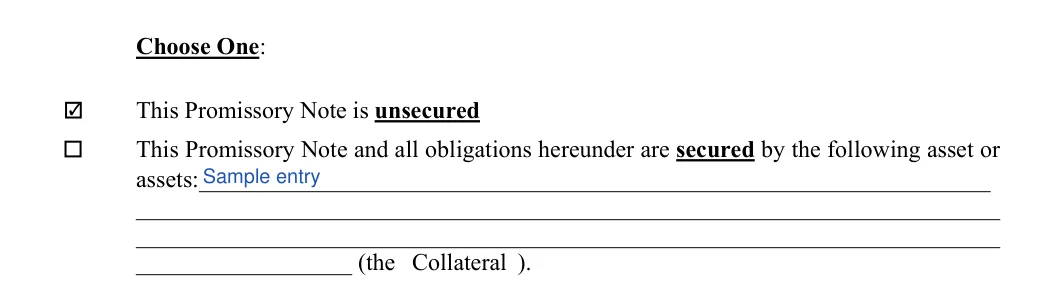
A secured note names collateral, which is property that backs the loan. An unsecured note names none. When the sum is large and the lender is unsure about the borrower, many lenders prefer a secured note, because the collateral stands behind the repayment. A fair collateral value is one that is in line with the amount borrowed.
Lenders often lend smaller sums to people they know well. In that case, an unsecured note is a common choice, since the borrower promises to repay and puts no property behind the promise. The type you choose changes only the collateral lines on page 2, so the other fields stay the same.
Agree the sum borrowed, the interest rate, the due day and the maturity date with the other party before you fill out the form. Then print two copies, so the borrower and the lender each keep a signed original. Keep a simple payment record next to the note, so it is easy to show what has been paid.
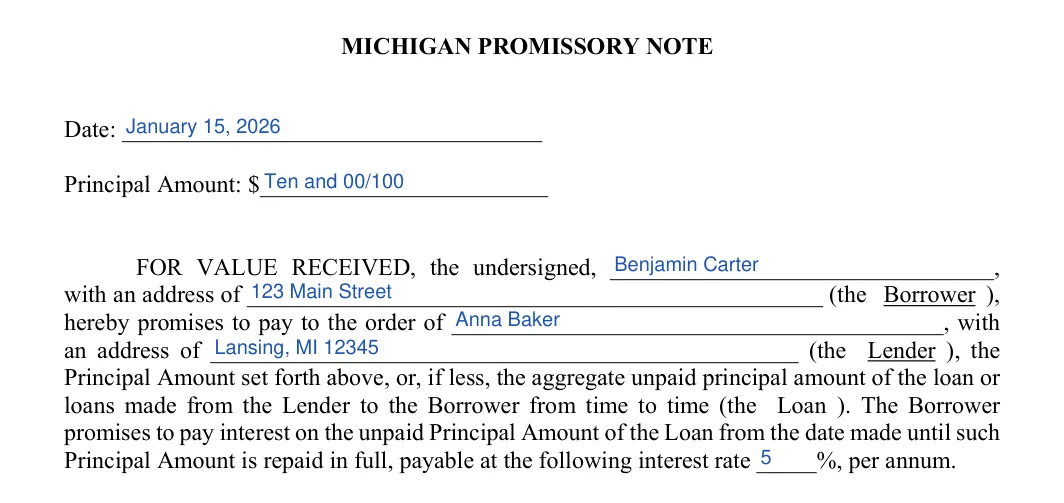
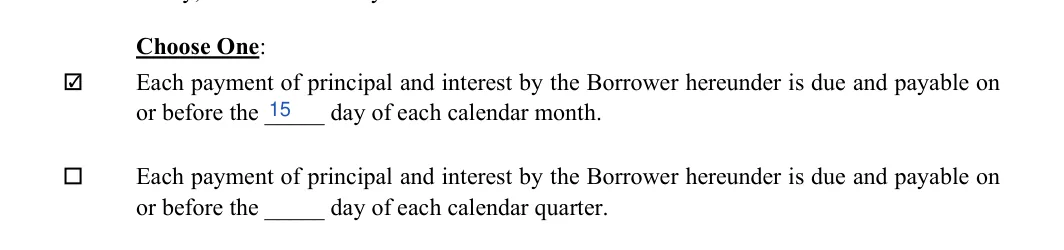
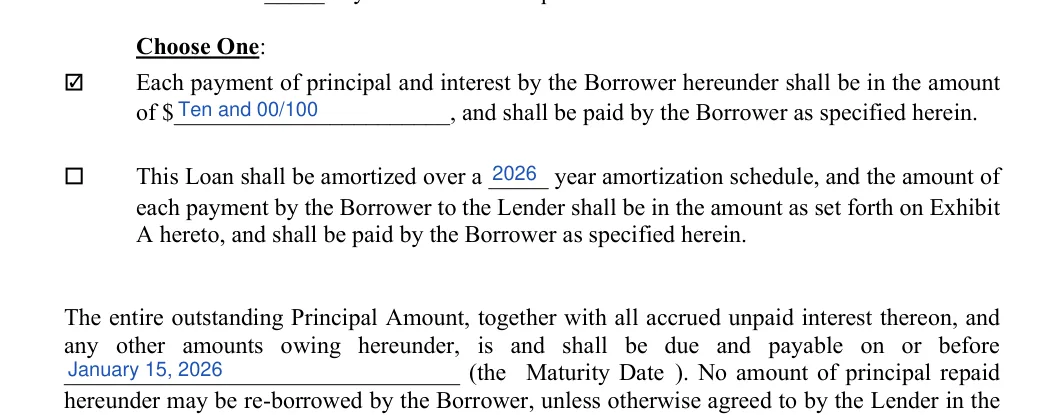
The Michigan promissory note PDF has 28 fillable fields. Work through it in order, from the date and principal amount to the two signatures. The six steps below follow the form, and each one shows a Michigan promissory note example filled in with sample entries.
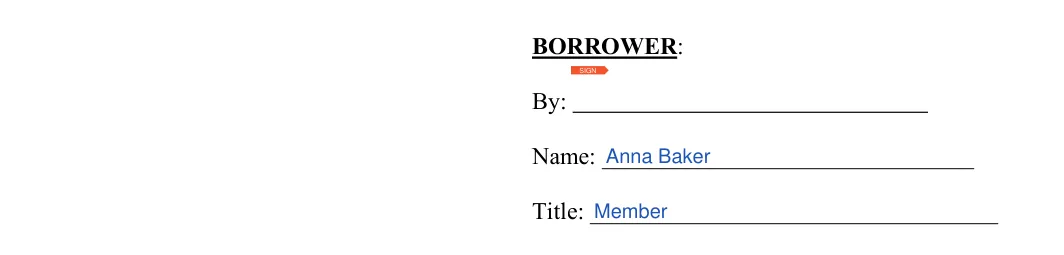
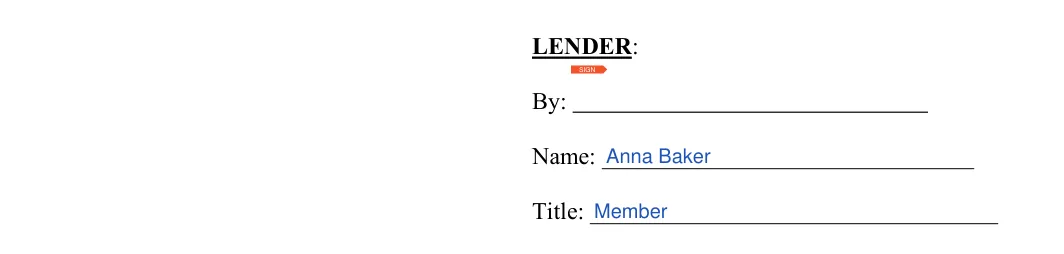
The screenshots under each step show the FormsPal Michigan promissory note template filled with sample entries in blue, so you can see where each answer goes. The names, addresses, dates and amounts are examples only.
To fill in the downloaded PDF on screen, use our online PDF editor. For a general overview of the document and a template for every state, see our sample promissory note template.
These four questions cover what readers ask most about interest rates and usury on a Michigan promissory note. Every answer comes from the Michigan Compiled Laws sections listed under Sources below.
For a note, the general limit is 7% per annum. The parties may stipulate in writing for the payment of any rate of interest, not exceeding 7% per annum.[1.1]
It depends on the loan. Three limits matter most.
A 95% rate is far above the 25% simple interest line for criminal usury. Criminal usury is a rate exceeding 25% at simple interest per annum, or the equivalent rate for a longer or shorter period. It applies to a person who is not authorized or permitted by law to charge it and who knowingly charges, takes or receives it.[1.5]
In Michigan, a 300% rate is also far above the 25% simple interest line. A person who, not being authorized or permitted by law to do so, knowingly charges a rate exceeding 25% at simple interest per annum is guilty of criminal usury.[1.5] A lender who charges interest in excess of what the act allows is also barred from the recovery of any interest.[1.4]

Other Promissory Note Forms by State
General information, not legal or tax advice.
