
A Washington promissory note is a written promise to repay borrowed money. It names the borrower, the lender, the amount and the payment terms. A rate is legal in Washington so long as it does not exceed the higher of 12% per annum or four percentage points above the average 26-week Treasury bill rate.[1] Fill out the free template below online, or download the PDF.
Last Updated: October 2026. This guide is reviewed and updated regularly to reflect current Washington law. If you notice an error or outdated information, please contact us.
Build Your Document
Answer a few simple questions to make your document in minutes
Save and Print
Save progress and finish on any device, download and print anytime
Sign and Use
Your valid, lawyer-approved document is ready
Under Wash. Rev. Code § 19.52.020, the interest on a note is legal as long as it does not exceed the higher of two figures. One is 12% per annum. The other is four percentage points above the average 26-week Treasury bill rate.[1]
Except as provided in subsection (4) of this section, any rate of interest shall be legal so long as the rate of interest does not exceed the higher of: (a) Twelve percent per annum; or (b) four percentage points above the equivalent coupon issue yield (as published by the Board of Governors of the Federal Reserve System) of the average bill rate for twenty-six week treasury bills as determined at the first bill market auction conducted during the calendar month immediately preceding the later of (i) the establishment of the interest rate by written agreement of the parties to the contract, or (ii) any adjustment in the interest rate in the case of a written agreement permitting an adjustment in the interest rate.
The statute breaks down into three parts.
The rule opens with the words "except as provided in subsection (4)". The ceiling above is subject to that subsection.[1]
Under the same section, no person may directly or indirectly take or receive any greater interest for the loan or forbearance of any money, goods, or things in action.[1]
Write the agreed rate as a yearly percentage on the interest line of the form. The form already says the rate is per annum, so a number such as 8 means 8% per year.
| Document Name | Washington Promissory Note Form |
| Other Name | WA Promissory Note |
| Max. Rate | The higher of 12% per annum or four percentage points above the average bill rate for 26-week Treasury bills[1] |
| Relevant Laws | Washington Revised Code, Section 19.52.020 |
| Avg. Time to Fill Out | 10 minutes |
| # of Fillable Fields | 28 |
| Available Formats | Adobe PDF |
Popular Local Promissory Note Forms
In case you want to lend or borrow money, think about signing a promissory note. It is a simple legally binding document commonly drafted by businesses and individuals in all states. Listed below are the state promissory note templates our visitors read about the most.
On a loan of money in which the funds advanced do not exceed $500, a Washington lender may charge and collect a setup charge. The statute says this setup charge is not considered interest. A separate cap limits how large the charge can be.[1]
The setup charge may not exceed 4% of the funds advanced, or $15, whichever is less. On a loan of under $100, a minimum charge not exceeding $4 may be made.[1] Three examples show how the cap works.
A setup charge is a one-time fee on the loan itself. It is not the interest rate, so do not write it on the interest line of the form.
Two more rules in the same statute cover specific kinds of loans. One covers a loan made under a commitment to lend. The other covers open-end credit. Each rule says when such a loan is not usurious.[1]
The template is a fillable PDF for a loan between one borrower and one lender. It has fields for the loan terms, the interest rate, the repayment schedule and the signatures. You can complete it on screen, print it and keep a copy for your records.
Before you start, agree the loan amount, the interest rate, the due day and the maturity date with the other party. Then print two copies of the signed note, so the borrower and the lender each keep one.
A promissory note puts a loan in writing so both sides can see what was agreed. People use one when a friend or relative lends money, when a buyer pays a seller over time, or when an owner lends money to a business. The note records the amount, the interest and the dates the borrower pays.
The PDF has 28 fillable fields across three form pages. Work through it in order, from the date and principal amount to the two signatures. The six steps below follow the form, and each one shows a example filled in with sample entries.
The screenshots under each step show the FormsPal Washington promissory note template filled with sample entries in blue, so you can see where each answer goes. The names, addresses, dates and amounts are examples only.
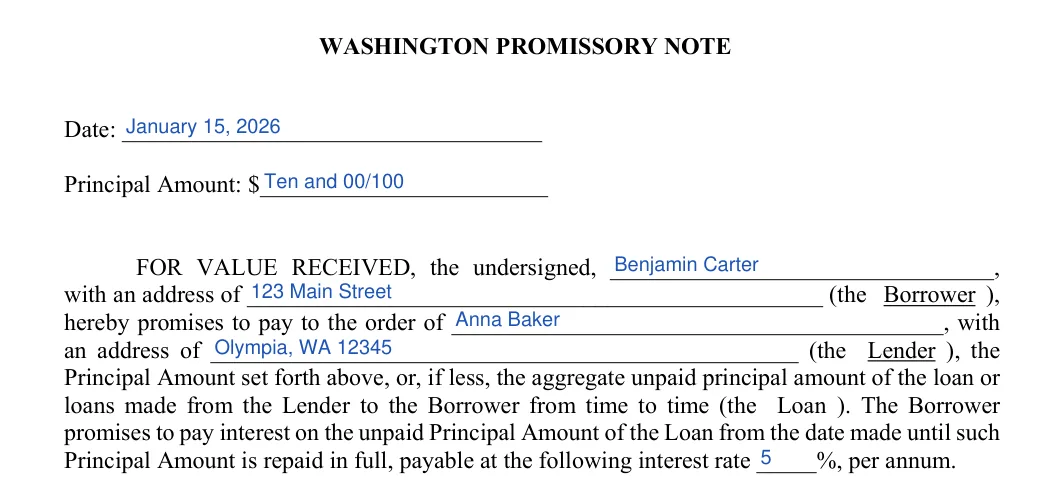
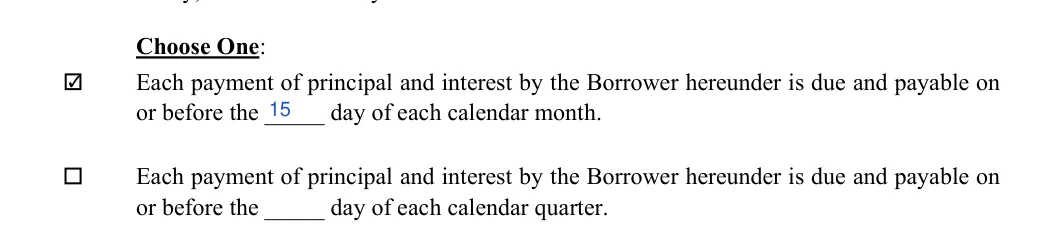
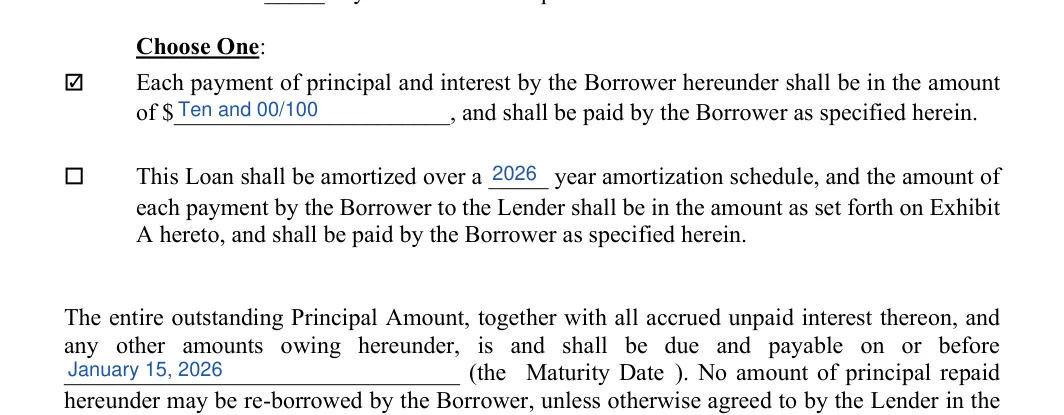
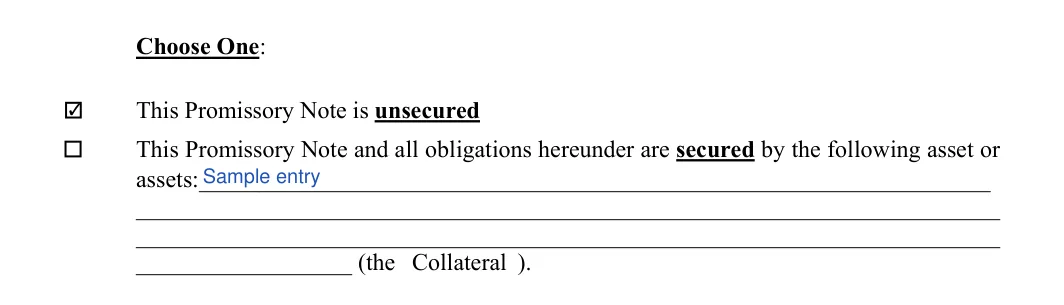


You can fill in the downloaded PDF in our online PDF editor. For a general overview of the document and a template for every state, see our standard promissory note form.
These answers cover the limit on what a lender may charge on this note. Each one follows Wash. Rev. Code § 19.52.020, the statute that sets the ceiling. They explain the limit, what usury means, and how a figure such as 30% or 100% compares with it.
Any rate of interest is legal so long as it does not exceed the higher of two figures.[1]
A usury law caps the interest a lender may take on a loan. In Washington, no person may directly or indirectly take or receive any greater interest for the loan or forbearance of any money, goods, or things in action. The cap is the higher of 12% per annum or four percentage points above the average 26-week Treasury bill rate.[1]
Usury is interest above the statutory ceiling. That ceiling is the higher of 12% per annum or four percentage points above the average bill rate for 26-week Treasury bills. A loan made under a commitment to lend at a permitted figure is not usurious.[1]
Washington treats interest as legal so long as it does not exceed the higher of 12% per annum or four percentage points above the average 26-week Treasury bill rate. A 30% figure is well above 12%. It is within the limit only if four points above the bill yield reaches 30%.[1]
The same ceiling applies to every loan. Interest is legal so long as it does not exceed the higher of 12% per annum or four percentage points above the average 26-week Treasury bill rate. A 100% figure is far above 12%. It is within the limit only if four points above the bill yield reaches 100%.[1]

Other Promissory Note Forms by State
General information, not legal or tax advice.
