
A Washington living will is a written document that states in advance which life-sustaining medical treatments you accept or refuse. It takes effect if a terminal or permanent unconscious condition leaves you unable to communicate.
Last Updated: September 2026. This guide is reviewed and updated regularly to reflect current Washington law. If you notice an error or outdated information, please contact us.
FormsPal pairs the living will with a Medical Power of Attorney in one document, so you can also name someone you trust to carry out your health care wishes. Both parts take effect only once your attending physician determines you can no longer make or express your own health care decisions.
To make a valid living will in Washington, you sign the document yourself. Then complete it either of two ways: acknowledgment before a notary public, or signatures from two qualified witnesses. A witness cannot be related to you by blood or marriage, and cannot stand to inherit from your estate. A witness also cannot be your attending physician or an employee of the facility where you are a patient.[1]
Once your attending physician learns of your declaration, Washington law requires the declaration, or a copy of it, to become part of your medical record. If withholding or withdrawing life-sustaining treatment is being considered, the record custodian must also forward a copy to the health care facility treating you.[1]
Washington law also defines the two conditions that can trigger a living will.[1]
The statutory form also asks whether you want artificially provided nutrition and hydration if you are ever diagnosed with either condition.[1]
Washington law sets out how a living will must be executed under Wash. Rev. Code § 70.122.030. You sign the declaration yourself, then complete it either of two ways: acknowledgment before a notary public, or signatures from two qualified witnesses. The statute also sets out a model declaration, and FormsPal’s form already includes this required language.[1]
Washington law also limits who may serve as a witness.[1]
Washington law lets you complete this document either with two qualifying witnesses or with notarization.[1] If you choose a notary instead, sign the declaration in front of the notary rather than filling in the witness acknowledgment section.
In practice, many people give copies of their signed living will to their physician, family members, and close friends so their wishes are known ahead of time.
In practice, many physicians who cannot honor a directive because of personal or moral objections will tell the patient or the patient’s representative, so another provider can be found.
A physician or facility must tell you of any policy or practice that would prevent them from honoring your directive as soon as they learn of it, and no practitioner can be required to take part in withholding or withdrawing treatment over their objection (RCW 70.122.060).[2]
Notarization is one of two ways to sign the directive itself, the other being two qualified witnesses. Copies and later updates do not need to be notarized, and a copy of the directive belongs in your medical record (RCW 70.122.030).[1]
Any adult may execute a health care directive (RCW 70.122.030(1)).[1]
The table below summarizes this form. This form is combined with a Medical Power of Attorney. The same signing page also lets you name a health care agent, so your instructions and your chosen decision-maker are recorded on one document.
| Document Name | Washington Living Will Form |
| State Form Name | Washington Health Care Directive |
| Signing Requirements | Two Witnesses or Notary Public |
| Validity Requirements | Section 70.122.030 |
| Avg. Time to Fill Out | 13 minutes |
| # of Fillable Fields | 48 |
| Available Formats | Adobe PDF; Microsoft Word |
| State Laws: Washington Revised Code, §§ 70.122.010 to 70.122.925 | |
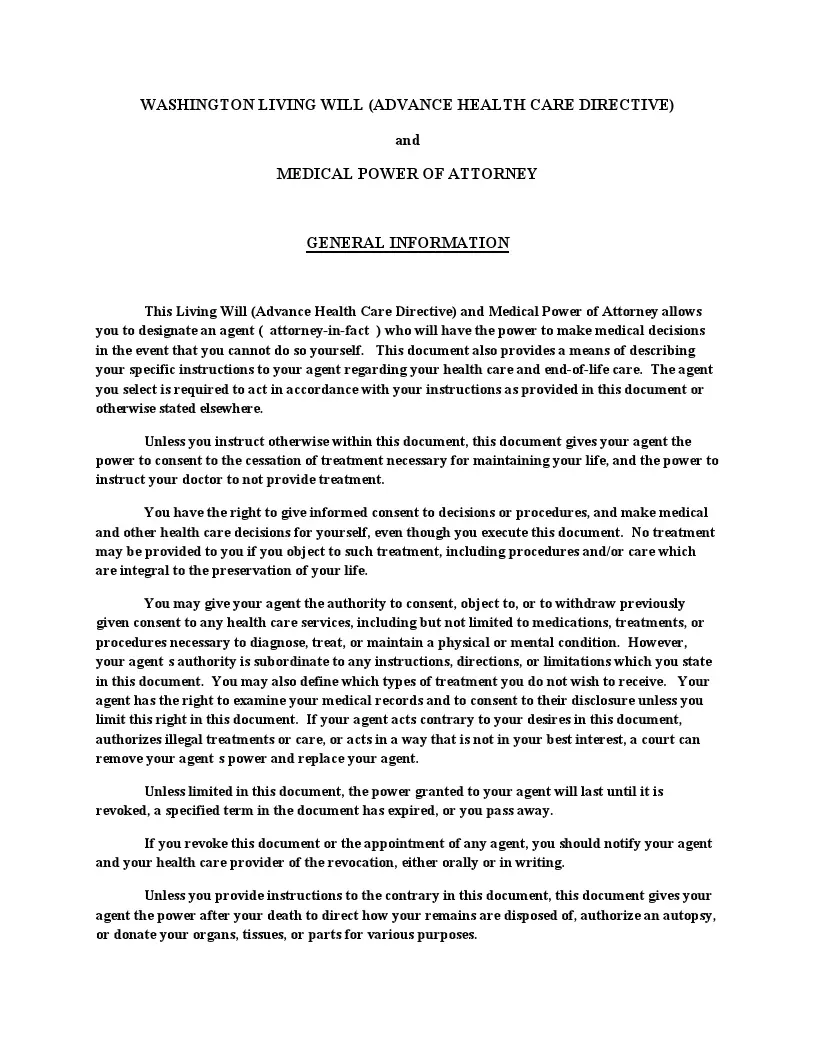
Complete the Washington living will form in eight steps. Fill in the declaration on page 2, initial your health care choices, then name a health care agent and an optional substitute agent. Add any extra instructions, then sign the form in front of two witnesses on page 8.


General information, not legal or tax advice.
