
Free Maryland Living Will Form

A Maryland living will, known under state law as an advance directive for health care, is a written or electronic document.[1.1] It lets a person 18 or older record end-of-life treatment choices and name a health care agent. It is sometimes also called a Health Care Power of Attorney, Medical Power of Attorney, or Health Care Directive.

Last Updated: September 2026. This guide is reviewed and updated regularly to reflect current Maryland law. If you notice an error or outdated information, please contact us.

Maryland living will form preview

Create a free high quality Maryland Living Will online now!

Build Your Document

Answer a few simple questions to make your document in minutes

Save and Print

Save progress and finish on any device, download and print anytime

Sign and Use

Your valid, lawyer-approved document is ready

... or download your Maryland Living Will Form as a  PDF file or   Word file

Even though creating a living will form is more often associated with elderly or seriously ill people, anyone 18 or older should consider making one, since an accident can happen to anyone.

To take effect, a Maryland advance directive must be dated, signed by you (or at your direction), and signed by two witnesses in your presence.[1.2] Store it somewhere safe but easily accessible in case of an emergency.

Signing Requirements and Laws

Maryland's Health Care Decisions Act sets the signing and witnessing rules for a Maryland living will, or advance directive. A written or electronic advance directive must be dated, signed by the declarant or at the declarant's express direction, and subscribed by two witnesses in the declarant's physical or electronic presence.[1.2]

Maryland's own signing rule, quoted directly from the statute below, calls you the declarant.

A written or electronic advance directive shall be dated, signed by or at the express direction of the declarant, and subscribed by two witnesses in the physical presence or electronic presence of the declarant.

Md. Code, Health-Gen. § 5-602

In plain terms, you (or someone signing at your direction) sign and date the document, and two witnesses sign it too, either in person or through an approved electronic presence method.

Maryland law adds two eligibility rules for your witnesses:

  • The health care agent you name in the document may not serve as one of your witnesses.[1.2]
  • At least one witness must be someone who is not knowingly entitled to any portion of your estate, or to any financial benefit because of your death.[1.2]

Two other ways the law allows. An oral advance directive works the same as a written one if you make it in front of your attending physician, physician assistant, or nurse practitioner, plus one witness.[1.2]

The practitioner and the witness must date and sign a note of it in your medical record. Separately, an unwitnessed electronic advance directive, a video or file, may be accepted if it is dated and stored through an electronic advance directive service recognized by the Maryland Health Care Commission.[1.2]

Two witnesses are required for every Maryland advance directive, so plan ahead and choose people who are not your health care agent and who will not inherit from you. Talk with your chosen agent, and any backup agent, before you sign, so they understand your wishes and agree to serve.

Definitions:

  • Artificial Nutrition and Hydration – these are any nutrients, food, or liquids introduced into the patient’s body intravenously or through a feeding tube.
  • Life-Sustaining Treatment – these are procedures and medicines, which are applied to prolong life and the process of dying. The list of such procedures and medications includes antibiotics, lung ventilation, dialysis, cardiopulmonary resuscitation, and transfusions.
  • Permanent Unconscious State – this is a condition in which the patient completely loses consciousness, and the recovery of the patient is not expected shortly. These conditions include irreversible coma and vegetative state.
  • Terminal Condition – it is an incurable disease that inevitably leads to death or a permanently unconscious state, and the recovery of the patient is not expected shortly.

Maryland Living Will Form Details

Document Name Maryland Living Will Form
State Form Name Maryland Advance Directive: Planning for Future Health Care Decisions
Signing Requirements Two Witnesses
Validity Requirements Md. Code, Health-Gen. § 5-602
Avg. Time to Fill Out 13 minutes
# of Fillable Fields 48
Available Formats Adobe PDF, Microsoft Word
State Laws: Md. Code, Health-Gen. §§ 5-602, 5-603 (see citations below)

Maryland law also provides an optional statutory form, the “Maryland Advance Directive: Planning for Future Health Care Decisions” form, under Md. Code, Health-Gen. § 5-603.[1.1] Using that exact form is optional. Any advance directive that meets the state's signing and witnessing requirements is valid, including this one.

Maryland offers several related estate planning documents. A Maryland last will and testament directs how your property is distributed after your death, which a living will does not cover. A Maryland durable power of attorney lets someone manage your finances while you are alive, separate from the health care decisions this document covers, and a Maryland general power of attorney covers similar financial matters on a non-durable basis. A Maryland small estate affidavit can help your family settle a small estate without full probate.

A Maryland living will is different from a MOLST, or Maryland Orders for Life-Sustaining Treatment, form. Your doctor completes and signs a MOLST with you based on your current health, and it is a medical order, not a legal document you fill out on your own. Many people have both: a living will that states their wishes in advance, and a MOLST their doctor uses once those wishes need to guide immediate medical care.
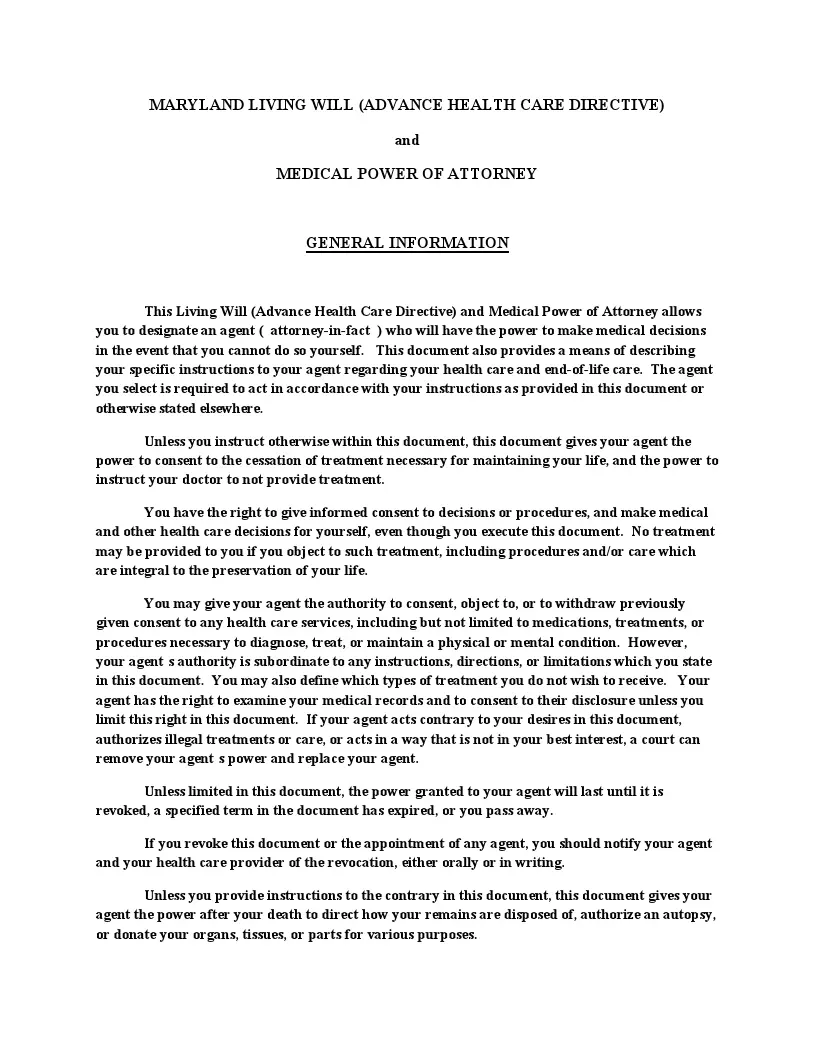

Template Preview
Create a free high quality Maryland Living Will online now!

Steps to Fill Out the Form

Maryland's Living Will (Advance Health Care Directive) and Medical Power of Attorney form runs eight pages and covers your treatment wishes, your health care agent's details, and your signature. Fill it out in the order below, then sign it in front of two witnesses who meet Maryland's eligibility rules.

  1. Fill in the declaration. On page 2, enter the date, your name, and your residence address in the opening declaration paragraph.
    Declaration section of Maryland living will form with date, name and address fields
  2. Initial your health care and end-of-life wishes. On page 2, initial each Maryland medical treatment you want withheld (CPR, nutrition or hydration by tube, a ventilator, dialysis, blood transfusions, organ transplants, or any artificial life-sustaining treatment) and each condition under which you do not want your life artificially extended. Initial only the items that reflect your own wishes, and leave the rest blank.
  3. Add further instructions (optional). On page 3, write any additional health care wishes, or leave this section blank. Use plain language so your agent and your doctors can follow your instructions later.
  4. Name your health care agent. On page 3, enter your agent's full legal name, address, and phone number. Pick someone you trust to carry out your wishes and who is willing to serve.
    Section fo declaring primary agent of living will for Maryland
  5. Name a substitute agent (optional). On page 4, enter the name, address, and phone number of the person who acts if your primary agent cannot. A substitute agent is optional, but naming one avoids a gap if your first choice becomes unavailable.
  6. Review the powers you are granting. Page 4 lists your agent's powers, lettered A through J: hiring health care personnel, accessing your medical records, consenting to or refusing medical care, refusing extreme life-prolonging procedures, refusing nourishment or hydration, authorizing pain relief, deciding on blood transfusions, arranging cremation, burial, or anatomical gifts, signing related documents and contracts, and other personal care decisions.
    Rights and Powers of health care agent review section of Maryland living will template
  7. Review when your agent's power takes effect. Page 6 explains that your agent's authority begins once your attending physician determines you cannot make your own health care decisions. Until that point, you keep full authority over your own health care choices.
  8. Review the HIPAA authorization. Page 6 authorizes your agent to receive your protected health information once their authority takes effect, so your doctors can share records and discuss your care with them.
  9. Review the remaining standard provisions. Pages 7 and 8 cover ratification of your agent's actions, nominating a conservator if one is ever needed, revocation of any prior health care power of attorney, and which state's law governs the document. Read each provision before you sign, since signing confirms you agree to all of them.
  10. Sign and date the form. On page 8, sign and print your name, and enter the date, in front of your two witnesses.[1.2]
    Signing part of Maryland living will document
  11. Have both witnesses complete the acknowledgment. Each witness signs, dates, and provides a phone number in the Witness Acknowledgment on page 8, confirming they watched you sign.[1.2]

Give a signed copy of your living will to your health care agent, your family, and your doctor, and keep the original where it can be found easily. Review it periodically and complete a new one if your wishes change. If you are planning your family's affairs more broadly, see our Maryland power of attorney hub for the full range of POA documents.

Does a Living Will in Maryland Require the Declarant's Signature?

Yes. A Maryland advance directive, written or electronic, must be signed by the declarant, or by someone else at the declarant’s express direction. It must also be dated and subscribed by two witnesses in the declarant's physical or electronic presence.[1.2]


General information, not legal or tax advice.

Sources

  1. Md. Code, Health-Gen. §§ 5-602, 5-603.
    • 1.1 § 5-603 (Maryland advance directive form)
    • 1.2 § 5-602
Published: Jul 17, 2022
Mara Erlach
Mara Erlach
Writer & Attorney
Mara has been practicing estate planning and trust law in California since 2003, taking pride in helping clients of all backgrounds and asset profiles form a complete and customized estate plan. Her specialties are: estate planning, wills and trusts, trust and probate administration.