
An Illinois living will (also called a Declaration) is a written document under the Illinois Living Will Act, 755 ILCS 35. It tells your doctor and family whether to withhold or withdraw life-sustaining procedures. It takes effect only once your attending physician personally examines you and determines you have an incurable and irreversible condition classified as terminal, with death imminent except for those procedures.[1.2] FormsPal’s builder walks you through the Illinois form in minutes, and you can download the finished document as a fillable PDF or Word file.
Last Updated: September 2026. This guide is reviewed and updated regularly to reflect current Illinois law. If you notice an error or outdated information, please contact us.
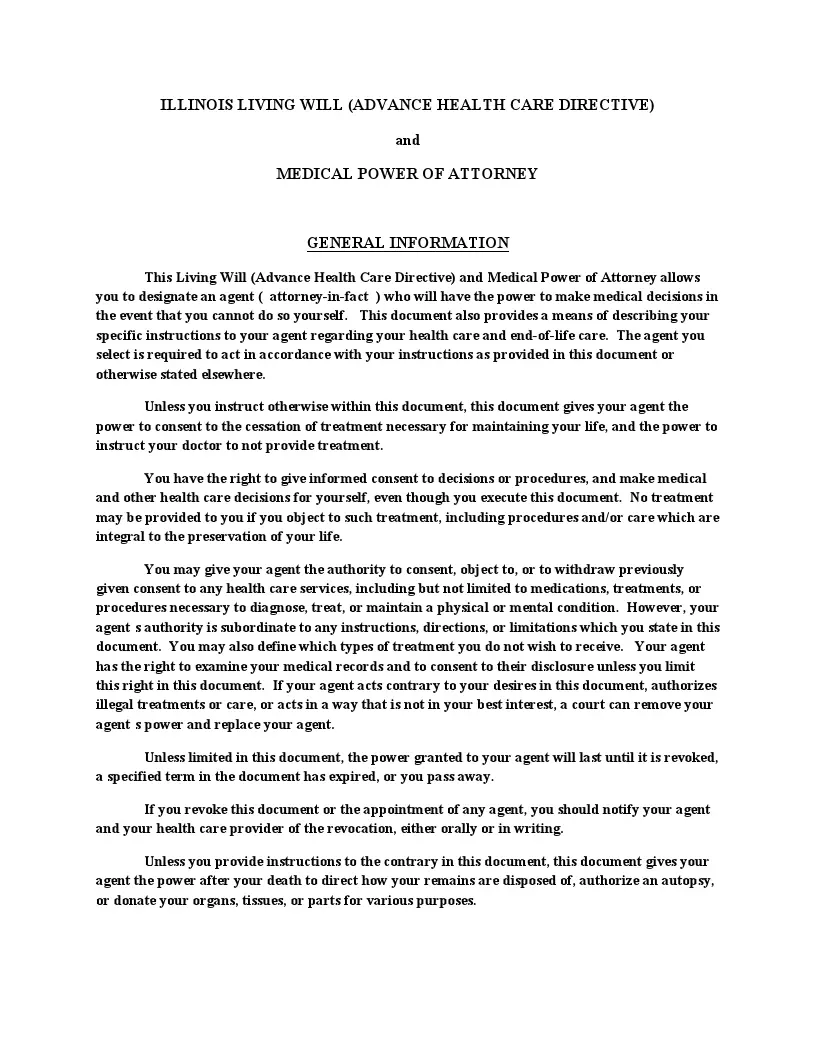
An Illinois living will is a written declaration under 755 ILCS 35 that lets you refuse life-sustaining procedures if you develop a terminal condition and can no longer speak for yourself. The document FormsPal provides combines this declaration with a medical power of attorney. The same form also names a health care agent to make other medical decisions for you. In Illinois, this kind of document is also called an advance directive.[1.2]
FormsPal offers living wills for every state, each one written to match that state’s own law, so a family member in another state can find their own version too.
Illinois law also offers an optional statutory form of the declaration, in 755 ILCS 35/3(e).[1.2] A declaration may follow that wording, but it does not have to.[1.1] FormsPal’s Illinois form already includes the witness attestation language the statute expects, shown below. Signing it in front of two qualifying witnesses satisfies the law without you having to draft your own wording.
A living will only covers end-of-life medical decisions. It is not the same as:
Many people fill out this Illinois form alongside a separate last will so that both medical wishes and property are covered.
Adults of any age can benefit from having a living will on file, not only older adults. An unexpected accident or sudden illness can leave anyone unable to communicate their wishes. Many younger adults complete one at the same time as choosing a health care agent.
If you also have a health care power of attorney, your agent's decisions control while the agent is available to make them (755 ILCS 35/3.5).[1.3]
To make a living will in Illinois, you must be of sound mind. You must also have reached the age of majority, or have obtained the status of an emancipated person under the Emancipation of Minors Act. You sign the declaration yourself, or direct someone else to sign it for you. The declaration is witnessed by two individuals who are 18 years of age or older.[1.1]
Your witnesses cannot be:[1.1]
Each witness signs a written statement, printed on the form itself, confirming what they observed:
“The declarant is personally known to me and I believe him or her to be of sound mind. I saw the declarant sign the declaration in my presence (or the declarant acknowledged in my presence that he or she had signed the declaration) and I signed the declaration as a witness in the presence of the declarant. I did not sign the declarant’s signature above for or at the direction of the declarant. At the date of this instrument, I am not entitled to any portion of the estate of the declarant according to the laws of intestate succession or, to the best of my knowledge and belief, under any will of declarant or other instrument taking effect at declarant’s death, or directly financially responsible for declarant’s medical care.”
In practice, most people also tell close relatives and their doctor that the declaration exists so it reaches their medical file before it is needed.
Your instructions take effect only once your attending physician personally examines you. The physician must determine you have an incurable and irreversible injury, disease, or illness classified as a terminal condition, with death imminent except for life-sustaining treatment. At that point, procedures that would only prolong dying may be withheld or withdrawn, and you may still receive comfort care such as pain medication.[1.2]
In practice, if a doctor is unwilling to follow your declaration, many people ask for a referral to another provider who will honor it.
Your living will operates only when it was validly signed and not revoked, you cannot give directions yourself, and your attending physician has verified a terminal condition (755 ILCS 35/9.5). It has no force during a pregnancy while the fetus could develop to live birth (755 ILCS 35/3(c)), and your own wishes always take priority over it (755 ILCS 35/7).[1.5]
A physician who is unwilling to follow your living will must say so promptly and, if you cannot arrange it yourself, notify the person with priority to act for you so that you can be transferred (755 ILCS 35/3(d) and 35/6). A physician who willfully fails to do this faces civil liability and professional discipline (755 ILCS 35/8).[1.4]
Most declarations that do not hold up fail for a signing mistake, not a wording problem. Check every signature line before you rely on the document, and keep the witness role separate from your health care agent’s role.
| Document Name | Illinois Living Will Form |
| State Form Name | Illinois Living Will Act |
| Signing Requirements | Two Witnesses |
| Validity Requirements | 755 ILCS 35/3[1.1] |
| Avg. Time to Fill Out | 13 minutes |
| # of Fillable Fields | 48 |
| Available Formats | Adobe PDF; Microsoft Word |
| State Laws: Illinois Compiled Statutes, 755 ILCS 35/3[1.1] | |
Popular Local Living Will Forms
The Illinois form FormsPal provides combines a living will with a medical power of attorney. Fill it out in this order, using either the PDF or our online builder. Then sign it in front of two witnesses.


Keep the signed original where your health care agent and doctor can find it, and give copies to your agent, your substitute agent, and your doctor. Hospitals commonly ask for a copy at admission, so keeping one with your other medical records saves time later.
If your wishes change, most people fill out a new declaration and destroy the old copies, then hand out the new signed copies the same way.
Review the document again whenever your health changes in a major way, or every few years. That way it keeps reflecting what you actually want and who you trust to carry it out.

General information, not legal or tax advice.
