
An Illinois prenuptial agreement is a written contract between two people who plan to marry. Illinois law defines it as an agreement between prospective spouses made in contemplation of marriage and to be effective upon marriage.[1.1] It sets out who owns what, how property and debt are handled, and whether either spouse can claim support if the marriage ends.
Last Updated: September 2026 - This guide is reviewed and updated regularly to reflect current Illinois law. If you notice an error or outdated information, please contact us.
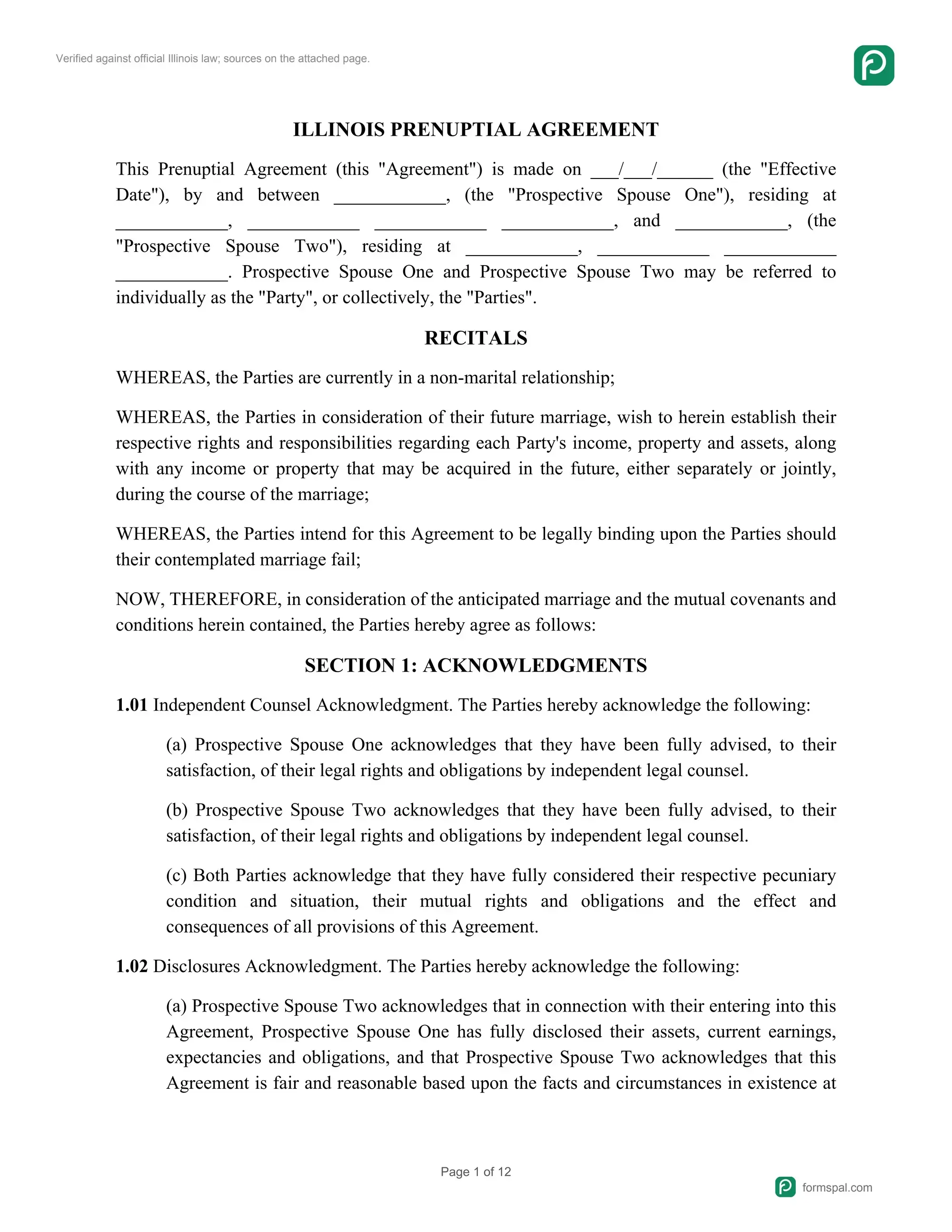
Build Your Document
Answer a few simple questions to make your document in minutes
Save and Print
Save progress and finish on any device, download and print anytime
Sign and Use
Your valid, lawyer-approved document is ready
The state calls this document a premarital agreement and governs it under the Illinois Uniform Premarital Agreement Act, 750 ILCS 10. It must be in writing and signed by both parties.[1.2] It cannot reduce a child's right to support.[1.3]
Illinois statutes use the term premarital agreement. Most couples say prenup. Both names describe the same contract.
A prenup is optional in Illinois. Couples use a prenuptial agreement template to record how assets, debts, taxes and support will be handled if the marriage ends, before those questions become contested.
Illinois sets two formal requirements and no more: put the agreement in writing, and have both spouses sign it before the wedding.[1.2] Everything else is practical work. The process below takes a couple from the first conversation to a signed agreement that is hard to challenge later.
Notarization is not required in Illinois. Section 750 ILCS 10/3 asks only for a written agreement signed by both parties.[1.2] Some states do require a notary or witnesses. Illinois does not, although signing in front of a notary is still common, because it makes the signatures easier to prove later.
Popular Local Prenuptial Agreement Forms
Illinois prenup laws sit in the Illinois Uniform Premarital Agreement Act at 750 ILCS 10. The Act sets the signing formalities and lists the subjects a couple may settle in advance. It also gives the grounds on which a court can refuse to enforce what they signed. The sections below follow that order.
A premarital agreement must be in writing and signed by both parties. Those are the only formalities the statute imposes. It is enforceable without consideration, so neither spouse has to pay or transfer anything to make the contract binding.[1.2] Notarization and witnessing are not compulsory in Illinois.
A premarital agreement becomes effective upon marriage.[1.4] Signing it changes nothing by itself, and if the wedding never happens the agreement never takes effect. If a marriage is later determined to be void, the agreement is enforceable only to the extent necessary to avoid an inequitable result.[1.7]
After marriage, a premarital agreement may be amended or revoked only by a written agreement signed by the parties.[1.5] A spoken promise to change a term does not count, and neither does one spouse signing alone. The statute of limitations on a claim under the agreement is tolled during the marriage.[1.8]
Section 750 ILCS 10/7 sets out the grounds. The spouse resisting the agreement has to prove one of the following.
An issue of unconscionability is decided by the court as a matter of law.[1.6]
Section 750 ILCS 10/4 lists what prospective spouses may agree on. It reaches property owned before and during the marriage, how that property is managed, what happens to it on separation, divorce or death, spousal support, and the law that governs the contract.[1.3] The full list follows.
Most challenges to prenuptial agreements do not argue about the wording of a clause. They argue that one spouse was rushed, or kept in the dark about the other's assets, or handed a deal so one-sided that no court should honor it. The mistakes below map onto the statutory grounds in Section 750 ILCS 10/7.[1.6]

It is a contract between two prospective spouses, made in contemplation of marriage and effective upon marriage.[1.1] The word prospective matters. Two people who are already married cannot make one, because the contract is defined by the marriage it precedes. Illinois law gives the document this exact meaning.
"Premarital agreement" means an agreement between prospective spouses made in contemplation of marriage and to be effective upon marriage.
Two limits hold whatever the document says. The right of a child to support may not be adversely affected by a premarital agreement.[1.3] A waiver of spousal support also has a floor. If that waiver causes one spouse undue hardship, and the cause was not reasonably foreseeable when the agreement was signed, a court may order support anyway.[1.6]
Child support and parenting arrangements are decided by the court at the time of the divorce, on the facts as they stand then.
Yes. Illinois enforces a premarital agreement that is in writing and signed by both parties.[1.2] A court sets one aside only in limited circumstances. The challenging spouse must prove they did not execute it voluntarily. The other route is proving the agreement was unconscionable when signed and that they were denied a fair and reasonable disclosure of the other spouse's property or financial obligations.[1.6]
Yes. No Illinois law requires an attorney to draft or sign a prenup. The Act asks only that the agreement be in writing and signed by both parties, and it is enforceable without consideration.[1.2] The risk in writing your own is the content, not the format. A thin financial disclosure is one of the legal grounds a spouse can later use to challenge the agreement. Couples with a business, a trust, or property in another state usually get an attorney involved.[1.6]
The Act prescribes no list of required clauses. It requires the writing and both signatures, and leaves the content to the couple.[1.2] In practice the document should identify both parties and state that it is made in contemplation of marriage. It should attach each spouse's financial disclosure and set out how property, debt and spousal support will be handled.
Other Prenuptial Agreement Forms by State
