
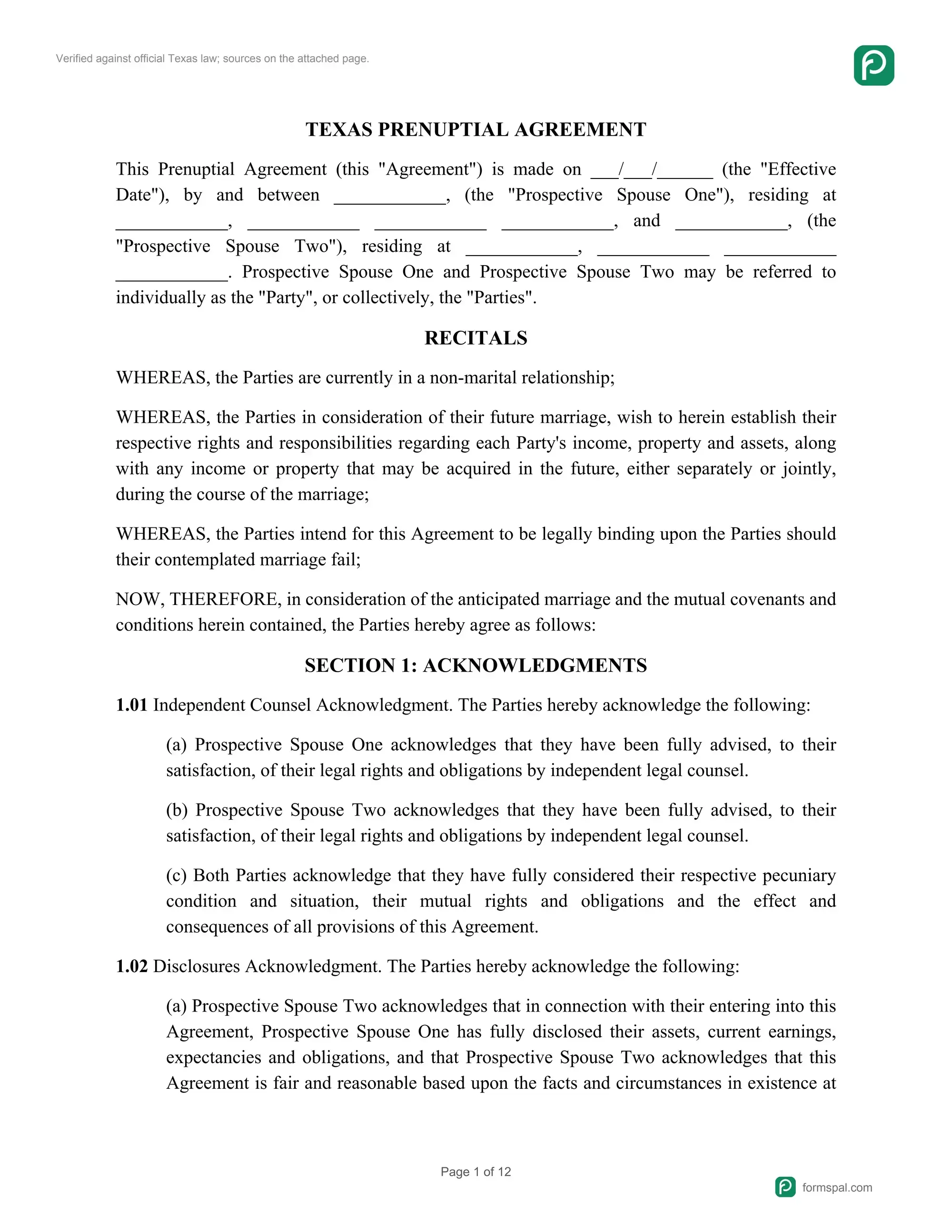
A Texas prenuptial agreement is a written contract that two people sign before they marry, and it takes effect on the day the marriage happens. Texas law calls it a premarital agreement. It fixes each spouse's rights in property, sets what happens to that property on divorce or death, and can modify or eliminate spousal support.[1.3]
Last Updated: September 2026. This guide is reviewed and updated regularly to reflect current Texas law. If you notice an error or outdated information, please contact us.
Build Your Document
Answer a few simple questions to make your document in minutes
Save and Print
Save progress and finish on any device, download and print anytime
Sign and Use
Your valid, lawyer-approved document is ready
A prenup cannot reduce a child's right to support, and it cannot contain terms that violate public policy or a criminal statute. You can build one from our prenuptial agreement template.
Chapter 4 of the Texas Family Code governs every prenuptial agreement signed in this state. It defines the agreement as one made between prospective spouses in contemplation of marriage, to be effective on marriage. The same chapter sets the signing formalities, lists what the couple may agree to, and names the only grounds a court may use to refuse enforcement.[1.1]
Forming a Texas prenuptial agreement takes very little. It must be in writing and signed by both parties, and it is enforceable without consideration.[1.2] Section 4.002 asks for nothing else:
A premarital agreement must be in writing and signed by both parties. The agreement is enforceable without consideration.
Some states require witnesses or a waiting period. Texas does not require a notary, witnesses or a waiting period: the agreement only has to be in writing and signed by both parties (Tex. Fam. Code § 4.002).[1.2] Many couples still notarize their signatures as simple proof of who signed and when.
A premarital agreement becomes effective on marriage, so signing it changes nothing until the wedding takes place.[1.4] After the marriage, the parties may amend or revoke it only by a written agreement that both of them sign.[1.5] That later agreement is usually called a postnuptial agreement.
Popular Local Prenuptial Agreement Forms
Texas is a community property state. Property that either spouse possesses during the marriage, or when the marriage ends, is presumed to be community property. Proving that a given asset is separate takes clear and convincing evidence. Separate property is what a spouse owned before marriage, plus anything received during marriage by gift, will, or inheritance.[2]
A prenup matters here because it lets the couple decide in advance which assets stay separate and which become marital property, instead of leaving that to the presumption.
Section 4.003 of the Tex. Fam. Code lists what prospective spouses may put in the agreement. The list reaches property either of them already owns and property either of them acquires later, wherever it is located.[1.3] A Texas prenup may set:
Two limits sit outside the couple's control. A premarital agreement may not adversely affect a child's right to support.[1.3] Sections 4.001 to 4.008 do not mention custody or visitation. In practice, couples leave both out of a prenup, because a Texas court decides them at the time of the divorce with the child's best interest in mind.
Yes. Chapter 4 requires a written agreement signed by both parties and nothing else, so it does not require a lawyer, a notary, or a witness. Using a template keeps the structure and the required terms in place. The risk in a do-it-yourself prenup is not the drafting, it is the disclosure.[1.2]
Exchange a written list of your assets, debts, and income before either of you signs, and attach it to the agreement. A missing financial disclosure is half of the only test that lets a Texas court refuse to enforce a prenup.
A workable order of steps:
Get legal advice from a family law attorney in three situations. One of you owns a business, either of you has children from an earlier marriage, or the estates differ sharply in size.

A Texas court will refuse to enforce a prenuptial agreement in only two situations. The first is that the spouse resisting it did not sign it voluntarily. The second is that the agreement was unconscionable when it was signed and three separate disclosure failures all occurred before signing. That spouse carries the burden of proving whichever ground is claimed.[1.6]
Unconscionable terms on their own are not enough. All three of these must also be true of the spouse resisting the agreement:
A void marriage is handled separately. If a court determines the marriage was void, the agreement is enforceable only to the extent needed to avoid an inequitable result.[1.7]
Yes. Texas courts enforce prenuptial agreements that meet the chapter 4 formalities, and the statute narrows the ways one can be attacked. The remedies and defenses in section 4.006 are the exclusive ones, including common law remedies and defenses. A spouse cannot fall back on a general contract argument the chapter does not list.[1.6]
Two more rules shape how a challenge plays out. Unconscionability is decided by the court as a matter of law, not by a jury.[1.6] A statute of limitations on a claim under the agreement is also tolled while the parties are married, so the clock does not run during the marriage.[1.8]
Other Prenuptial Agreement Forms by State
