
A California prenuptial agreement is a written contract that two people sign before they marry to set the rules for their property and spousal support if the marriage ends through separation, divorce, or death. It cannot limit a child's right to support.[1]
Last Updated: September 2026. This guide to prenuptial agreements was checked against the family law sections listed under Sources.
Build Your Document
Answer a few simple questions to make your document in minutes
Save and Print
Save progress and finish on any device, download and print anytime
Sign and Use
Your valid, lawyer-approved document is ready
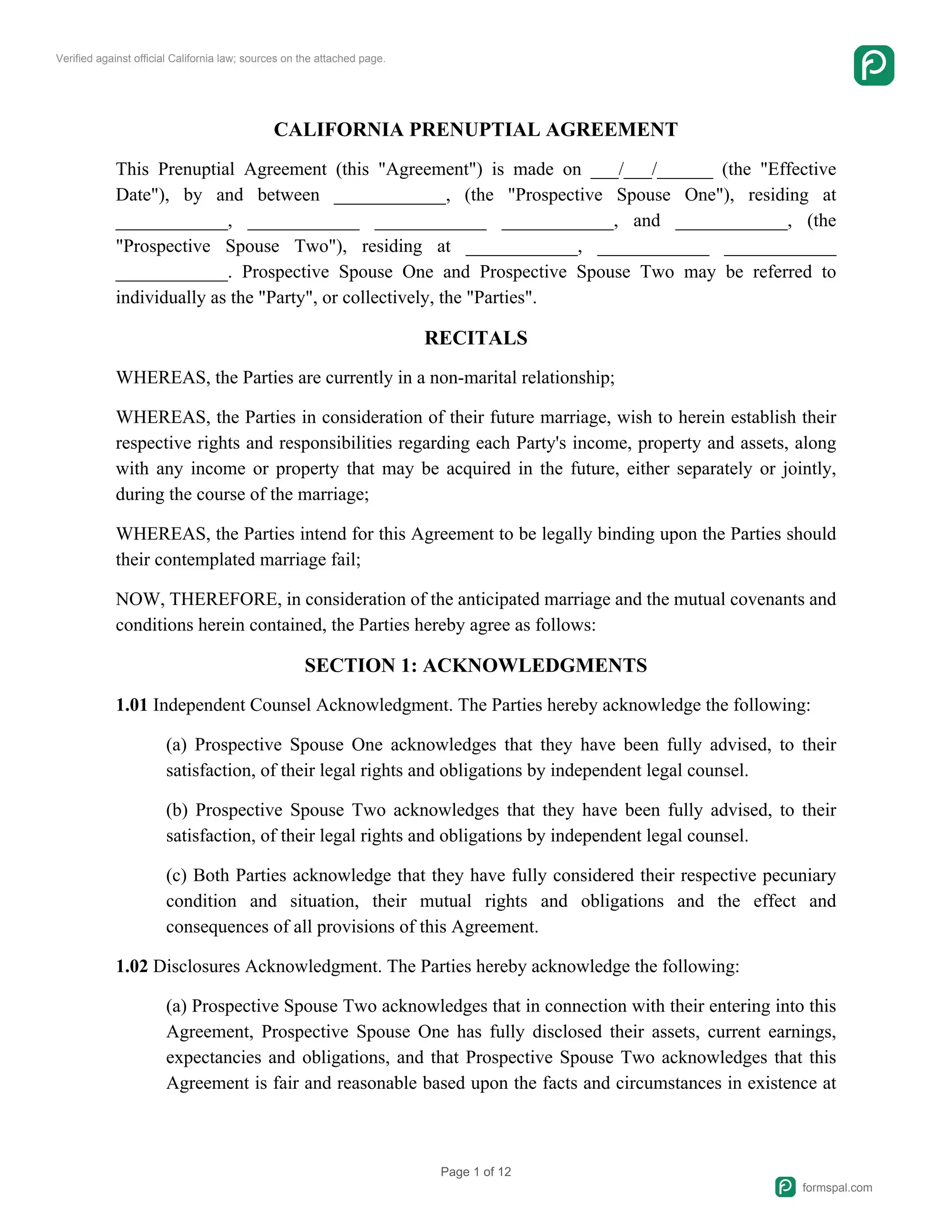
You can build one with our prenuptial agreement template or start from the file above in PDF, Word, or OpenDocument format.
State family law sets the requirements for prenuptial agreements in Sections 1610 to 1617. Those sections cover how the contract must be signed, what it may include, when it takes effect at marriage, and the grounds a court can use to refuse enforcement.
A premarital agreement must be in writing and signed by both parties. It is enforceable without consideration, so neither spouse has to give money or property in exchange for the other's signature.[3] The law does not require a notary or witnesses.
These rules control when prenups start and how they can change:
Couples who did not sign before marriage can sign a postnuptial agreement instead.
Popular Local Prenuptial Agreement Forms
Prenups can cover property rights, debts, business interests, estate planning, life insurance, and any other matter, including personal rights and obligations, that does not violate public policy or a statute imposing a criminal penalty. Section 1612 lets the spouses address these subjects:[1]
A premarital agreement cannot adversely affect a child's right to support.[1] Child custody is also left to the family court, which decides it based on the child's best interests when the parents separate or divorce.
Prenuptial agreements can include spousal support terms, including a full waiver of support. A spousal support provision is not enforceable if the spouse it is used against had no independent counsel when the prenup was signed. It is also unenforceable if the provision is unconscionable at the time of enforcement.[1]
California is a community property state. Without a prenup, assets and debts acquired during the marriage are generally subject to equal division at divorce. Prenuptial agreements let spouses decide in advance which property stays separate and which becomes community property, including a business started during the marriage.[1]
The process for making a prenup has four parts: full financial disclosure, drafting the terms, time to review the final version, and signatures from both parties. Couples who skip a step give the other spouse grounds to challenge the prenup if the marriage ends in divorce.[7]
Courts enforce prenuptial agreements unless the spouse challenging one proves one of two grounds. They must show they did not sign voluntarily, or that the prenup was unconscionable when signed and they lacked fair financial disclosure.[7]
A family court can invalidate a prenup on these grounds:[7]
An issue of unconscionability is decided by the court as a matter of law.[7]
A void marriage changes the result. If the marriage is declared void, the prenup is enforceable only to the extent necessary to avoid an inequitable result.[8]

The 7-day rule requires at least seven calendar days between the time a party is first presented with the final version of a prenup and the time that party signs it. The rule applies to prenuptial agreements signed on or after January 1, 2020, whether or not they have an attorney.[7]
For an agreement executed on or after January 1, 2020, the party against whom enforcement is sought had not less than seven calendar days between the time that party was first presented with the final agreement and the time the agreement was signed, regardless of whether the party is represented by legal counsel.
If the rule is not met, a court treats the signing as involuntary, and an involuntary contract is not enforceable.[7]
Yes. State law lets couples write their own prenups without hiring family law attorneys. But a spouse who signs without a lawyer must waive legal counsel in a separate writing and be fully informed of the rights being given up.[7]
For a spouse who signs without legal counsel, a court deems the contract involuntary unless it finds in writing or on the record that the spouse:[7]
Other Prenuptial Agreement Forms by State
Unless noted otherwise, the sections below are from the California Family Code, published by the California Legislative Information.
