
A California Living Will is also called an Advanced Healthcare Directive. Normally, you can explain to your doctor which procedures you approve or disapprove of, which you want to avoid. California Living Will Form is issued for the circumstances when you can no longer personally take care of your health treatment.
Last Updated: September 2026. This guide is reviewed and updated regularly to reflect current California law. If you notice an error or outdated information, please contact us.
With a living will form, you can resolve two important matters. You can name an agent, someone you trust who can take responsibility for making medical decisions for you, and you can state your wishes for health care and for organ or body donation after death. If desired, you can limit the powers of your trusted person.
A California living will must be dated and signed to take effect, and it must be signed by two qualified witnesses or acknowledged before a notary public. California law also provides a combined statutory form that pairs a power of attorney for health care with specific care instructions.[2]
You must date and sign the form and have it signed by two competent witnesses or acknowledged before a notary public.[2]
Each witness must be an adult. People connected to your medical care cannot serve as a witness.[1] The excluded people are:
Aside from those restrictions, most adults you know can serve as a witness.
One witness must be independent. At least one of your two witnesses cannot be related to you by blood, marriage, or adoption, and cannot be entitled to any part of your estate under a will that exists when you sign or under state law.[1] This rule applies only when you use two witnesses. It does not apply if you choose notarization instead.
After signing, give a signed copy of the form to your physician and to any other health care providers you use. Also give a copy to any health care institution where you receive care, and to any health care agent you have named.
Each witness signs a declaration under penalty of perjury. The declaration confirms that you signed or acknowledged the form in the witness's presence, and that you appeared to be of sound mind and free from duress, fraud, or undue influence. It also confirms that the witness is not your named agent or a person excluded above. The witness meeting the independence rule also declares that they are not related to you and do not stand to inherit from you.[1]
I declare under penalty of perjury under the laws of California that the individual who signed or acknowledged this advance health care directive is personally known to me, or that the individual's identity was proven to me by convincing evidence, that the individual signed or acknowledged this advance directive in my presence, that the individual appears to be of sound mind and under no duress, fraud, or undue influence, that I am not a person appointed as agent by this advance directive, and that I am not the individual's health care provider, an employee of the individual's health care provider, the operator of a community care facility, an employee of an operator of a community care facility, the operator of a residential care facility for the elderly, nor an employee of an operator of a residential care facility for the elderly.
If you live in a skilled nursing facility, a patient advocate or ombudsman designated by the State Department of Aging must sign as one of your witnesses (Cal. Prob. Code § 4675, as set out in the statutory form in § 4701).[2]
| Document Name | California Living Will Form |
| State Form Name | California Advance Health Care Directive |
| Signing Requirements | Two Witnesses or Notary Public |
| Avg. Time to Fill Out | 13 minutes |
| # of Fillable Fields | 48 |
| Available Formats | Adobe PDF; Microsoft Word |
| State Laws: California Probate Code §§ 4674[1] and 4701[2] (see Sources below) | |
A few mistakes can undo an otherwise valid living will, and each one traces back to the signing and witness rules already covered above. Choosing an ineligible person, skipping a required signer, or leaving a date blank can each cause a problem. Review the list below before you sign.
Filling out a California living will means working through five parts of the statutory form. Those parts are your declaration, your health care agent, that agent's authority, your end-of-life and organ-donation choices, and your signature. The steps below walk through each part in order, using our online builder, or download a blank copy to fill out by hand.


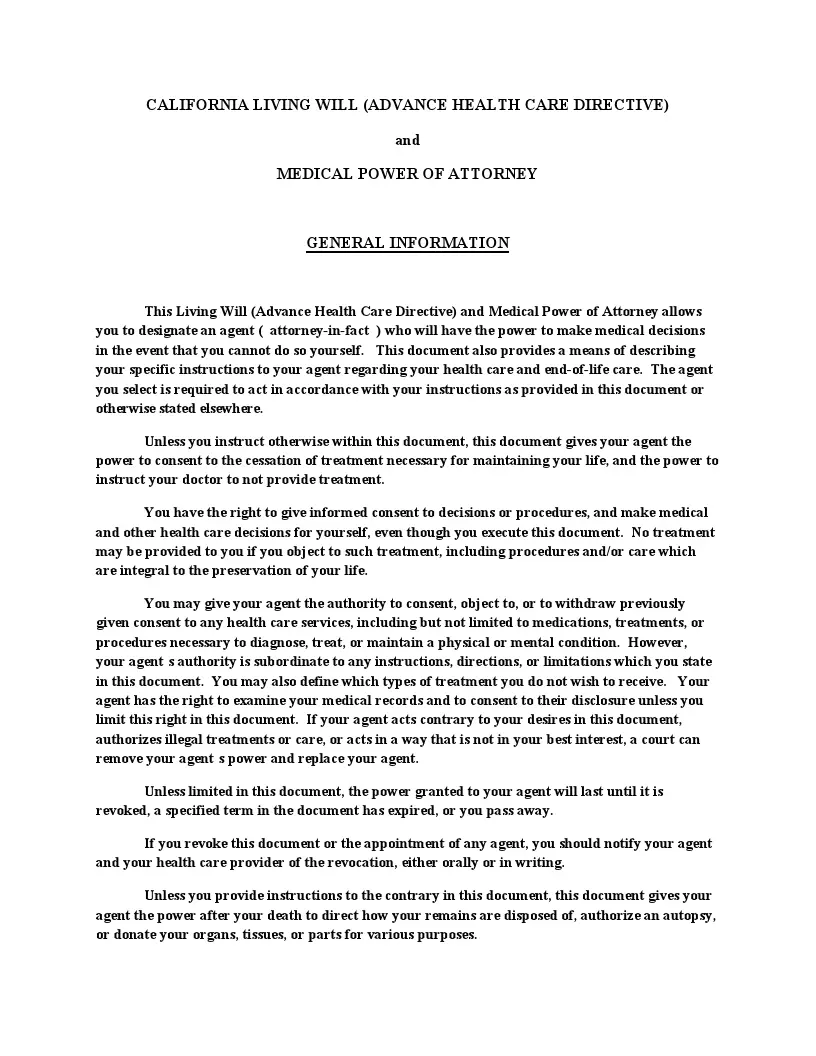
A California living will, also called an advance health care directive, is a written legal document that records your health care wishes in advance. It lets you name an agent to make medical decisions for you if you cannot make them yourself, and it becomes valid once you date it, sign it, and have it signed by two qualified witnesses or a notary public.[2]
To create a California living will, write your health care wishes and, if you choose, name a health care agent on the statutory form, then date and sign it.[2] The form takes effect once two qualified witnesses sign the declaration described above, or once a notary public acknowledges your signature instead.[1]
General information, not legal or tax advice.
Unless noted otherwise, the sources below are from the California Probate Code, published by the California Legislative Information.
