
A Tennessee living will is a written advance directive. It lets you set out, in advance, the medical care you want or want to refuse if illness or injury leaves you unable to communicate your wishes. It lets you name a health care agent, list the treatments you accept or refuse, and record your wishes on organ donation.
Last Updated: September 2026. This guide is reviewed and updated regularly to reflect current Tennessee law. If you notice an error or outdated information, please contact us.
This document is different from a last will, which only controls property after death, and from a financial power of attorney, which covers money and property rather than medical care. Anyone who wants their treatment wishes followed if they cannot speak for themselves can complete one. It is worth having before a serious illness or an accident makes it urgent.
Under Tennessee Code Annotated section 68-11-1803, your advance directive must be in writing and signed by you, the principal. It must then also be either notarized or witnessed by two people.[1] This applies whether your document names a health care agent, lists treatment choices, or does both, the same writing and signing rule covers the whole declaration.
The advance directive must either be notarized or witnessed by two (2) witnesses.
Tennessee sets rules for who can act as a witness. A witness must be a competent adult, and cannot be the person you name as your health care agent. At least one of your two witnesses cannot be related to you by blood, marriage, or adoption, and cannot be in line to inherit any part of your estate.[1]
The witnesses do more than sign their names. Tennessee law requires the document to include an attestation clause, a statement the witnesses sign that confirms they meet the requirements above.[1]
You may revoke a declaration at any time, whatever your mental state or competency, by a written revocation that you date and sign, or by an oral statement to your attending physician (Tenn. Code Ann. § 32-11-106).[1]
Tennessee's Right to Natural Death Act declares your right to accept, refuse, withdraw from or otherwise control decisions about your own medical care (Tenn. Code Ann. § 32-11-102(a)) and lets you state your wishes on organ donation (§ 32-11-103(4)).[1]
| Document Name | Tennessee Living Will Form |
| State Form Name | Tennessee Advance Directive for Health Care |
| Signing Requirements | Notarized or Two Witnesses |
| Avg. Time to Fill Out | 13 minutes |
| # of Fillable Fields | 48 |
| Available Formats | Adobe PDF; Microsoft Word |
| State Laws: Tenn. Code Ann. § 68-11-1803 | |
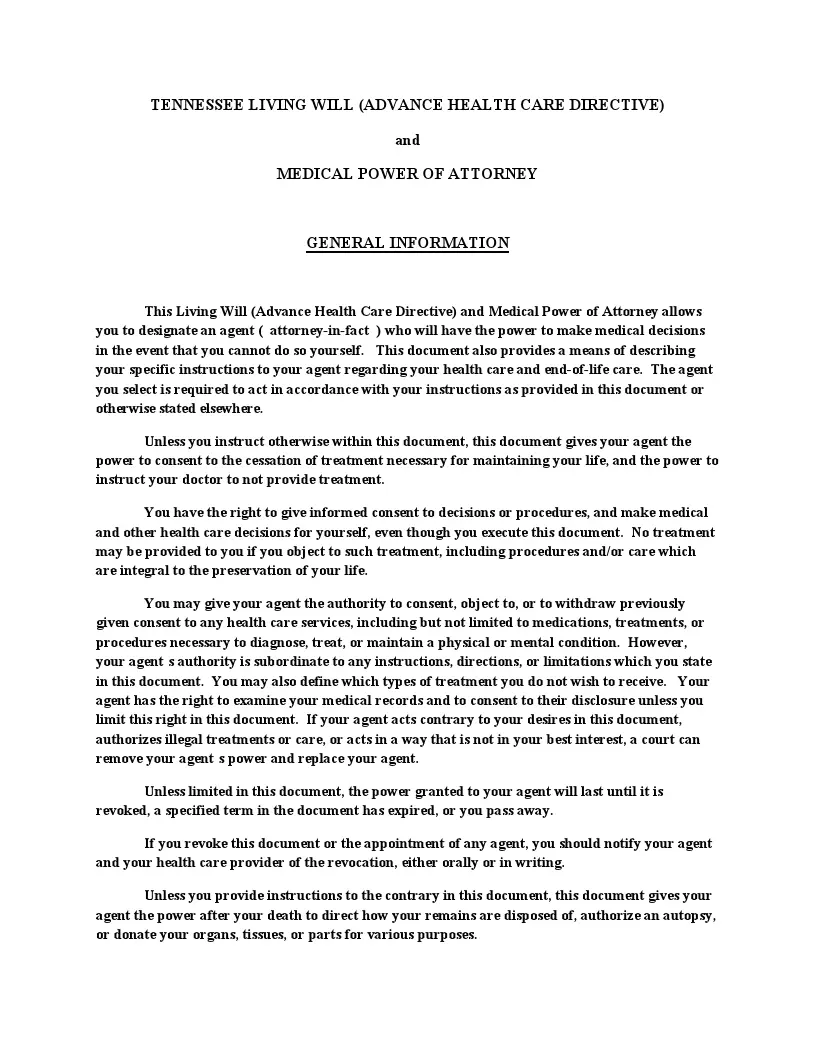
This form has 48 fillable fields across a declaration, a health care agent section, and a signing page. Follow the form in this order to fill it out correctly the first time. Each step below matches a specific part of the PDF, so you can work through the document from start to finish without missing a page.
1. Complete the declaration
Fill in the date, your full name, and your address at the top of the declaration.
2. Initial the treatments you refuse
Initial each treatment you do not want:

3. Initial the conditions under End-of-Life Care
Initial the conditions under which you do not want life-sustaining treatment continued. This is where you describe the point at which you would rather be allowed to die naturally than be kept alive by machines.

4. Add Additional Instructions if you have any
This section is optional. Write any further wishes here, or leave it blank.

5. Name your health care agent
Enter the name, address, and phone number of the person you want making medical decisions for you if you cannot make them yourself.

6. Name a substitute agent
Enter the name, address, and phone number of a backup agent in case your first choice is unavailable.
7. Review the powers you are granting
Read through the list of powers your agent will have. No entries are needed here, this section only explains what your agent can do on your behalf. It is worth reading closely so there are no surprises about how much authority your agent holds once the form takes effect.
8. Sign and date the declaration
Sign and date the form, and print your name, in the block near the end of the document.

9. Have two witnesses sign, or have the form notarized
Either have two qualified witnesses print their names and addresses and sign the witness acknowledgment, or take the form to a notary instead.
Give a copy of your signed living will to your attending physician or other concerned health care provider, who must make it part of your medical record (Tenn. Code Ann. § 32-11-104(b)). Keeping a copy yourself and giving one to a trusted person is good practice.[1]
Your health care agent is the person who will make medical decisions for you if you cannot make them yourself, so choose someone who understands your wishes and is willing to follow them even under pressure from family members. Your agent cannot be one of your two witnesses.[1]
A spouse, adult child, sibling, or close friend can usually serve. Talk with your chosen agent before you sign, walk them through the choices you made on the form, and give them a copy once it is complete. You can change your agent at any time by completing a new declaration.
The form also has room for a substitute agent, someone who steps in only if your first choice is unavailable or unwilling to serve. Naming a substitute means your wishes still have someone to carry them out if your first choice cannot be reached.

Once your Tennessee living will is complete and witnessed or notarized, it only helps you if the right people can find it when it matters. It is common practice to give a copy to your primary doctor's office and to the person you named as your health care agent, and to keep the original somewhere your family knows to look. Many people also review the document every few years, or after a major health change, to make sure it still reflects their wishes.
No. Tennessee law gives you a choice, your document is valid once it is either notarized or signed by two witnesses.[1] You do not need both. Some people pick whichever is easier to arrange, a notary at a bank or shipping store, or two adults who meet the requirements above. Either option carries the same legal weight, so pick whichever is more convenient for you and the people helping you complete the form.
General information, not legal or tax advice.
