
Free Pennsylvania Living Will Form

A Pennsylvania living will is a written document that lets a person state, in advance, whether they want life-sustaining treatment if they become permanently unconscious or have an end-stage medical condition. It is part of Pennsylvania’s Advance Directive for Health Care.

Last Updated: September 2026. This guide is reviewed and updated regularly to reflect current Pennsylvania law. If you notice an error or outdated information, please contact us.
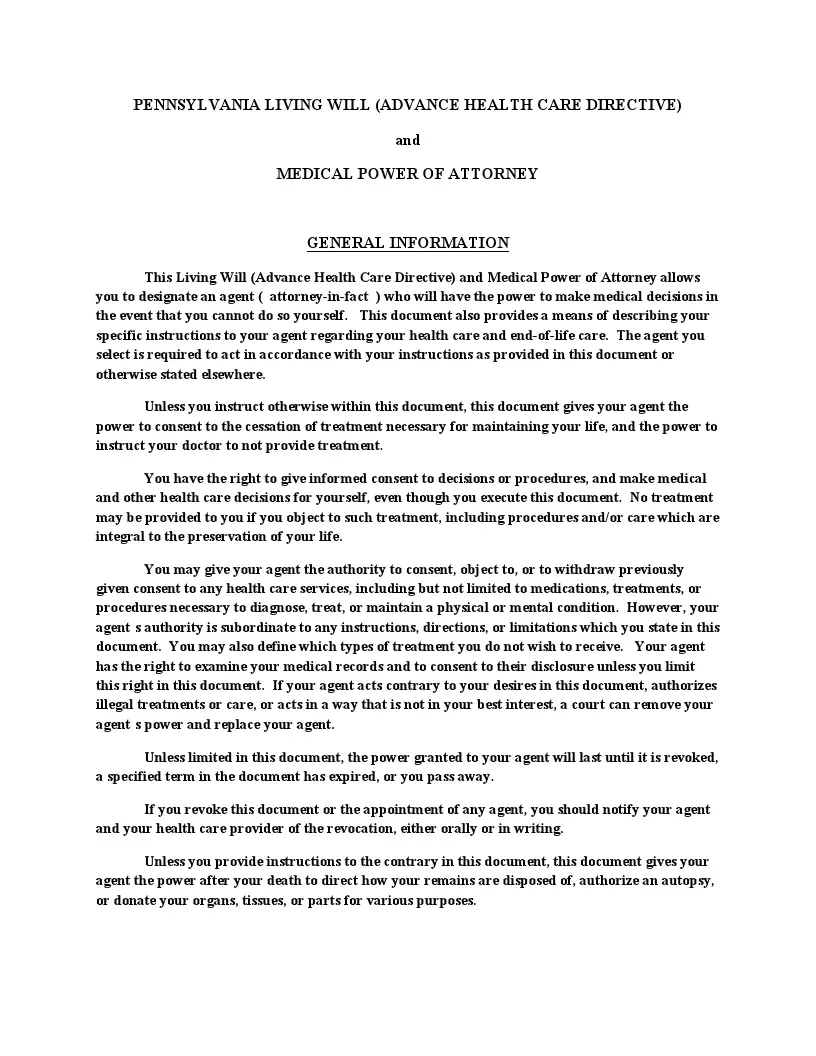
Pennsylvania living will form preview

Create a free high quality Pennsylvania Living Will online now!

Build Your Document

Answer a few simple questions to make your document in minutes

Save and Print

Save progress and finish on any device, download and print anytime

Sign and Use

Your valid, lawyer-approved document is ready

... or download your Pennsylvania Living Will Form as a  PDF file or   Word file

In Pennsylvania, the living will is usually combined with a Health Care Power of Attorney into one statutory form, so the person named as agent can also make medical decisions if the principal cannot.[2]

In Pennsylvania, the declarant chooses the relevant medical measures and defines his or her preferences in the Living Will. According to Part III of the Pennsylvania Advance Directive, the patient provides an agreement to or refusal of the following measures:

  • Medical therapy to relieve pain and provide comfort, though such medical strategies may cause habit-forming, difficulty of respiration, or shorten life.
  • Life-prolonging practices, including Cardiopulmonary Resuscitation (CPR), defibrillation, artificial ventilation, dialysis, surgery, chemotherapy, radiation treatment, and antibiotics.
  • The form allows the patient to indicate whether one agrees to tube feeding, which comprises artificial nutrition and hydration.
  • Making organ gifts
  • Instruct and grant access to a health care agent to execute the principal’s wishes.

Signing Requirements and Laws

Before creating a Pennsylvania living will, the document must meet the formalities set out in 20 Pa.C.S. Section 5442.[1] The rules below explain each requirement, including who must sign it and who may not serve as a witness.

  • The principal must sign the living will, either personally or by mark. If the principal cannot sign, another person may sign on the principal’s behalf and at the principal’s direction.[1]
  • A healthcare provider, or an agent of a healthcare provider, cannot sign the living will on the principal’s behalf if that provider or agent gives healthcare services to the principal.[1]
  • The living will is not valid unless two witnesses, each 18 years of age or older, sign it. A person who signs the document on the principal’s behalf cannot also serve as one of the two witnesses.[1]

Choose witnesses carefully. Many people avoid naming a witness who is a relative or who works for their healthcare provider, though only the rule above is required by statute.

If you are pregnant, a decision to withhold or withdraw life-sustaining treatment, including nutrition and hydration, may not be carried out unless your attending physician and an obstetrician certify that the treatment would not allow the continuing development and live birth of the unborn child, would be physically harmful to you, or would cause you pain that cannot be relieved by medication (20 Pa.C.S. § 5471 statutory form).[2]

You may revoke your living will at any time and in any manner, whatever your mental or physical condition. The revocation takes effect when you, or a witness to it, communicate it to your attending physician or other provider (20 Pa.C.S. § 5444).[1]

You may make a living will if you are of sound mind and meet any one of these: you are 18 or older, you have graduated from high school, you have married, or you are an emancipated minor (20 Pa.C.S. § 5442(a)).[1]

Your living will becomes operative once a copy is given to your attending physician and the physician determines that you are incompetent and have an end-stage medical condition or are permanently unconscious (20 Pa.C.S. § 5443(a)).[1]

Form Details

Document Name Living Will Form
State Form Name Pennsylvania Combined Living Will & Health Care Power of Attorney
Signing Requirements Two Witnesses
Validity Requirements 20 Pa.C.S. Section 5442[1]
Specific Powers 20 Pa.C.S. Section 5471[2]
Avg. Time to Fill Out 13 minutes
# of Fillable Fields 48
Available Formats Adobe PDF; Microsoft Word
State Laws: 20 Pa.C.S. Sections 5442 and 5471[1][2]

Does a Pennsylvania Living Will Require the Declarant’s Signature?

Yes. Under 20 Pa.C.S. Section 5442, the living will must be dated and signed by the principal, either by signature or by mark, or by another person signing on the principal’s behalf and at the principal’s direction if the principal cannot sign. This protects the principal’s wishes even if two healthcare providers later disagree about their care. The document also needs two witnesses who are each 18 or older.[1]

Once these requirements are met, it is time to fill out the form.

Template Preview
Create a free high quality Pennsylvania Living Will online now!

Steps to Fill Out the Form

Follow these steps to fill out the combined living will and health care power of attorney form. Each step below matches a part of the document, in the order it appears on the page, so you can move through the form from the first page to the signature and witness lines on the last page.

  1. Read the general information. Download the combined living will and healthcare power of attorney form from FormsPal. Read the general information on page 1 before you fill in any fields, and use our online form builder if you want to complete it electronically.
  2. Complete the living will declaration. On page 2, fill in your name and county, then move to the treatment choices below it.
  3. Initial your treatment and end of life care choices. Initial the treatments you want and the ones you refuse if you have an end-stage medical condition or are permanently unconscious, including CPR, a ventilator, dialysis, surgery, chemotherapy, radiation, antibiotics, and tube feeding. Page 2 lists each option separately.
    End of life treatment choices on the living will form
  4. Add additional instructions (optional). If you want to add instructions the form does not already cover, write them in the additional instructions space on page 3.
  5. Appoint your health care agent. On page 3, name the person you want to make health care decisions for you if you cannot. Include their address, phone numbers, and email.
    Healthcare agent assignment section of the living will form
  6. Name a substitute agent. Page 4 lets you name a substitute agent who steps in if your first choice is unavailable or unwilling to serve.
  7. Review the powers granted to your agent. Page 4 lists the specific powers your health care agent will have, such as authorizing or withholding treatment and requesting your medical records. Cross out any power you do not want to give.
    Healthcare agent powers section of the living will form
  8. Review the medical power of attorney terms. Page 7 explains how your health care agent’s authority takes effect and how long it lasts.
  9. Sign and date the document. Sign and date the form on page 8 in the presence of your two witnesses.
  10. Complete the witness acknowledgment and signatures. Have both witnesses, each 18 or older, sign and print their names on page 8 in your presence. A person who signed the form on your behalf cannot serve as a witness.[1]
    Witness signature section of the living will form

Frequently Asked Questions

What Does the Pennsylvania Combined Form Cover?

Pennsylvania law provides a combined statutory form that puts a health care power of attorney and a living will in one document, in three parts.[2] Each part covers a different stage of health care planning.

  • Part I explains the form and how Pennsylvania law protects a health care agent and health care providers who follow the principal’s wishes in good faith.[2]
  • Part II is the durable health care power of attorney. It is where the principal names a health care agent and lists the specific medical decisions that agent can make, including admitting the principal to a care facility, hiring medical staff, and authorizing organ donation.[2]
  • Part III is the living will itself. It lets the principal accept or decline life-sustaining treatment, tube feeding, and organ donation if the principal has an end-stage medical condition or is permanently unconscious. This part also documents whether the health care agent must follow the principal’s written instructions exactly or may use them only as guidance.[2]

General information, not legal or tax advice.

Sources

Unless noted otherwise, the sources below are from the 20 Pa.C.S..

  1. 20 Pa.C.S. § 5442.
  2. 20 Pa.C.S. § 5471.
Mara Erlach
Mara Erlach
Writer & Attorney
Mara has been practicing estate planning and trust law in California since 2003, taking pride in helping clients of all backgrounds and asset profiles form a complete and customized estate plan. Her specialties are: estate planning, wills and trusts, trust and probate administration.