
A Pennsylvania lease agreement is a written contract between a landlord and a tenant. It sets the rent, the security deposit, and the rules for a rental unit under the state's Landlord and Tenant Act of 1951. Pennsylvania law caps the security deposit, sets a deadline for the landlord to account for it after move-out, and sets the notice a landlord must give before ending a tenancy. Use the builder below to create a free, ready-to-sign lease, or read on for the state rules that apply to your rental.
Last Updated: September 2026. This guide is reviewed and updated regularly to reflect current Pennsylvania law. If you notice an error or outdated information, please contact us.
Build Your Document
Answer a few simple questions to make your document in minutes
Save and Print
Save progress and finish on any device, download and print anytime
Sign and Use
Your valid, lawyer-approved document is ready
Tenant-landlord relations in Pennsylvania are governed by the Landlord and Tenant Act of 1951 and its later amendments, found at 68 P.S. §§ 250.101 to 250.602. The statute sets rules for security deposits, the notice a landlord must give before ending a tenancy, and other rights and duties covered in detail below.
It is a signed contract between a landlord and a renter for the use of a home or apartment. The tenant agrees to pay rent on time and take care of the property. The landlord agrees to make repairs and provide the services named in the document. The same basic rule applies in every state.
No oral changes can be made to a signed lease. Pennsylvania law requires a lease to be in writing and signed by both parties. Without a signature, the agreement has only the effect of a lease at will, not the binding lease its term describes.[2.1] Signed lease paperwork can serve as evidence if a dispute reaches court.
"Any such lease must be in writing and signed by the parties making or creating the same, otherwise it shall have the force and effect of a lease at will only and shall not be given any greater force or effect either in law or equity, notwithstanding any consideration therefor, unless the tenancy has continued for more than one year and the landlord and tenant have recognized its rightful existence by claiming and admitting liability for the rent, in which case the tenancy shall become one from year to year."
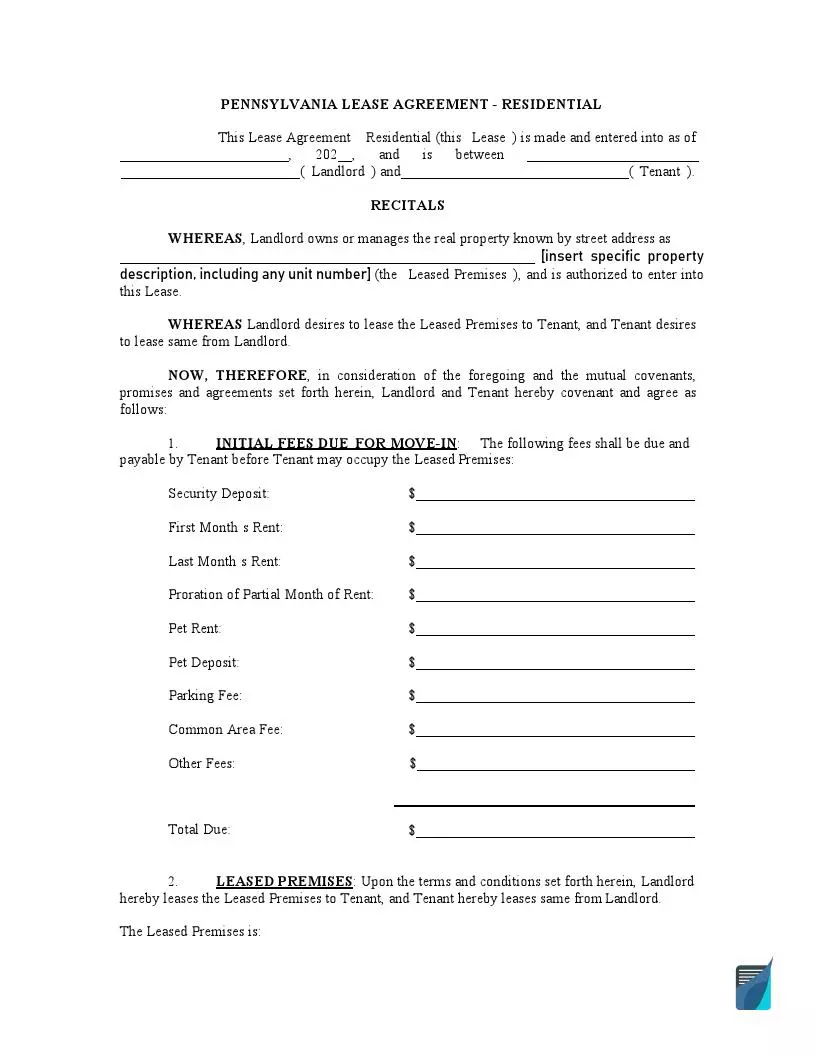
A lease agreement may be concluded for various terms and should contain the following information:
This document is also known as a PA rental lease, a Pennsylvania residential lease agreement, or a standard lease form. Whichever name you use, it is the same rental contract described on this page.
| Document Name | Pennsylvania Rental Lease Agreement Form |
| Other Names | PA Rental Lease, Pennsylvania Residential Lease Agreement |
| Relevant Laws | Pennsylvania Landlord and Tenant Act of 1951 |
| Security Deposit Amount | Two months' rent (first year); one month's rent for renewals |
| Security Deposit Return | Written list of damages within thirty (30) days of termination date |
| Avg. Time to Fill Out | 18 minutes |
| # of Fillable Fields | 119 |
| Available Formats | Adobe PDF |
You can hire a lawyer to draft a document that follows state rules, or you can build one yourself. The builder above walks you through the required terms step by step, so you can create, download, and print a ready-to-sign PDF from home.
Pennsylvania law sets a cap on the security deposit and a timeline for the landlord to account for it. During the first year of a lease, a landlord cannot ask for more than two months' rent as a security deposit. Starting in the second year, including any renewal, the cap drops to one month's rent. Once a tenant has lived in the unit for five years or more, a rent increase alone does not let the landlord raise the deposit.[2.6]
Any deposit over $100 must go into an escrow account at an institution regulated by the Federal Reserve Board, the Federal Home Loan Bank Board, the Comptroller of the Currency, or the Pennsylvania Department of Banking. The landlord must tell the tenant in writing which institution holds the funds and how much was deposited. Interest earned on the deposit belongs to the tenant and is paid out once a year, on the anniversary of the lease.[2.7]
The lease ends, or the landlord accepts the unit back. Within thirty days after whichever happens first, the landlord must give the tenant a written list of any damages being charged against the deposit.[2.8]
Common mistake: missing the 30-day deadline costs more than the deposit. A landlord who sends the damage list late forfeits the right to keep any of the deposit. A landlord who owes the tenant a refund and does not pay it within thirty days owes double the amount that was wrongly withheld.[2.8]
A Pennsylvania lease ends on its stated expiration date unless either party acts sooner. To end a tenancy early, a landlord or tenant must give one of the following written notices, based on how long the lease term is or why it is ending.
A lease can end early after a tenant's death. If the sole tenant of a unit dies during the lease term, the executor or administrator of the tenant's estate can end the lease. The notice to the landlord must be in writing, given fourteen days in advance.[2.9]
Pennsylvania law gives tenants several protections beyond notice periods and deposit rules. Abandoned personal property is one example.
A landlord sends the tenant a notice first. The tenant then has ten days from the postmark date of that notice to retrieve the property, or to ask that it be stored for up to thirty more days. A landlord who skips this process is liable for treble damages, plus reasonable attorney fees and court costs.[2.5]
A lease cannot be ended or left unrenewed because the tenant or a member of the tenant's family joined a tenants' organization.[2.2] The landlord also cannot charge a fee or extra rent because a tenant exercised a right this law gives.[2.4]
Answers to the questions renters and landlords ask most about this lease. The topics below cover deposit limits, escrow rules, and what a landlord can collect before move-in, all drawn from the same statute cited throughout this page.
Yes. Any deposit over $100 collected under a residential lease must be placed in an escrow account at an institution regulated by a state or federal banking authority.[2.7]
A landlord has thirty days to act. The clock starts when the lease ends, or when the landlord takes back the unit, whichever comes first. In that time the landlord must give the tenant a written list of any damages being charged against the deposit. Missing the deadline forfeits the landlord's right to withhold any part of it.[2.8]
Not without limit. Pennsylvania caps the security deposit itself at two months' rent during the first year of the lease, dropping to one month's rent from the second year on. A landlord can still ask for first month's rent in advance, but the deposit portion of what is collected cannot exceed these caps.[2.6]
The security deposit Pennsylvania landlords can collect is capped at two months' rent in the first year of a lease and one month's rent after that. Whatever a landlord calls the payment, the portion held as a security deposit cannot go over these limits.[2.6]
The required notice depends on the lease terms. Tenants and landlords ending a lease of one year or less, or one with no fixed end date, must give fifteen days' written notice. A lease longer than one year needs thirty days' notice, and a notice based on unpaid rent needs only ten days.[1.2][1.1][2.3]

General information, not legal or tax advice.