
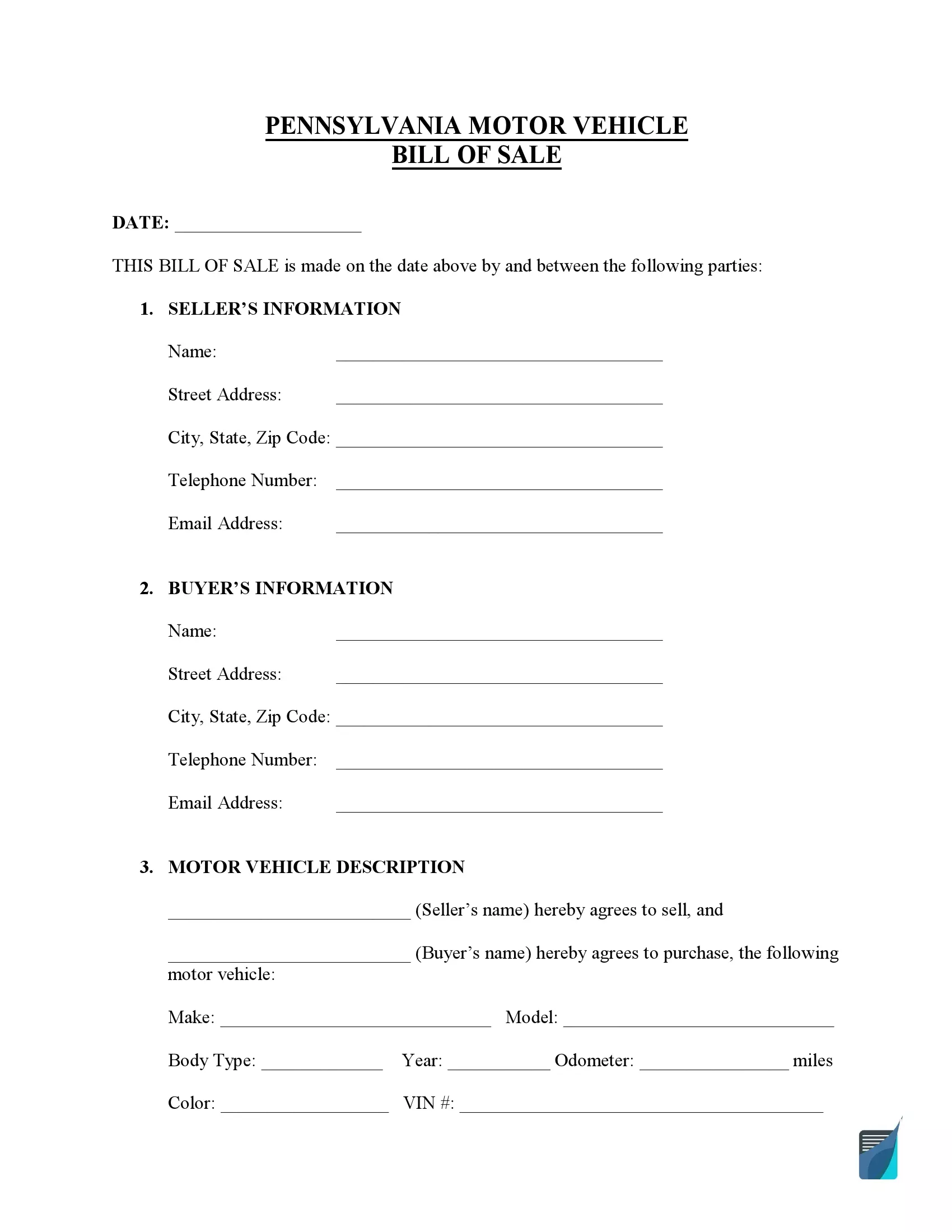
A Pennsylvania car bill of sale is a written record that a vehicle changed hands from a seller to a buyer. It names both people, describes the vehicle by its VIN, make, model and year, and shows the date and price. For a private vehicle transfer, the vehicle code calls for the seller's title assignment to be sworn to before a notary, while notarizing the bill of sale itself is optional.[2] Download the free form below or fill it out online.
Last Updated: October 2026. This guide is reviewed and updated regularly to reflect current Pennsylvania law. If you notice an error or outdated information, please contact us.
Build Your Document
Answer a few simple questions to make your document in minutes
Save and Print
Save progress and finish on any device, download and print anytime
Sign and Use
Your valid, lawyer-approved document is ready
| Document Name | Pennsylvania Vehicle Bill of Sale Form |
| Other Names | Pennsylvania Car Bill of Sale, Pennsylvania Automobile Bill of Sale |
| DMV | Pennsylvania Department of Motor Vehicles |
| Bill of Sale Required? | No |
| Notarization | Optional for the bill of sale (the seller's title assignment is notarized)[2] |
| Avg. Time to Fill Out | 7 minutes |
| # of Fillable Fields | 59 |
Each Pennsylvania bill of sale serves one type of transaction. Vehicles, boats, firearms and other property each have their own form, so pick the one that matches your sale. You can also browse our bill of sale template library for other transaction types.
Private handgun sales must take place at a licensed dealer or a county sheriff's office, except between spouses, parents and children, or grandparents and grandchildren (18 Pa.C.S. § 6111(c)).[4]
Use a vehicle bill of sale in Pennsylvania to put a private car sale in writing. It records the seller, the buyer, the vehicle and the price, and it goes with the title paperwork.
| Alternative Name | Car Bill of Sale |
| Seller’s Signature | Signature line on the form |
| Buyer’s Signature | Signature line on the form |
| Notarization | Optional for the bill of sale (the seller's title assignment is notarized) |
| Download | PDF Template |

A boat bill of sale in PA gives the seller and the buyer a written record of the sale. Name both parties, describe the vessel and add the date and price.
| Alternative Name | Vessel Bill of Sale |
| Seller’s Signature | Signature line on the form |
| Buyer’s Signature | Signature line on the form |
| Notarization | Parties may choose to notarize |
| Download | PDF Template |

A gun bill of sale in PA records who sold a firearm, who bought it and when. Describe the firearm by make, model and serial number, and keep a signed copy with your records.
| Alternative Name | Gun Bill of Sale |
| Seller’s Signature | Signature line on the form |
| Buyer’s Signature | Signature line on the form |
| Notarization | Parties may choose to notarize |
| Download | PDF Template |

A Pennsylvania general bill of sale records the sale of other personal property, such as equipment or furniture. It shows what was sold, the price and the date.
| Alternative Name | Generic Bill of Sale |
| Seller’s Signature | Signature line on the form |
| Buyer’s Signature | Signature line on the form |
| Notarization | Parties may choose to notarize |
| Download | PDF Template |
Notarization is part of a private vehicle transfer in Pennsylvania. The vehicle code calls for the seller's assignment of the title to be sworn to before a notary public or other officer empowered to administer oaths, or verified by a licensed issuing agent. Notarizing the bill of sale itself is optional.[2] The Pennsylvania DMV also names the Pennsylvania Certificate of Title as the document to transfer and asks for a copy of the buyer's license or photo ID.[1]
Sworn to before a notary public or other officer empowered to administer oaths
The statute lets a private seller and buyer use any one of these routes:[2]
The Pennsylvania motor vehicle bill of sale from FormsPal runs four form pages. Work through its parts in the order below, then have the seller and the buyer sign. Each step names the part of the form and the page where it appears, so you can match it to the printed PDF.


In a Pennsylvania car sale, the title must be transferred to the buyer. The buyer must apply for a Pennsylvania certificate of title within 20 days of the sale or of bringing the vehicle into the state, whichever is later (75 Pa.C.S. § 1103.1(b)).[5] The Pennsylvania DMV names the Pennsylvania Certificate of Title as the document to transfer, and it asks for a copy of the buyer's license or photo ID.[1] Keep the signed motor vehicle bill of sale with the title paperwork, because it records the sale itself.
The Pennsylvania DMV lists these points for a sale:[1]
A lienholder is the lender with a claim on the vehicle. Once the loan is satisfied, 75 Pa.C.S. § 1135(a)(1) says the outstanding certificate of title must be mailed or delivered immediately to the owner of the vehicle. It goes with proper evidence of satisfaction and release.[3]
If you need help with the paperwork, a local PennDOT office can answer your questions. After the title is transferred, the seller removes the license plate and returns it to PennDOT unless moving it to another vehicle. Form MV-4ST, the Vehicle Sales and Use Tax Return/Application for Registration, is used with a Pennsylvania certificate of title and is available only from authorized PennDOT agents.[1]
Form MV-140 or Request for Registration is designed to register a vehicle for the first time or renew the registration.

Request for Vehicle Information (Form DL-135) is used to obtain someone else’s or your own vehicle records. These records can only be used for the purpose specified in the document.

Affidavit of Gift, or Form MV-13ST, certifies that the vehicle is transferred without consideration, monetary or other.

Application for Correction of Vehicle Record or Verification of Vehicle Identification Number (VIN)

Form PFBC-734 or Affidavit of Purchase/Ownership is used to establish ownership of boats purchased at flea markets, garage sales, auction sales, and other private transactions.

Certification of Boat Length (Form PFBC-R6) is used when there is a discrepancy concerning the exact length of the boat, and a correction is needed.

Name the seller and the buyer, describe the vehicle by its VIN, make, model and year, and enter the date, price and payment method. The steps above go through the FormsPal form part by part. Alongside the form, the Pennsylvania Certificate of Title must be transferred to the buyer.[1] A private vehicle transfer is also sworn to before a notary public or other officer empowered to administer oaths.[2]
For a private transfer of a vehicle, 75 Pa.C.S. § 1111(a) calls for the seller's assignment of the title to be sworn to before a notary public or other officer empowered to administer oaths. The statute also allows verification by a licensed wholesale vehicle auction or a licensed issuing agent in place of a notary. Notarizing the bill of sale itself is optional.[2]
A notary public is one route, but not the only one. The statute allows another officer empowered to administer oaths, or verification by a licensed wholesale vehicle auction or a licensed issuing agent, in place of a notary.[2] The Pennsylvania Certificate of Title must still be transferred to the buyer.[1]
Pennsylvania has no statute that requires a bill of sale. Keep one anyway: the Department of Revenue may ask for a copy to verify the purchase price when it is far below market value.[7]

Other Pennsylvania Forms
General information, not legal or tax advice.


