
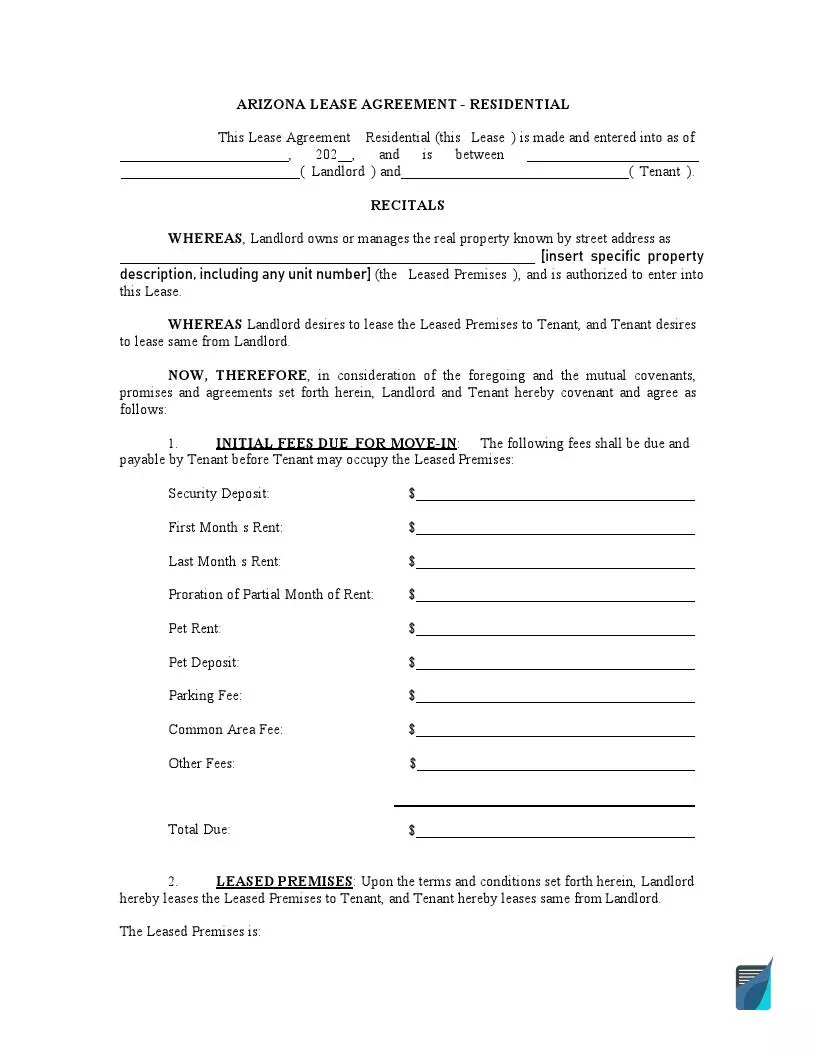
An Arizona lease agreement is a written contract between a landlord and a tenant that sets the rent, the length of the tenancy, and each party’s duties under Title 33 of the Arizona Revised Statutes. The tenant pays rent and follows the property rules, and the landlord provides the rental unit and handles repairs and disclosures the law requires.
Last Updated: September 2026. This guide is reviewed and updated regularly to reflect current Arizona law. If you notice an error or outdated information, please contact us.
Build Your Document
Answer a few simple questions to make your document in minutes
Save and Print
Save progress and finish on any device, download and print anytime
Sign and Use
Your valid, lawyer-approved document is ready
A rental agreement describes the deal in detail: the rent amount, a description of the rented space, and the identities of the parties. The party renting out the space is the landlord, or owner, and the party who receives it is the tenant, or renter.
In the US, rules that regulate lease agreements vary from state to state. In Arizona, laws that bind a renter and a landlord are stated in Title 33 of Arizona Revised Statutes (ARS). You may find most of them in Chapter 10.
Arizona’s security deposit rules come from Ariz. Rev. Stat. § 33-1321. A landlord cannot demand or receive a security deposit, however it is labeled, worth more than one and one-half month’s rent. Any fee or deposit the landlord does not designate as nonrefundable is treated as refundable, and the landlord must state the purpose of every nonrefundable fee or deposit in writing.[1]
After the tenancy ends, the landlord has fourteen days, not counting Saturdays, Sundays, or legal holidays, to send the tenant an itemized list of deductions along with any amount still owed. The landlord mails this list and any payment due by first-class mail to the tenant’s last known address.[1]
If the tenant does not dispute the deductions within sixty days of that mailing, the amount in the list becomes final and any further claims are waived. If the landlord fails to follow this process, the tenant can recover the deposit plus damages equal to twice the amount wrongfully withheld.[1]
A landlord shall not demand or receive security, however denominated, including prepaid rent in an amount or value of more than one and one-half month’s rent.
A security deposit and a nonrefundable fee are not the same thing in Arizona. Only a fee the landlord labels nonrefundable in writing can be kept regardless of move-out condition. Everything else must be treated as refundable.
Rent is due at the time and place the lease sets. If the lease is silent, Arizona law makes rent payable at the dwelling unit at the beginning of each month (Section 33-1314(C)). Stating the due date in the lease is recommended, not required.[3] The lease can also state how the tenant pays rent, such as by check, money order, or online transfer, and whether a returned payment carries an extra charge both sides accepted in writing.
Arizona's residential landlord and tenant law sets no dollar cap on late fees. A late fee must be reasonable and set out in the written lease (Section 33-1368(B)). The $5-per-day cap in Section 33-1414 applies only to mobile home park spaces.[4]
When a tenant fails to pay rent, the landlord may give a written five-day notice to pay. If the rent is not paid within five days after that notice, the landlord may end the lease by filing a special detainer action (Section 33-1368(B)).[4]
Arizona leases commonly address how and when the landlord may enter the rented space, including how much advance notice the landlord gives the tenant before a visit. Check the notice terms written into your own lease.
Many leases separate routine visits, such as inspections or repairs, from emergencies that call for immediate entry. Spelling out both situations in the lease helps both parties avoid disagreements about access later.
Under Section 33-1343(D), the landlord must give the tenant at least two days' notice of intent to enter and may enter only at reasonable times, except in an emergency or when giving notice is impracticable.[5]
Arizona law sets minimum notice periods for ending a periodic tenancy without cause. For a week-to-week tenancy, either the landlord or the tenant must give the other written notice at least ten days before the termination date named in the notice. For a month-to-month tenancy, either side must give at least thirty days of written notice before the next periodic rental date.[2]
Count these notice windows carefully. Our deadline calculator can help you confirm the exact date a written notice takes effect.
Many landlords send a renewal notice before the current term ends, offering the tenant a new term or a switch to month-to-month rent. Tenants who want to stay should reply in writing before that term expires, since silence can leave both parties unsure about the property’s status.
When closing a leasing deal in Arizona, both parties commonly exchange several disclosures. These include:
| Document Name | Arizona Rental Lease Agreement Form |
| Other Names | AZ Rental Lease, Arizona Residential Lease Agreement |
| Relevant Laws | Arizona Revised Statutes, Title 33, Chapter 10 |
| Security Deposit Amount | One and a half months’ rent |
| Security Deposit Return | Fourteen (14) days after the tenancy ends, excluding weekends and legal holidays |
| Avg. Time to Fill Out | 18 minutes |
| # of Fillable Fields | 119 |
| Available Formats | Adobe PDF |
An Arizona lease agreement typically identifies both parties, the rented property’s address, the rent amount and due date, the security deposit terms, the length of the tenancy, and each party’s maintenance duties. Covering these points in writing helps both parties avoid disputes once the lease is signed.
Good documentation matters too. Photos of the property’s condition at move-in, along with any written notice about repairs during the tenancy, can help tenants and landlords resolve disagreements without a dispute later.
You can build an Arizona lease agreement online in a few minutes with the document builder above. The builder asks plain-language questions about your rental and turns your answers into a finished lease agreement, ready to download or print.
Tenants have a right to a habitable rental property, timely repairs, and clear terms on rent and fees. Landlords can set specific property rules, such as pet, parking, and noise policies, as long as the rules and any related fees appear in the signed lease and do not conflict with state rules.
Common property conditions include working plumbing, heat, and locks, along with smoke detectors that meet safety codes. When tenants and landlords agree on additional conditions, such as lawn care or utility duties, spelling out those terms helps both sides avoid confusion.
An Arizona lease agreement operates under state law that gives tenants and landlords enforceable rights, and comparing rules from other states can help renters know what is typical.
Arizona landlords have fourteen days after the tenancy ends, not counting Saturdays, Sundays, or legal holidays, to send the tenant an itemized list of deductions and any amount still owed.[1]
An Arizona landlord cannot charge a security deposit worth more than one and one-half month’s rent, and any fee not labeled nonrefundable in writing is refundable. On move-in, the landlord must give the tenant a signed lease copy, a move-in form noting existing damage, and written notice that the tenant may attend the move-out inspection.
After the tenancy ends, the landlord mails the itemized deduction list and any amount due within fourteen days. If the tenant does not dispute it within sixty days, the amount becomes final. If the landlord fails to follow this process, the tenant can recover the deposit plus damages equal to twice the amount wrongfully withheld.[1]

Other Rental Lease Agreement Forms by State
General information, not legal or tax advice.
Unless noted otherwise, the sources below are from the Ariz. Rev. Stat..
