
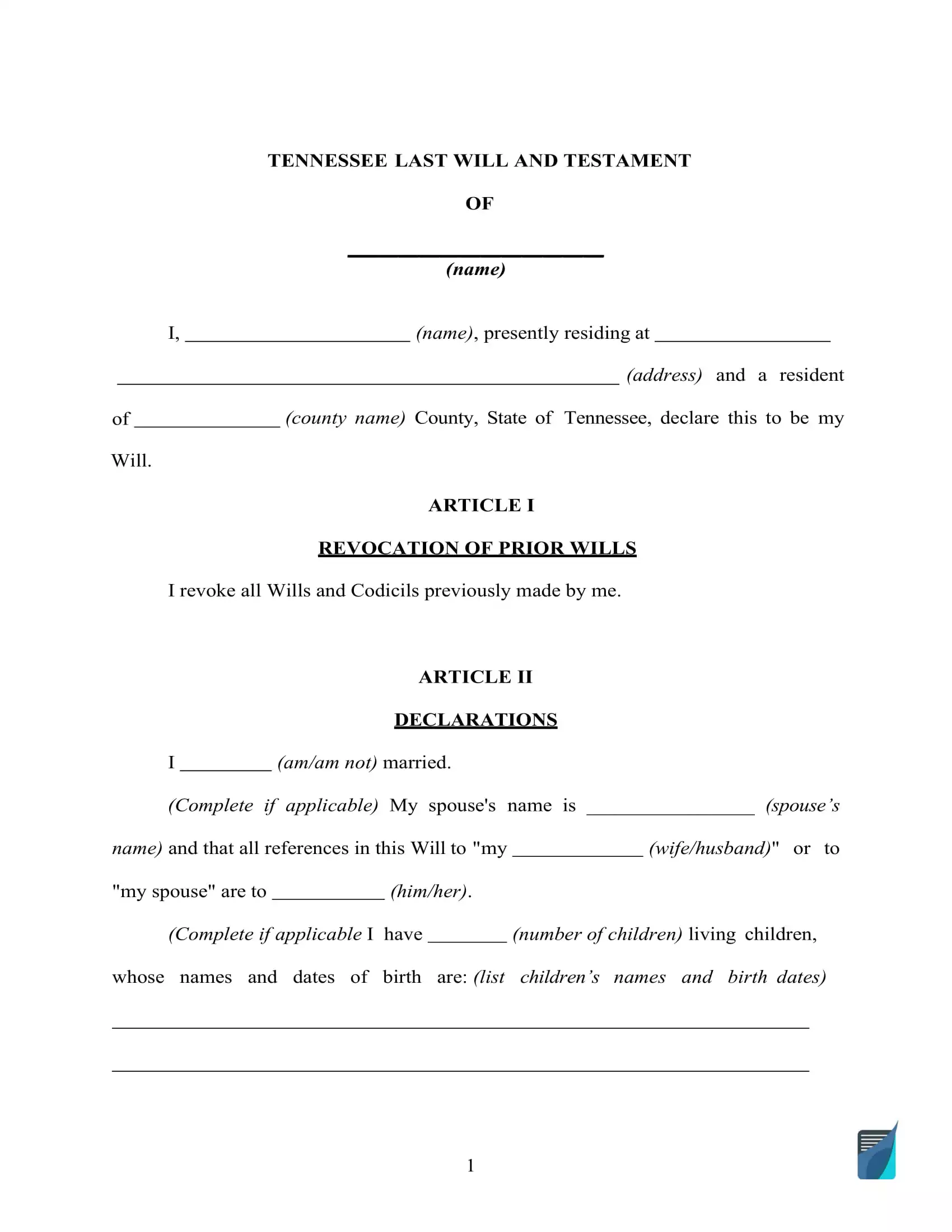
A Tennessee last will and testament is a document that contains the final will of its owner (testator) and decides precisely how and by whom their estate will be used in case of death.
Last Updated: September 2026. This guide is reviewed and updated regularly to reflect current Tennessee law. If you notice an error or outdated information, please contact us.
Build Your Document
Answer a few simple questions to make your document in minutes
Save and Print
Save progress and finish on any device, download and print anytime
Sign and Use
Your valid, lawyer-approved document is ready
A last will still matters even if you own little property, since it names who receives what you do have, appoints an executor to carry out your wishes, and can name a guardian for minor children.
This Tennessee last will and testament template is free to download and covers your executor, beneficiaries, and guardian nominations, but it does not replace a living will or a living trust for other parts of your estate plan.
Some people call this document a "testament" or a "last will and testament." Tennessee’s statutes use the single term "will" throughout Title 32.
Tennessee’s will requirements come from Title 32 of the Tennessee Code. To be valid, a will needs a testator who is at least eighteen and of sound mind, a signature from that testator, and two competent, disinterested witnesses who sign in the testator’s presence and in each other’s presence.
| Requirements | State laws | |
| Statutes | Tennessee Code Title 32, Wills | |
| Signing requirement | Two witnesses | Tenn. Code Ann. § 32-1-104(a). Signature and witness requirements |
| Age of testator | 18 or older | Tenn. Code Ann. § 32-1-102. Persons qualified to make a will |
| Witness qualifications | Competent to serve as a witness | Tenn. Code Ann. § 32-1-103(a). Who may act as a witness |
| Interested witnesses | Must be disinterested | Tenn. Code Ann. § 32-1-103(c). Effect of an interested witness |
| Self-proving wills | Needs a separate affidavit | Tenn. Code Ann. § 32-1-104(b). Self-proving affidavit effect |
The execution of a will, other than a holographic or nuncupative will, must be by the signature of the testator and of at least two (2) witnesses.
A self-proving affidavit is a separate step. Signing the will itself does not automatically make it self-proving, so you still need the extra affidavit if you want that benefit.[1.8]
Tennessee also recognizes a holographic will. No witnesses need to sign it, but the signature and all material provisions must be in your own handwriting, and two witnesses must prove that the handwriting is yours (Tenn. Code Ann. § 32-1-105). Any other handwritten will must be signed by you and at least two witnesses, just like a typed one (Tenn. Code Ann. § 32-1-104(a)).[1.9]
An oral (nuncupative) will is recognized only in a narrow case: the person must be in imminent peril of death and die of it, declare the will before two disinterested witnesses, and have a witness write it down within 30 days. It can pass only personal property worth up to $1,000 (Tenn. Code Ann. § 32-1-106).[1.10]
Follow these seven steps to complete a Tennessee last will with our template. You will decide whether to use an attorney, name your executor and any guardian, list your beneficiaries and property, then sign the document with two witnesses.


Using a witness who is also a beneficiary can create problems. Tennessee law also calls for two witnesses with no interest in the estate.[1.3]
Once your will is signed, you can deposit it, sealed, for safekeeping with the court that exercises probate jurisdiction in the county where you live. The court keeps it, gives you a certificate of deposit, and charges a fee set by statute (Tenn. Code Ann. § 32-1-112).[1.11]

This Tennessee last will and testament template is valid when the testator is at least eighteen years old and signs the document, or directs someone else to sign it for them. It must also be witnessed by two competent, disinterested people who sign in the testator’s presence and in each other’s presence. No notary is needed for the will itself to be valid, since the execution rule calls only for the testator's signature and the signatures of at least two witnesses (Tenn. Code Ann. § 32-1-104(a)).[1.4]
Testamentary capacity means you meet two requirements when you sign your will: you are old enough, and you are of sound mind. Tennessee sets the age at eighteen and requires that the testator be of sound mind.[1.1]
Married couples in many states, including Tennessee, do not automatically split everything acquired during the marriage the way they would in a community-property state. Even so, in Tennessee your spouse can elect against the will and take 10% to 40% of your net estate, depending on how long you were married (Tenn. Code Ann. § 31-4-101).[1.12] It is common practice to address a spouse directly in the will, even to reduce what they receive, rather than leave them out entirely.
Apart from a spouse's elective share (Tenn. Code Ann. § 31-4-101), you may leave out adult children and other relatives if the will says so. A child born after you sign who is neither provided for nor expressly disinherited takes the share they would get if you had no will (Tenn. Code Ann. § 32-3-103), so name after-born children or add a clause covering them.[1.13] Many people who want to leave someone out simply name them and state that intent clearly in the will.
| Related documents | When to make it |
| Codicil | There are several small adjustments you’d like to make to your will. |
| Self-proving affidavit | You need to facilitate the probate in the future. |
| Living will | You want to be sure that, in case you become incapacitated, you get treated exactly how you’d wish to. |
| Living trust | You want to think about an alternative to a will. |
General information, not legal or tax advice.
