
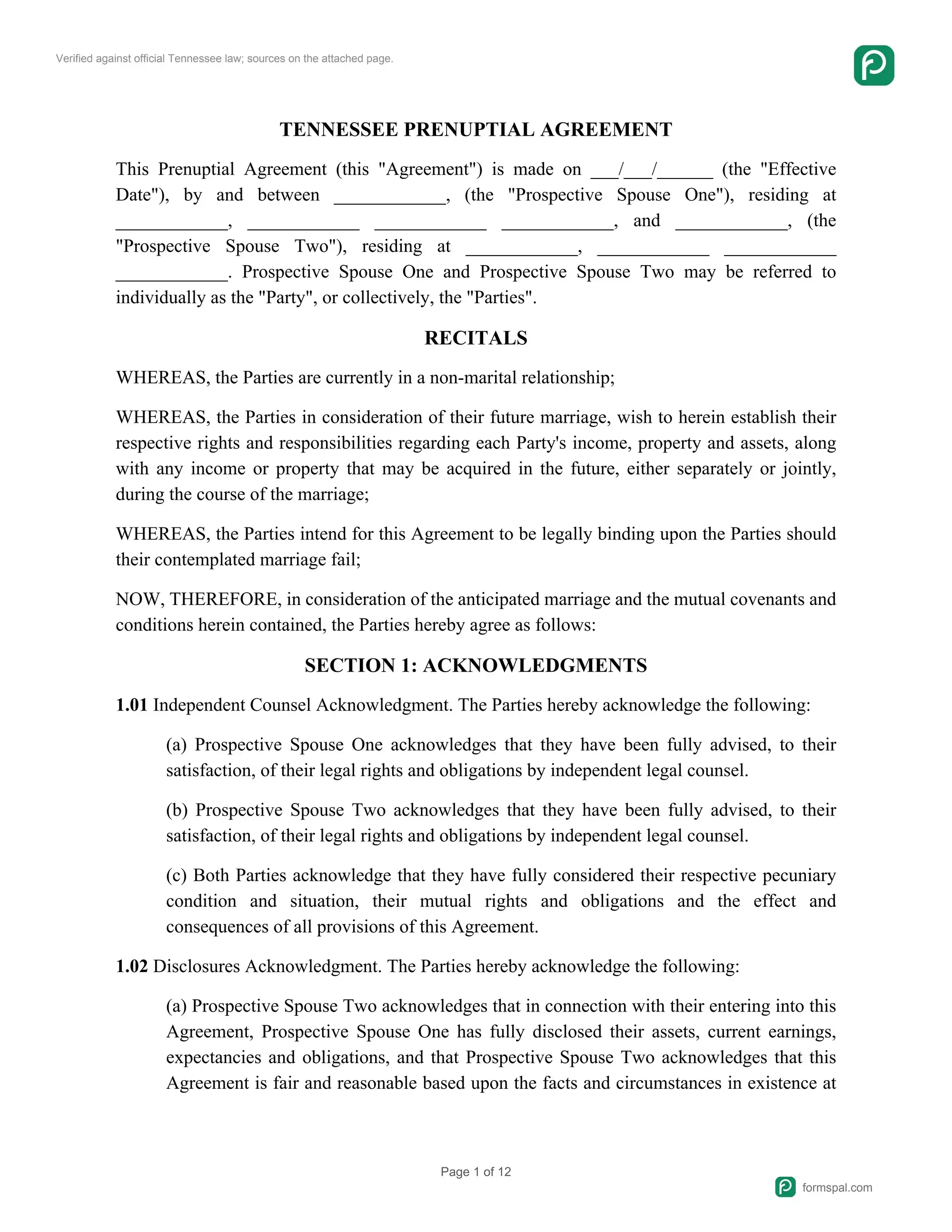
A Tennessee prenuptial agreement is a written contract two people sign before they marry. It records who owns what, how debts are handled, and how property is divided if the marriage ends in divorce or in the death of one spouse.
Tennessee courts are bound by an agreement that covers property either spouse owned before the marriage, provided the couple signed it freely, knowledgeably and in good faith.[1.2] It cannot set child support or custody. Our free prenuptial template follows the same rules in every state.
Build Your Document
Answer a few simple questions to make your document in minutes
Save and Print
Save progress and finish on any device, download and print anytime
Sign and Use
Your valid, lawyer-approved document is ready
It is a contract about money, signed before the marriage and brought to life by it. Couples use one to say which assets stay with one person, which belong to both, how debts are shared, and what happens to all of it in a divorce or on death. The Tenn. Code Ann. treats it as a contract concerning property owned by either spouse before the marriage.[1.2]
Tennessee judges and family law attorneys also call the document an antenuptial agreement, a premarital agreement, or simply a prenup. The state code uses the phrase antenuptial or prenuptial agreement for the same contract. A couple who signs the same kind of contract after the ceremony has a postnuptial agreement instead.
Three sections of the Tenn. Code Ann. carry the rules. Section 36-3-501 makes an agreement about property owned before the marriage binding on any court with jurisdiction. The spouses must have signed it freely, knowledgeably and in good faith, with no duress and no undue influence.[1.2] Section 36-3-502 limits what a marriage contract can do to creditors.[1.3]
Put the agreement in writing. Tennessee's statute of frauds makes an agreement founded on consideration of marriage unenforceable unless it is in writing and signed by the party to be charged.[1.1] A spoken promise will not do. Have both parties sign before the wedding, and sign voluntarily.
Section 36-3-501 does not list a notary or witnesses among the things that make a prenuptial agreement binding.[1.2] Tennessee family law attorneys still recommend notarizing the signatures, because it makes them harder to dispute years later.
Sign early. Prenuptial agreements handed over days before the ceremony are easier to attack as signed under pressure, and duress is one of the things the statute tests.[1.2]
A signed prenuptial agreement binds any court that has jurisdiction over the spouses. The judge has to find first that both spouses signed it freely, knowledgeably and in good faith, without duress or undue influence.[1.2] That finding sits in the discretion of the court, so a judge weighs how the signing actually went rather than ticking off a checklist.[1.2]
Once the terms clear that test they carry the same legal weight as any other contract. The statute makes them enforceable by all remedies available for enforcement of contract terms.[1.2]
A Tennessee judge can decline to enforce a prenuptial agreement. Because the statute leaves the decision to the discretion of the court, the grounds turn on how the agreement was made rather than on a fixed list.[1.2] These are the arguments that come up:
Yes, when the couple makes the agreement the way the statute describes. An agreement covering property either spouse owned before the marriage binds any court with jurisdiction over the spouses. The judge has to find that both of them signed it freely, knowledgeably and in good faith, without duress or undue influence.[1.2] The terms are then enforceable by all remedies available for enforcement of contract terms.[1.2]
Notwithstanding any other provision of law to the contrary, any antenuptial or prenuptial agreement entered into by spouses concerning property owned by either spouse before the marriage that is the subject of such agreement shall be binding upon any court having jurisdiction over such spouses and/or such agreement if such agreement is determined, in the discretion of such court, to have been entered into by such spouses freely, knowledgeably and in good faith and without exertion of duress or undue influence upon either spouse.
Prenuptial agreements are binding, but binding is not the same as untouchable. That decision sits with the judge, who can refuse to enforce the agreement when the circumstances of the signing do not satisfy the statute.[1.2]
A Tennessee prenuptial agreement is a money and property document, and nothing else. The statute is built around property that either spouse owned before the marriage, and that scope sits at the core of most agreements.[1.2] Couples go further in practice, using the contract to protect a business, keep one partner clear of the other's debts, and settle spousal support in a divorce. These are the provisions that show up most often:
Two subjects are legally out of reach, and a third carries a limit written into the code. A prenuptial agreement cannot decide child custody or parenting time, and it cannot waive or cap child support. Those questions belong to the judge, who rules on what is best for the child at the time of the divorce rather than years ahead of it.
The third limit protects creditors. Section 36-3-502 of the Tenn. Code Ann. says no marriage settlement or other marriage contract is good against creditors in one situation. It applies where the contract secures the intended wife and the children of the marriage more than she brought in. The comparison also takes in what the husband owned when he married, after his just debts are deducted.[1.3]
A prenuptial agreement cannot put assets beyond the reach of people you owe. If that is the goal, it is the wrong legal tool and a creditor can look straight through it.[1.3]
No. Tennessee divides marital property by equitable distribution, not by an automatic half and half split. In a divorce, a judge weighs each spouse's contribution to the marriage, their finances and other factors, then divides what the couple built together in whatever way is fair. Fair and equal are not the same thing.
A prenuptial agreement is how couples settle this in advance instead of leaving it to a judge. An agreement covering property owned before the marriage is binding once it meets the test in the statute.[1.2]
You can write your own. Nothing in Section 36-3-501 of the Tenn. Code Ann. asks for a lawyer to draft or review the document. What the section does ask is that both spouses enter into it freely, knowledgeably and in good faith, with no duress and no undue influence.[1.2] Knowledgeably is the word that does the work, because a spouse who did not understand what they signed has an argument.
Have a family law attorney review the agreement if your finances are complicated or if one of you owns a business. Prenuptial agreements are contracts like any other, so read Section 36-3-501 of the Tenn. Code Ann. before you sign either way.
Last Updated: September 2026. This guide is reviewed and updated regularly to reflect current Tennessee law. If you notice an error or outdated information, please contact us.
