
A Tennessee eviction notice is a written notice a landlord serves on a tenant to end the tenancy for unpaid rent, a lease violation, or another lawful reason, before the landlord can file an eviction case in court.
Last Updated: September 2026. This guide is reviewed and updated regularly to reflect current Tennessee law. If you notice an error or outdated information, please contact us.
Build Your Document
Answer a few simple questions to make your document in minutes
Save and Print
Save progress and finish on any device, download and print anytime
Sign and Use
Your valid, lawyer-approved document is ready
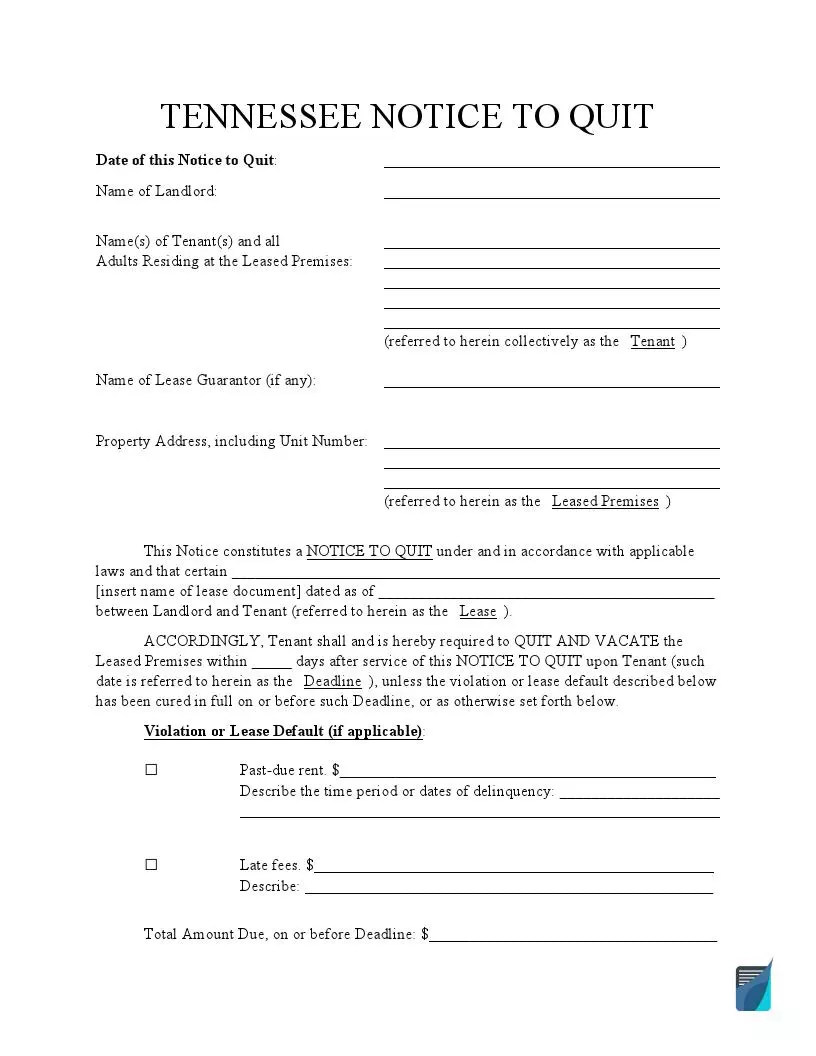
The eviction notice template lets a Tennessee landlord enter the tenant's name, the property address, the reason for eviction, and the date the tenancy ends. Tennessee law sets the notice period by the reason for eviction, from a 14-day notice for a curable breach to a 7-day notice for a repeat breach.
This document is also called a notice to quit or a notice to vacate. All three names refer to the same written notice a landlord serves on a tenant in Tennessee before going to court.
Tennessee law sets the notice period a landlord must give before ending a tenancy, and the period depends on why the tenancy is ending. A breach the tenant can fix, such as unpaid rent, gets a chance to cure it. A breach that cannot be fixed, or one that repeats within six months, ends the tenancy on a shorter timeline.[2]
Outside the counties covered by the Uniform Residential Landlord and Tenant Act, fourteen days' notice is sufficient to end a residential tenancy for eviction when the tenant neglects or refuses to pay rent that is due and in arrears on demand, or damages the premises beyond normal wear and tear (Tenn. Code Ann. § 66-7-109(a)(1)).[1]
In counties under the Uniform Residential Landlord and Tenant Act, there is a five-day grace period, counting the due date as day one, before a late fee may be charged. No fee may be charged if the fifth day falls on a Sunday or legal holiday and the rent is paid the next business day, and the late fee may not exceed ten percent of the rent past due (Tenn. Code Ann. § 66-28-201(d)).[1]
| Notice to Cure a Breach (Curable, Including Nonpayment) | 14 days[2] |
| Notice for a Noncurable Breach | At least 14 days[2] |
| Notice for a Repeat Violation (Within 6 Months) | At least 7 days[2] |
| State Law | Tenn. Code Ann. § 66-28-505[2] |
Tennessee law recognizes several kinds of eviction notice, and the type a landlord uses depends on why the tenancy is ending. A curable breach, a noncurable breach, a repeat violation, and a false service animal claim each carry their own notice period under Tennessee law.[2]
Example. Landlord Ben Carter rents a property at 123 Main Street to tenant Anna Baker. When Anna misses a rent payment, Ben serves her a 14-day notice that states the amount owed and the address of the property. Anna pays what she owes within the 14-day window, so the tenancy continues and Ben cannot file an eviction case over that missed payment. If Anna had not paid or moved out, Ben could then take the notice to court.
Example. If Anna instead commits a breach that cannot be fixed, Ben can set a termination date at least 14 days after Anna receives it, with no chance for her to cure it. If Anna repeats the same breach again within six months, Ben only needs to give her a 7-day written notice stating the breach and when the tenancy ends.[2]
The shortest Tennessee notice is three days, not an immediate order to leave. A landlord may end the rental agreement three days after the tenant receives a written notice that details the violation if the tenant, or anyone there with the tenant's consent, willfully or intentionally commits a violent act, behaves so as to be a real and present danger to the health, safety, or welfare of others, or creates a hazardous or unsanitary condition affecting others (Tenn. Code Ann. § 66-28-517(a), (b)). Outside the counties the Act covers, § 66-7-109(d) provides a three-day notice for a violent act, drug-related criminal activity, or a real and present danger.[1]
Where domestic abuse is the underlying offense, only the perpetrator may be evicted, not the victims, minor children, or innocent occupants, and the victim and all adult tenants must agree in writing not to let the perpetrator return and to report any return. These rights apply only once the victim has an order of protection for the incident and has given the landlord a copy (Tenn. Code Ann. § 66-28-517(g)).[1]
Tennessee law also sets rules that apply to landlords and tenants once a notice is served, covering how a tenant's repairs get authorized, how a waiver must be written, and what the landlord can still collect after the tenancy ends. These rules apply alongside the notice periods described above. A landlord who wants to count a notice period exactly can use FormsPal's deadline calculator.[2]
An eviction in Tennessee moves from a written notice to a court case, then to a court order allowing the sheriff to remove the tenant. A landlord cannot skip the court step, however long the tenant has been in breach.
No self-help evictions. Tennessee law does not let a landlord enter and hold the property, change the locks, shut off utilities, or remove a tenant's belongings outside the legal process. This protection applies whether the tenant has fallen behind on rent or broken some other lease term. Entry is only allowed where the law gives it, and only in a peaceable manner.[1]
A landlord who locks a tenant out or cuts essential services instead of going through the courts can be made to restore possession and to pay the tenant's actual damages, punitive damages where appropriate, and a reasonable attorney's fee, and if the tenant ends the rental agreement over it the landlord must return all prepaid rent and security deposits (Tenn. Code Ann. § 66-28-504). Self-help entry is separately prohibited (§ 29-18-101).[1]
An eviction case in Tennessee uses two main court documents, one that the landlord files to start the case and one that the court issues once the landlord wins. Each document has its own role in moving the case from a filing to the tenant's removal.
Yes. Tennessee law treats a repeat breach the same way it treats nuisance or waste by the tenant. If the tenant repeats substantially the same act or omission within six months of an earlier notice, the landlord may end the rental agreement. The landlord must give the tenant a 7-day written notice stating the breach and when the tenancy ends.[2]
The tenant gets a 14-day window after receiving written notice to fix a lease breach that can be cured, such as unpaid rent. Fixing the problem within that window lets the rental agreement continue, and the landlord cannot proceed with the eviction over that issue.[2]
For a curable breach, the tenant gets a 14-day written notice and a chance to fix the problem first. Where the breach cannot be cured, the landlord may still set the termination date, but not earlier than 14 days after the tenant receives it.[2]

General information, not legal or tax advice.
