
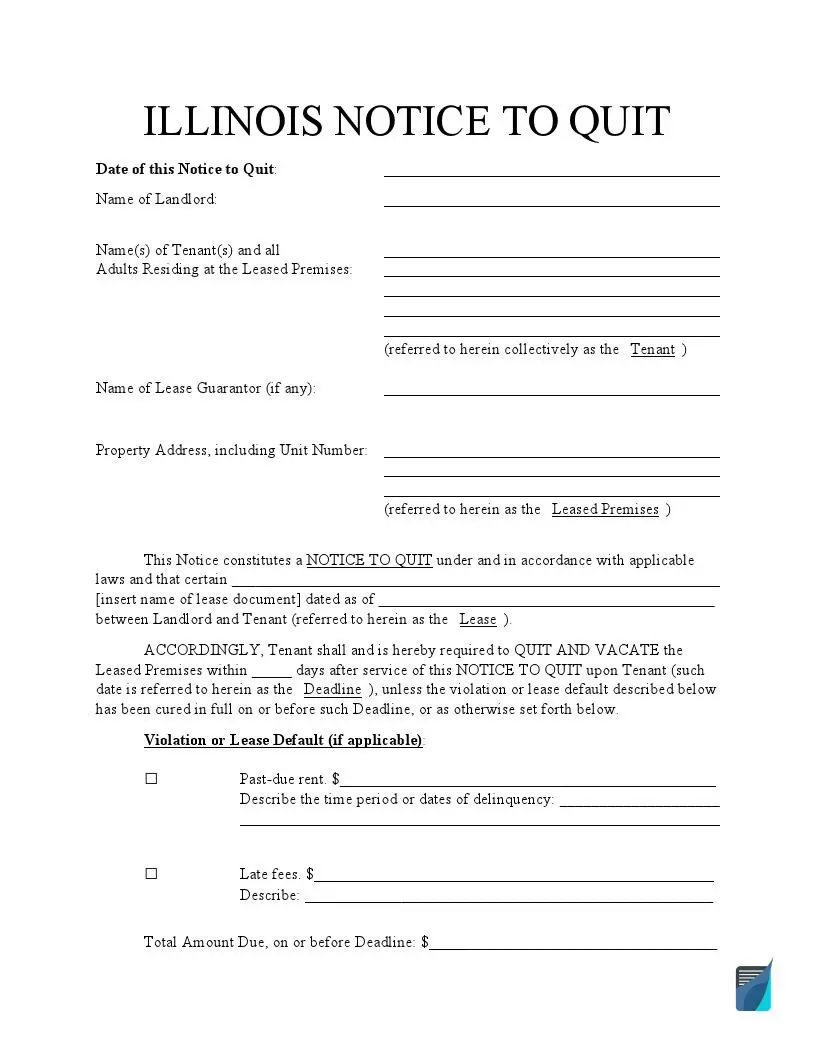
An Illinois eviction notice is a written notice a landlord serves on a tenant to end the tenancy for nonpayment of rent, a lease violation, or without cause, before filing an eviction case in court.
Last Updated: September 2026. This guide is reviewed and updated regularly to reflect current Illinois law. If you notice an error or outdated information, please contact us.
Build Your Document
Answer a few simple questions to make your document in minutes
Save and Print
Save progress and finish on any device, download and print anytime
Sign and Use
Your valid, lawyer-approved document is ready
The notice states why the tenancy is ending and how many days the tenant has to pay, fix the problem, or move out. Illinois law sets a different notice period for each reason, and the landlord must file suit in the local circuit court if the tenant does not respond in time.
Illinois eviction law sets a different minimum notice period for each reason a landlord ends a tenancy. A landlord must give the tenant at least 5 days of written warning for unpaid rent.[3] Breaking a lease term requires at least 10 days of written warning.[4] Ending a tenancy without cause requires at least 30 days of advance warning.[2] Outside that process, state law does not let a landlord force a tenant out on their own.[1]
This document must be in writing and must give the tenant a deadline of at least 5 days to pay.[3] Landlords and tenants can count that window with FormsPal's deadline calculator. To keep a partial payment from voiding it, the law requires this exact language:
Only FULL PAYMENT of the rent demanded in this notice will waive the landlord's right to terminate the lease under this notice, unless the landlord agrees in writing to continue the lease in exchange for receiving partial payment.
This requirement is not waived just because the tenant pays part of the rent before the deadline, as long as the full amount demanded is not paid by then. The landlord may also agree in writing to accept partial payment and keep the lease going instead of ending it.[3]
A few more rules apply once a nonpayment case reaches court:
An Illinois eviction notice is also called a notice to quit or a notice to vacate. All three names refer to the same document.
| Notice of Non-Payment | 5 days |
| Notice of Non-Compliance (Lease Violation) | 10 days |
| No-Cause Notice to Quit | 30 days |
| State Laws | Illinois Compiled Statutes, Chapter 735, Sections 5/9-201 to 5/9-212 |
Landlords in the state use different eviction notices depending on why the tenancy is ending. A curable lease problem can be fixed within that window, while a no-cause termination cannot be cured and only requires the tenant to move out.
Popular Local Eviction Notice Forms
State law does not allow a landlord to remove a tenant without going through the courts.[1] In practice, an eviction case generally follows the steps below, though the exact experience can vary by county and by case.
Keep a copy of the document, proof it was delivered, and any messages exchanged with the tenant. This paperwork becomes evidence if the case goes to court.
No self-help evictions. State law limits what a landlord may do outside this process, including retaking the premises, cutting off services, or taking the tenant's belongings.[1]
Eviction cases in the state use a small set of standard court forms. Each one plays a different role once the case moves from a written warning to a filing in the circuit court, and the tenant should recognize each by name if they are served with one.
Landlords and tenants can visit the Illinois Courts website for approved form templates and filing requirements.
Yes. State law allows a landlord to give a tenant only 5 days to pay, but only for unpaid rent. The landlord must give the tenant a written demand for the amount owed and a deadline of at least 5 days to pay before filing an eviction case. This is the shortest period the law allows.[3] Other grounds, such as breaking a lease term or a no-cause termination, require more time.

General information, not legal or tax advice.
Unless noted otherwise, the sources below are from the Illinois Compiled Statutes.
