
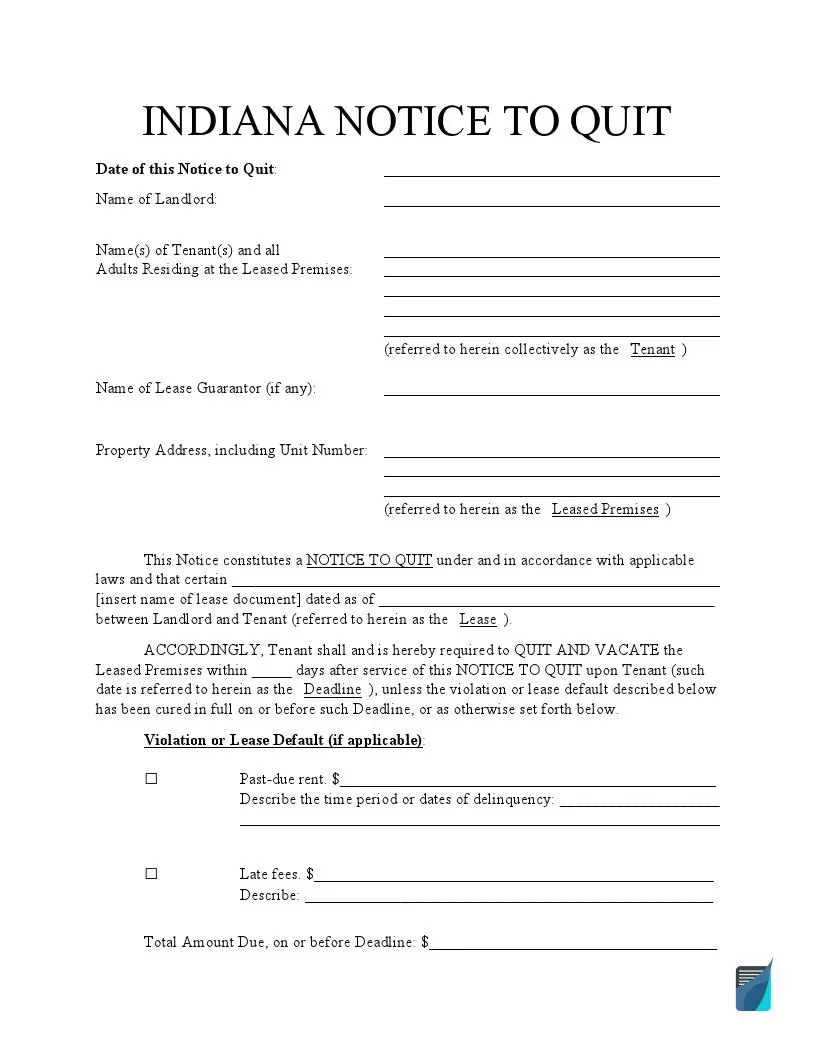
An Indiana eviction notice is a written notice a landlord serves on a tenant to end a tenancy for nonpayment of rent, a lease violation, or without cause, before filing an eviction case in court. For nonpayment of rent, Indiana law sets a notice period of at least ten days, unless the landlord and tenant have agreed otherwise or the tenant pays what is owed before the notice period ends.
Indiana law does not let a landlord force a tenant out without going through the court process first. Changing the locks, shutting off utilities, or removing a tenant’s belongings without a judge’s order is against the law. Use the button below to create a free Indiana eviction notice for the situation that applies to your lease.
Build Your Document
Answer a few simple questions to make your document in minutes
Save and Print
Save progress and finish on any device, download and print anytime
Sign and Use
Your valid, lawyer-approved document is ready
Last Updated: September 2026. This guide is reviewed and updated regularly to reflect current Indiana law. If you notice an error or outdated information, please contact us.
Indiana’s eviction rules for landlords and tenants are in Title 32, Article 31 of the Indiana Code, sometimes called the Landlord-Tenant Relations chapter. It sets the notice a landlord must give before ending a tenancy, when no notice is required, how notice must be delivered, and what a landlord may not do to remove a tenant without a court order.
Here is what the statute says:
| Rent Grace Period | Not specified |
| Notice of Non-Payment | 10 days |
| Notice of Non-Compliance | Not specified |
| State Laws | Ind. Code §§ 32-31-1-6, 32-31-1-7, 32-31-1-8, 32-31-1-9, 32-31-1-20, 32-31-5-6 |
Indiana law also sets rules for how a notice has to reach the tenant. Notice may be given to the tenant directly.[1.5] If the tenant cannot be found, it may be given to another person living at the property, or posted on a visible part of the property if no one is there to receive it.[1.5] Whoever serves the notice must explain what it says to the person being served.[1.5]
Indiana landlords use different eviction notices depending on why the tenancy is ending. The most common are the 10-Day Notice to Quit for unpaid rent and the 30-Day Notice for ending a month-to-month tenancy, and Indiana law also addresses property damage and a few situations where no notice is required at all.
An eviction notice is also called a notice to quit or a notice to vacate. FormsPal’s builder above creates the exact document for the notice type your situation calls for.
10-Day Notice to Quit (Non-Payment of Rent)
A 10-Day Notice to Quit tells the tenant that rent is overdue and that the tenancy will end if the tenant does not pay in full within ten days. Under Section 32-31-1-6 of the Ind. Code, the landlord must give at least ten days written notice before ending the lease for unpaid rent, unless the lease says otherwise or the tenant pays what is owed before the notice period ends.[1.2]
The written notice itself must also tell the tenant they have to vacate not more than ten days after receiving it, unless the rent due is paid within that time.[1.3] Count the ten-day period with FormsPal’s deadline calculator to confirm the exact date the notice expires.
30-Day Notice to Quit (Month-to-Month Lease Termination)
A 30-Day Notice to Quit ends a month-to-month tenancy without stating a cause. Many Indiana landlords and tenants use a 30-day notice period as a matter of common practice or because the lease requires it. Check the lease for the exact notice period it sets, and send the notice in a way that lets you confirm the other party received it.
Waste or Property Damage
Indiana law treats serious damage to the property differently from a simple unpaid rent case. A tenant at will (a tenant with no fixed lease term) who commits waste, meaning serious damage to or destruction of the property, triggers a separate termination rule of its own.[1.4]
When No Notice Is Required
Indiana law does not require the landlord to give notice before ending a tenancy in a few specific situations:[1.4]
Each of these is a type of eviction notice that generally has to reach the tenant before a landlord can file a case in court, except in the no-notice situations listed above. Do not forget that both parties still need to follow the rules and clauses already written into the rental agreement itself.
Popular Local Eviction Notice Forms
Filing an eviction in Indiana follows the same basic path in every county. The landlord sends the required notice, waits out the notice period, and if the tenant still has not paid or moved out, files a complaint with the court that handles these cases. Indiana law also limits what a landlord may do outside of this court process.
Except when authorized by a court order, Indiana law does not let a landlord deny a tenant access to their home. This includes changing the locks, adding a device that blocks entry, or otherwise interfering with the tenant’s access to or possession of the dwelling.[1.1] A landlord who tries to force a tenant out this way, instead of going through the legal process, risks legal consequences of their own.
During the notice period, the tenant can pay what is owed in full or move out. If neither happens by the end of the period, the next legal step depends on which notice was already sent, a 10-Day Notice for unpaid rent or a 30-Day Notice to end a month-to-month tenancy.
If the tenant still has not paid or moved out, the landlord can file a complaint in the court that handles eviction cases in the county where the rental property is located. The tenant then has a chance to respond before a judge decides whether the eviction can go forward.
If the court rules in the landlord’s favor, it issues an order returning possession of the property to the landlord. The exact hearing schedule and any further steps depend on the court handling the case, so check with that court directly for dates and local rules.
Indiana’s eviction lawsuit is built around two court documents: the complaint the landlord files to start the case, and the answer the tenant can file in response. FormsPal does not provide these court forms directly, since they are filed with, and often provided by, the local court handling the case.
This document, submitted by the landlord, formally starts the eviction case in court. It typically comes with a copy of the eviction notice already sent to the tenant.
This is the tenant’s written response to the landlord’s complaint. File it with the court by the deadline stated in the paperwork the tenant receives. If you are unsure how any of these rules apply to your situation, consider talking with a local landlord-tenant lawyer.

General information, not legal or tax advice.
