
An Indiana last will and testament template is a written document that lets a testator (the person making the will) name an executor, choose beneficiaries for their property, and appoint a guardian for minor children. It must be signed by the testator and by two attesting witnesses to be valid in Indiana.[1.3]
Last Updated: September 2026. This guide is reviewed and updated regularly to reflect current Indiana law. If you notice an error or outdated information, please contact us.
Build Your Document
Answer a few simple questions to make your document in minutes
Save and Print
Save progress and finish on any device, download and print anytime
Sign and Use
Your valid, lawyer-approved document is ready
Preparing a last will lets you decide who receives your property instead of leaving that decision to state law. It also lets you name a guardian for your children and leave burial instructions, and it can be changed or revoked at any time before you die.
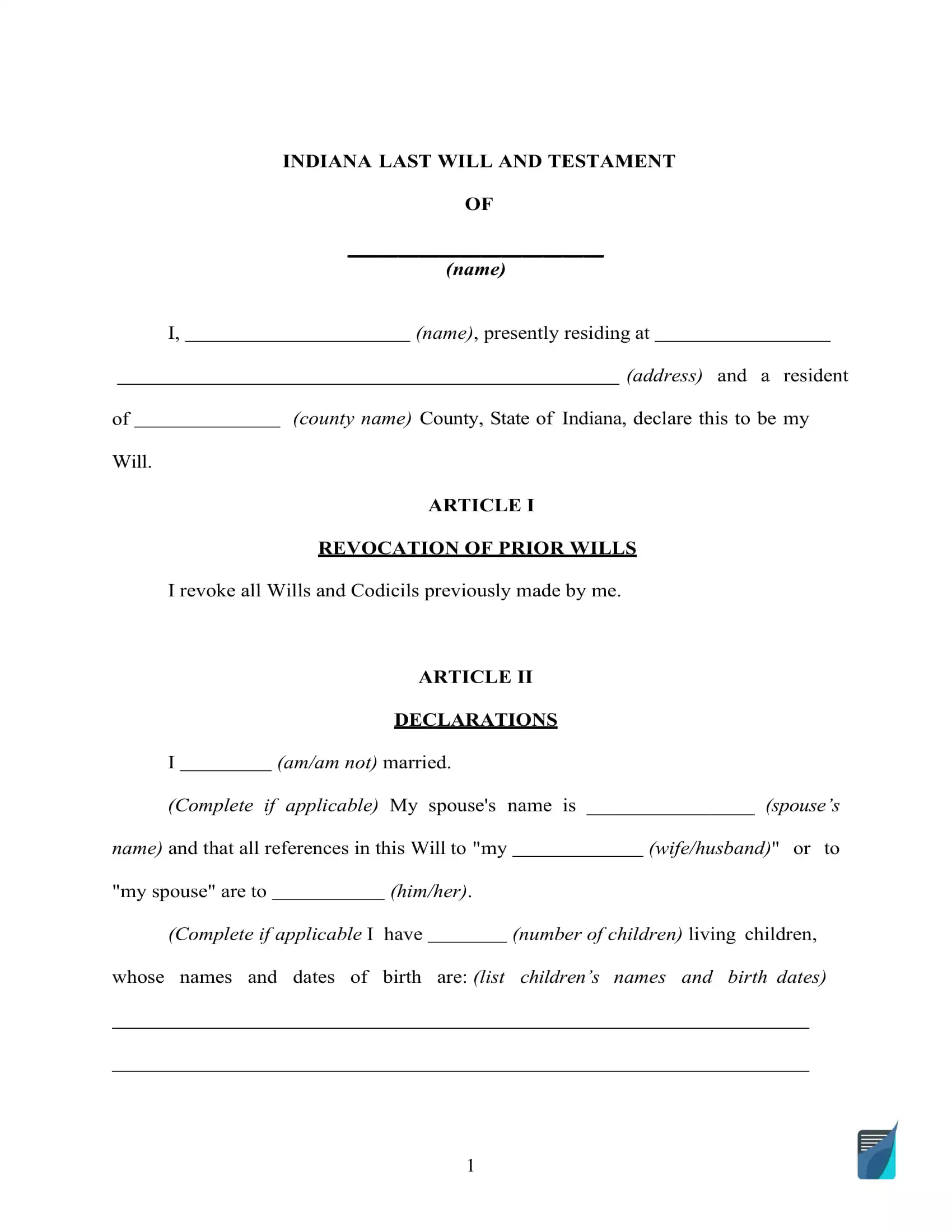
Download the free, fillable Indiana last will and testament template below as a PDF or Word file, or build one with our online document maker. This page also covers Indiana’s signing rules and walks through how to complete the form.
Indiana law sets out exactly who can sign a last will and how it must be witnessed before a probate court will accept it. Download the fillable PDF or Word form below and follow each requirement as you fill it in.
| Requirements | State laws | |
| Statutes | Title 29 – Probate; Article 1 – Probate Code | |
| Signing requirement | Two attesting witnesses | 29-1-5-3. Signatures; videotape (see Sources) |
| Age of testator | 18 and older or younger person under certain circumstances | 29-1-5-1. Sound mind; armed forces (see Sources) |
| Self-proving wills | Allowed | 29-1-5-3.1. Self-proving clause (see Sources) |
Indiana has no separate rule for handwritten wills: every will other than a nuncupative (oral) will must be in writing and signed by the testator and at least two witnesses (Ind. Code 29-1-5-2, 29-1-5-3), so a handwritten will is valid only when it is witnessed, and an unwitnessed holographic will is not.[2.1]
Indiana recognizes an oral (nuncupative) will only in limited cases: the testator must be in imminent peril of death and die of that peril, the will must be declared before two disinterested witnesses, written down within 30 days, and offered for probate within six months, and it can pass only personal property worth up to $1,000 ($10,000 for a person in active military, air, or naval service in time of war) (Ind. Code 29-1-5-4).[2.2]
Indiana also recognizes electronic wills: an electronic will must be signed with the testator's electronic signature and attested by the electronic signatures of at least two witnesses, all in each other's presence, under the conditions set in Ind. Code 29-1-21-4.[3.1]
A will is valid in Indiana when the testator signs it (or directs someone else to sign it for them) and at least two witnesses watch the signing and sign the will themselves.[1.3] Skipping any of these steps can leave a will open to challenge in probate court.
Adding a self-proving affidavit under the will’s self-proving clause lets the court accept the will without calling your witnesses to testify, which can speed up probate.[1.3]
1. Think about your options. One thing to bear in mind is whether you wish to write the entire document by hand (holographic wills) or use a fillable last will and testament form that we provide. The latter comes in two formats (PDF and DOCX) so that you could have more options regarding editing it the way you need. You can also create a customized document by answering simple questions if you opt for our Indiana last will maker.
2. Indicate your information. Establish the testator and their particulars: full names and addresses (city, county, and state). Go through the details you wrote along with the remainder of the section.

3. Choose the executor. Name the executor who will carry out your will. Enter their full legal name and their city, county, and state of residence. It is advised to choose somebody who resides in the same state as you.
As a safeguard, you can also name an alternate executor. That way, if the person you chose first cannot serve, a second dependable executor is already named and ready to step in.

4. Indicate the guardian (optional). In case you’ve got minor or dependent children and do not want the court to select a guardian for them when you are no longer on this Earth, you can appoint somebody you know as a guardian for your children. It is also possible to assign someone who will take care of any pets you might have.

5. Specify your beneficiaries. At this stage, you establish people who are going to receive your assets. For each inheritor, specify these details: full name, address, and the way they are related to you. Charitable organizations can also be your beneficiaries.
6. Designate possessions. You can indicate which of your respective inheritors gets this or that piece of property. Otherwise, the assets will be divided evenly between the beneficiaries. Property can include cash, shares, realty, business ownership, money for unresolved arrears, and any tangible items of commercial value that count among your possessions.

7. Ask witnesses to sign the document. Under Indiana law, at least two witnesses must watch you sign and then sign the will themselves, in your presence and in each other’s presence.[1.3] As an extra precaution against situations when the will is contested or any other problems, it makes sense to assign a witness who’s younger than you to ensure they will still be there after you are gone.

Indiana sets no minimum age for witnesses: any person competent to be a witness may attest your will (Ind. Code 29-1-5-2). Use witnesses who receive nothing under the will: if a beneficiary witnesses and the will cannot be proved without them, their gift is void, except for the share they would have taken without a will.[2.3]
Indiana does not require a will to be notarized: it is valid when you and at least two witnesses sign it (Ind. Code 29-1-5-3). Even the self-proving clause is signed by you and the witnesses under the penalties for perjury, not before a notary (Ind. Code 29-1-5-3.1).[2.4]

Indiana testators most often ask about self-proving affidavits, who can sign in their place, and how to change a will after signing it. The three answers below cite the same Indiana statute that governs signing and witnessing a will.
No, in Indiana, there isn’t such a requirement.[1.3] But, attaching one could be rather useful since it eliminates the demand for witnesses’ testimony during probate, which eases the process substantially.
No, only you can change your will. There is only one particular situation when a third party is allowed to get involved. In case you’re physically incapable of signing your last will and testament, someone can do it instead of you, at your direction and in your presence.[1.3]
Yes. Under Section 29-1-5-6 of the Ind. Code, you revoke a will by destroying or marking it up with the intent to cancel it, or by signing a new will or written statement that cancels the old one.[1.2]
For minor changes, it is recommended to use a codicil. But if you want to change a lot of things, it is better to create a new will.
| Related documents | When to create one |
| Codicil | You would like to make one or a few slight modifications to your will. |
| Self-proving affidavit | You want to expedite the probate later on. |
| Living will | You want to establish what health care you expect if you’re unable to express that yourself. |
| Living trust | You would like to skip probate by putting your property in the possession of a trust. |
General information, not legal or tax advice.
