An Indiana small estate affidavit is a written statement that an estate qualifies for Indiana's small estate procedure under Ind. Code § 29-1-8-1. It is made by or on behalf of the distributee, the person entitled to the property. For a person who died after June 30, 2022, the gross probate estate cannot exceed $100,000.[1.1] At least 45 days must also have passed since the death.[1.2]
Last Updated: October 2026. This guide is reviewed and updated regularly to reflect current Indiana law. If you notice an error or outdated information, please contact us.
Create a free high quality Indiana Small Estate Affidavit online now!
Build Your Document
Answer a few simple questions to make your document in minutes
Save and Print
Save progress and finish on any device, download and print anytime
Sign and Use
Your valid, lawyer-approved document is ready
... or download your Indiana Small Estate Affidavit Form as a PDF file
Two terms appear throughout the form. The decedent is the person who died. The affiant is the person who makes the statements in a small estate affidavit and signs it.
The PDF on this page is Form CCA-EM-0722-5000, the "Affidavit for Transfer of Assets Without Administration" approved by Indiana's Coalition for Court Access. It is two pages long and contains:
A caption with the county and the decedent's name
Twelve numbered statements, including the value of the estate (item 5), why the listed people are entitled (item 6) and up to five people entitled to property, with the holder of each item (item 7)
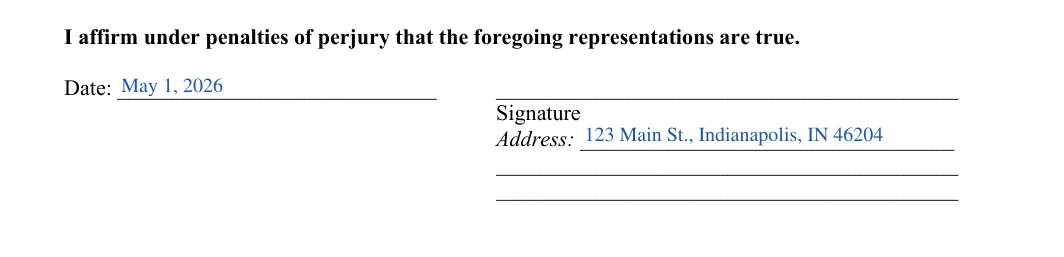
An affirmation under penalties of perjury, followed by the date, the affiant's signature and address
Have these details ready before you start:
The decedent's full name, date of death and the Indiana county where the decedent lived
For each person entitled to property: name, age, address, relationship to the decedent, a description of the property and their percentage of it
The name and address of each bank, company or person holding the property
If the property passes under a will: the county and court where the will was probated and recorded, the date, and a copy of the will to attach as Exhibit A
Indiana Laws and Requirements
Indiana allows a small estate affidavit only when three conditions in Ind. Code § 29-1-8-1 are met. The affidavit is made by or on behalf of the distributee, the person entitled to receive the property, and it must state each condition.[2] The three conditions are:
Value limit: the gross probate estate, wherever located and less liens, encumbrances and reasonable funeral expenses, cannot exceed $100,000 for the estate of an individual who dies after June 30, 2022.[1.1]
Waiting period: at least 45 days must have passed since the death of the decedent.[1.2]
No personal representative: no application or petition for the appointment of a personal representative can be pending or have been granted in any jurisdiction.[2]
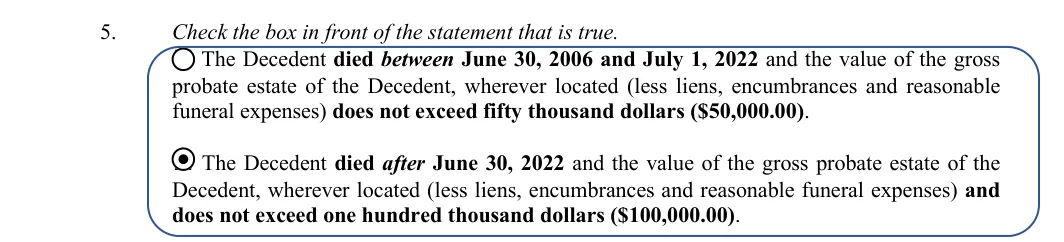
Item 5 of the form has two boxes. Check the $50,000 box only if the person died after June 30, 2006 and before July 1, 2022. For a person who died after June 30, 2022, check the $100,000 box.[1.1]
Check the date of death first. The value limit depends on it, and the form asks for it in item 1.[1.1]
Under Ind. Code § 29-1-8-1(a), the affidavit is presented to the person or business that owes the decedent money or holds the decedent's personal property, and that person must then pay or deliver it to the distributee.[1.3]
Other Indiana Forms
Need some other Indiana forms? We offer free templates and straightforward personalization experience to everyone who wishes for less hassle when dealing with forms.
Create a free high quality Indiana Small Estate Affidavit online now!
Filling Out the Indiana Small Estate Affidavit Form
Fill out the two-page Form CCA-EM-0722-5000 from top to bottom. The seven steps below follow its caption and numbered items. Fill in the downloaded PDF with our PDF editor, or print it and write the answers by hand.
The screenshots under each step show Form CCA-EM-0722-5000, the court-approved Indiana form, filled with sample entries in blue, so you can see where each answer goes. The names, addresses, dates and amounts are examples only.
Caption (page 1). Fill in the county on the "COUNTY OF" line and write the decedent's full name under "IN RE THE ESTATE OF".Step 1: sample entries, not a real document.
Items 1 to 4 (page 1). Enter the date of death in item 1 and the Indiana county where the decedent lived in item 2. Items 3 and 4 are printed statements: no application or petition has been made to appoint a personal representative of the estate, and more than 45 days have passed since the death. Wait until the 45 days have passed before you sign.Step 2: sample entries, not a real document.
Item 5, value of the estate (page 1). Check one box. The first box is for a person who died after June 30, 2006 and before July 1, 2022, with a $50,000 limit. The second box is for a person who died after June 30, 2022, with a $100,000 limit. Both measure the gross probate estate, wherever located, less liens, encumbrances and reasonable funeral expenses.Step 3: sample entries, not a real document.
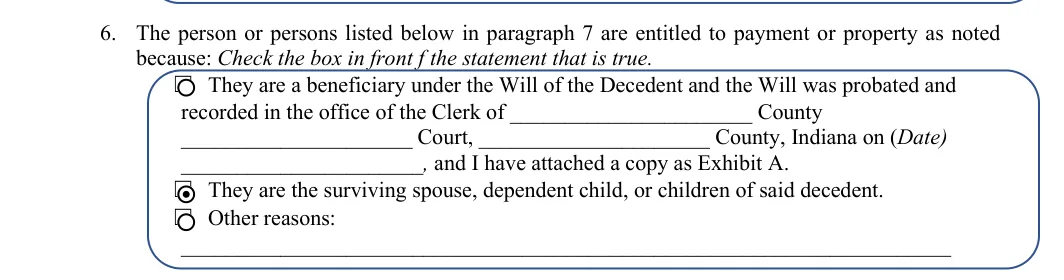
Item 6, why the people in item 7 are entitled (page 1). Check one box. If they take under a will, the will must already be probated and recorded: enter the county and court where it was recorded and the date, and attach a copy of the will as Exhibit A. Check the second box if they are the decedent's surviving spouse, dependent child or children, or check "Other reasons" and explain on the line below it.Step 4: sample entries, not a real document.
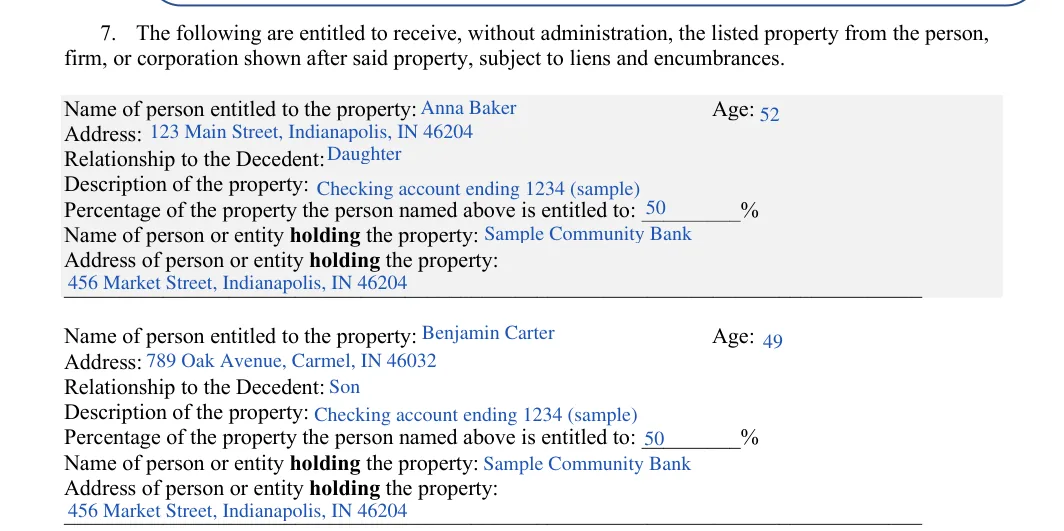
Item 7, people entitled and who holds the property (pages 1 and 2). For each person entitled to property, enter their name, age, address and relationship to the decedent, a description of the property, their percentage of it, and the name and address of the person or company holding it, such as a bank. The form has room for five people, two on page 1 and three on page 2.Step 5: sample entries, not a real document.
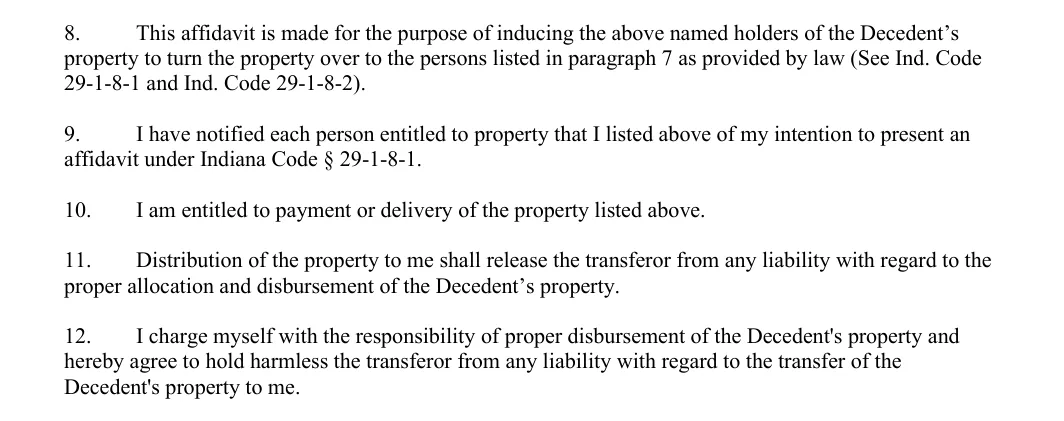
Items 8 to 12 (page 2). These are printed statements. In item 9 you say you have told each person listed in item 7 that you intend to present the affidavit, so do that before you sign. In items 10 to 12 you state that you are entitled to payment or delivery of the property, that delivery releases the holder from liability, and that you take responsibility for passing the property on correctly.Step 6: sample entries, not a real document.
Affirmation, date, signature and address (page 2). The form ends with the printed affirmation that the statements are true under penalties of perjury. Enter the date, sign on the Signature line and write your address on the lines below it. Then give the affidavit to each person or company holding the property listed in item 7.Step 7: sample entries, not a real document.
Ind. Code § 29-1-8-1 sets three conditions for the small estate procedure in Indiana. They are a value limit of $100,000 for a death after June 30, 2022, a wait of at least 45 days, and no pending personal representative.[1.1][1.2][2] The answers below cover each condition and the earlier limits.
Do I need probate if the estate is small?
Indiana has a separate small estate procedure that uses an affidavit, available when three conditions are met. The gross probate estate cannot exceed $100,000 for a person who died after June 30, 2022.[1.1] At least 45 days must have passed since the death, and no application to appoint a personal representative can be pending or granted.[1.2][2] Our guide What Is Probate explains the court process.
What is the amount for a small estate affidavit?
For a person who died after June 30, 2022, the amount is $100,000. It is measured on the gross probate estate, wherever located, less liens, encumbrances and reasonable funeral expenses.[1.1] The affidavit states that the estate's value does not exceed that amount.[2]
What is the threshold for a small estate affidavit in Indiana?
The Indiana threshold depends on the date of death:
$100,000 when the person died after June 30, 2022
$50,000 when the person died after June 30, 2006 and before July 1, 2022
$25,000 when the person died before July 1, 2006[1.1]
How much does an estate have to be worth to go to probate in Indiana?
When the person died after June 30, 2022, an estate worth more than $100,000 does not meet the value condition for a small estate affidavit in Indiana.[1.1] The limit counts the gross probate estate after liens, encumbrances and reasonable funeral expenses.
General information, not legal or tax advice.
Sources
Unless noted otherwise, the sources below are from the Ind. Code.
Mara has been practicing estate planning and trust law in California since 2003, taking pride in helping clients of all backgrounds and asset profiles form a complete and customized estate plan. Her specialties are: estate planning, wills and trusts, trust and probate administration.