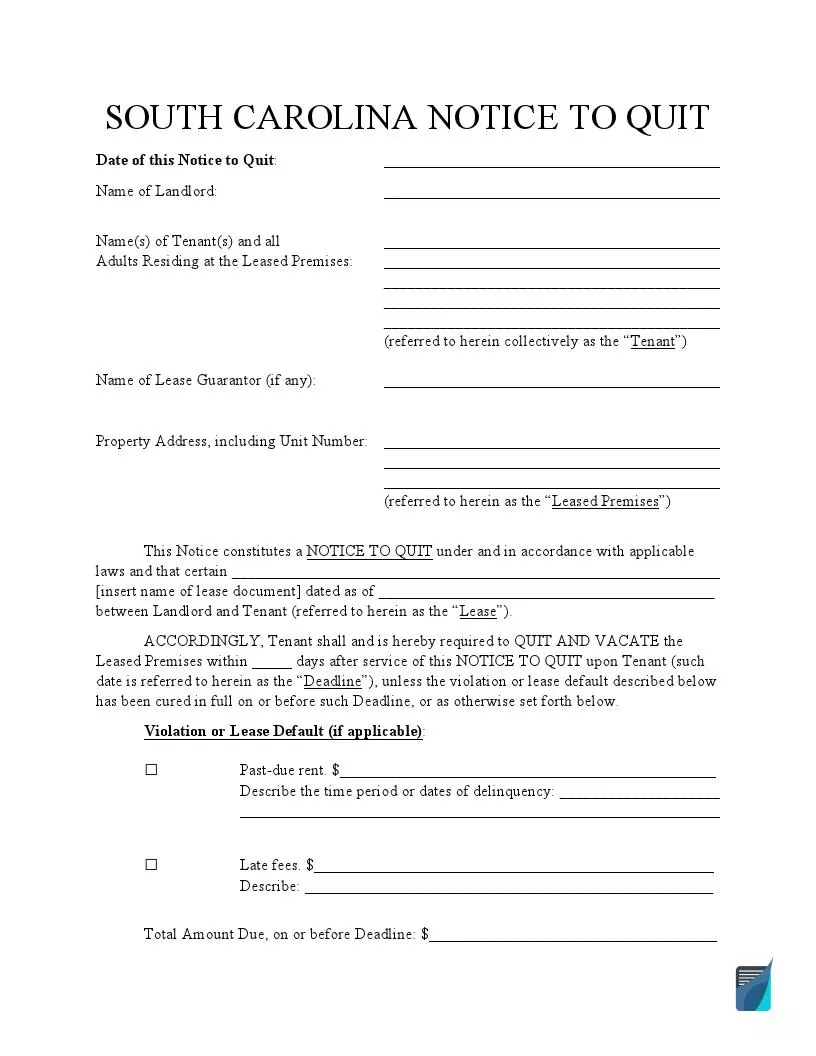
A South Carolina eviction notice is a written notice a landlord serves on a tenant to end the tenancy for nonpayment of rent, a lease violation, or without cause.[1.5][1.9] In practice, a court case follows if the notice is not obeyed. South Carolina landlords use three main types: a 5-day notice for unpaid rent, a 14-day notice for a lease violation, and a 30-day notice to end a month-to-month tenancy without a reason.
Last Updated: September 2026. This guide is reviewed and updated regularly to reflect current South Carolina law. If you notice an error or outdated information, please contact us.
If the tenant does not pay the rent or fix the lease violation within the notice period, the rental agreement ends on the date the notice states.[1.5] The notice itself is not a court order. A landlord may not recover possession of the unit by action or otherwise except as the statute allows,[1.8] and in practice that means an ejectment case in court.
South Carolina Eviction Laws
South Carolina eviction law sets out four notice periods, one for each way a tenancy can end. A landlord must give five days notice for unpaid rent, fourteen days notice for a lease violation, and thirty days notice to end a month-to-month tenancy without cause.[1.5][1.9] These rules sit in Title 27, Chapter 40 of the South Carolina Code of Laws, commonly called the Residential Landlord and Tenant Act.
A South Carolina eviction notice is also called a notice to quit or a notice to vacate. The Rule to Vacate or Show Cause is a separate document served in the action for possession, not the landlord's initial notice.[1.10]
- Nonpayment of rent: 5 days notice, then the landlord may terminate the rental agreement if the rent is still unpaid.[1.5]
- Lease violation (noncompliance): the rental agreement terminates on a date not less than fourteen days after receipt of the notice, if the breach is not remedied in fourteen days.[1.5]
- Month-to-month tenancy, no cause: at least thirty days before the termination date specified in the notice.[1.9]
- Week-to-week tenancy, no cause: at least seven days before the termination date specified in the notice.[1.9]
- Court ejectment case: after the notice period ends, the landlord files an Application for Ejectment under the state's ejectment of tenants statute.[2.1][2.2]
South Carolina Eviction Notice Laws Details
Eviction Notice Types Used In South Carolina
South Carolina landlords use three notice types depending on why they are ending the tenancy. A 5-day notice covers unpaid rent, a 14-day notice covers a lease violation the tenant can fix, and a 30-day or 7-day notice ends a month-to-month or week-to-week tenancy without a stated reason.[1.5][1.9] Each notice must be in writing and delivered to the tenant.[1]
- 5-Day Notice to Quit (Nonpayment). Used when the tenant has not paid rent. The tenant has 5 days to pay the rent or move out before the landlord can file for ejectment.[1.5]
- 14-Day Notice to Quit (Noncompliance). Used when the tenant has violated a term of the lease other than nonpayment. The tenant has 14 days to fix the problem or move out.[1.5]
- 30-Day Notice to Quit (Month-to-Month). Used to end a month-to-month tenancy without a stated cause. Either the landlord or the tenant can send this notice.[1.9]
- 7-Day Notice to Quit (Week-to-Week). Used to end a week-to-week tenancy without a stated cause.[1.9]
Create a free South Carolina Eviction Notice online in under 5 minutes!
Eviction Process In South Carolina
Evicting a tenant in South Carolina takes three steps. The landlord first gives the tenant the required written notice.[1.5] If the tenant does not comply, the landlord files an Application for Ejectment, and the sheriff enforces a Writ of Ejectment if the landlord wins the case.[2.1][2.2] A landlord may not take possession of the unit by action or otherwise except as the statute allows.[1.8]
- Serve the notice. The landlord delivers the 5-day, 14-day, 30-day, or 7-day notice required for the reason behind the eviction.[1]
- File for ejectment. If the tenant does not pay, cure the violation, or move out, the landlord files an Application for Ejectment in court. The court then issues a Rule to Show Cause, and the tenant has ten days after being served to respond or move out.[2.1]
- Enforce the writ. If the magistrate rules for the landlord, the magistrate must issue a Writ of Ejectment within five days, and the sheriff or a constable carries out the writ.[2.2] In practice, the tenant has very little time to leave once the writ is posted or delivered.
A landlord may not recover or take possession of the dwelling unit by action or otherwise, including wilful diminution of required essential services to the tenant by interrupting or causing the interruption of services, except in case of abandonment, surrender, termination, or as permitted in this chapter.
A landlord who locks a tenant out or shuts off utilities without going through the Magistrate's Court violates this law, even if the tenant owes rent.[1.8]
South Carolina Tenant and Landlord Rights
South Carolina law gives tenants and landlords rights that apply outside the notice and court process. These cover the security deposit, the landlord's right to enter, lock changes, retaliation, and what happens to a tenant's property after a fire or an eviction.
- Security deposit: any deduction from the deposit must be itemized in writing, and the deposit must be returned within thirty days after termination of the tenancy and delivery of possession and demand by the tenant, whichever is later.[1.1]
- Landlord's right to enter: apart from an emergency, the landlord must give the tenant at least twenty-four hours notice of his intent to enter, and may enter only at reasonable times.[1.2]
- Lock changes: a tenant cannot change the locks without the landlord's permission.[1.2]
- Repeated nonpayment notices: once a landlord gives a tenant one written nonpayment notice, or the rental agreement itself states this rule in plain language, the landlord's notice obligation for nonpayment is satisfied for the rest of that lease term.[1.5]
- Landlord repairs after a tenant's failure to maintain the unit: if a tenant does not keep the unit clean and safe as the lease and state law require, the landlord may give written notice. If the tenant does not fix the problem within 14 days, or promptly in an emergency, the landlord may enter, complete the repair, and bill the tenant for the cost.[1.6]
- Landlord noncompliance: if the landlord fails to meet a duty under the lease or state law, the tenant can give written notice, and the landlord has 14 days to fix the problem before the tenant may end the lease.[1.3]
- Fire or casualty: a tenant who immediately vacates because fire or casualty has substantially impaired the unit may end the rental agreement by notifying the landlord in writing within seven days thereafter.[1.4]
- Retaliation: if a landlord retaliates against a tenant for a protected complaint by refusing to renew the lease, and the tenant is current on rent, the landlord may not recover possession of the dwelling unit for seventy-five days. A tenant who intends to raise retaliation as a defense must notify the landlord in writing within ten days after service of the Rule to Show Cause.[1.10]
- Abandonment: the unexplained absence of a tenant for a period of fifteen days after default in the payment of rent is construed as abandonment of the unit. If the tenant leaves personal property with a fair market value of five hundred dollars or less behind, the landlord may enter and dispose of it.[1.7]
- Property removed during an eviction: personal property placed on a public street or highway after an eviction is removed by municipal or county officials after a period of forty-eight hours, excluding Saturdays, Sundays, and holidays.[1.5]
South Carolina eviction cases use four Magistrate's Court forms. The Application for Ejectment starts the case, and the Rule to Show Cause notifies the tenant of it. The Writ of Ejectment authorizes the sheriff to remove the tenant, and the Affidavit and Itemization of Accounts lists what the tenant owes for unpaid rent.
- Application for Ejectment (SCCA/732). The landlord files this form to start the eviction case after the notice period ends.
- Rule to Show Cause (SCCA/733). The Magistrate's Court issues this to the tenant. The tenant has ten days after being served to respond or move out.[2.1]
- Writ of Ejectment (SCCA/734). The court issues this after ruling for the landlord, authorizing the sheriff to remove the tenant.[2.2]
- Affidavit and Itemization of Accounts (SCCA/716). The landlord attaches this to a nonpayment case to itemize the exact rent owed.
Frequently Asked Questions
What Is the 30-Day Eviction Notice in SC?
Either the landlord or the tenant may end a month-to-month tenancy in South Carolina by giving the other at least thirty days of written notice before the termination date stated in the notice.[1.9] This 30-day notice does not require a reason.[1] A landlord who wants the tenant out at the end of a rental period, or a tenant who wants to move, uses this notice instead of the 5-day or 14-day notice.
General information, not legal or tax advice.
Sources
- S.C. Code Ann. §§ 27-40-410 to 27-40-910. Accessed September 2026.
- 1.1 § 27-40-410
- 1.2 § 27-40-530
- 1.3 § 27-40-610
- 1.4 § 27-40-650
- 1.5 § 27-40-710
- 1.6 § 27-40-720
- 1.7 § 27-40-730
- 1.8 § 27-40-760
- 1.9 § 27-40-770
- 1.10 § 27-40-910
- S.C. Code Ann. §§ 27-37-10 to 27-37-140. Accessed September 2026.
- 2.1 § 27-37-20
- 2.2 § 27-37-100
With over 25 years of experience as a business and transactional attorney, Jennifer has mastered the craft of closing highly successful deals for her clients. Through her wide-ranging expertise in commercial contracts, real estate transactions, M&A and corporate law, Jennifer secures results that are second-to-none.