A South Carolina small estate affidavit is a sworn written statement made by or for a person claiming to be a decedent's successor. It goes to whoever owes the decedent money or holds the decedent's property. S.C. Code Ann. § 62-3-1201 then allows payment or delivery for an estate of $45,000 or less, 30 days or more after the decedent died, with the probate judge's approval.[1] Download the court's free Form SCCA 420ES below and follow the 10 steps to complete it.
Last Updated: October 2026. This guide is reviewed and updated regularly to reflect current South Carolina law. If you notice an error or outdated information, please contact us.
Create a free high quality South Carolina Small Estate Affidavit online now!
Build Your Document
Answer a few simple questions to make your document in minutes
Save and Print
Save progress and finish on any device, download and print anytime
Sign and Use
Your valid, lawyer-approved document is ready
... or download your South Carolina Small Estate Affidavit Form as a PDF file
The state's small estate affidavit rules are in S.C. Code Ann. § 62-3-1201. The section covers tangible personal property and instruments that show a debt, an obligation or stock belonging to the decedent, and real property is not on that list.[1]
The section sets these conditions for using the affidavit.[1]
The entire probate estate, wherever located, is worth no more than $45,000 after liens and encumbrances.
At least 30 days have passed since the decedent died.
No application or petition to appoint a personal representative, the person a court names to manage the estate, is pending or has been granted in any jurisdiction.
The probate judge approves and countersigns the affidavit, and only once satisfied that the successor is entitled to the property.
The statute words the dollar limit this way.
The value of the entire probate estate (the decedent's property passing under the decedent's will plus the decedent's property passing by intestacy), wherever located, less liens and encumbrances, does not exceed forty-five thousand dollars.
In plain words, the limit counts assets that pass under a will and assets that pass without one.
South Carolina Small Estate Affidavit Laws Details
The probate court of the county where the decedent was domiciled at death. If the decedent was not domiciled in South Carolina, the county where the decedent's property is located.[1]
Court Approval
Approved and countersigned by the probate judge[1]
The form is titled "Affidavit for Collection of Personal Property Pursuant to Small Estate Proceeding." The current edition is marked SCCA 420ES (Revised 03/2026), so you may also see it called Form 420ES.
If the decedent lived in another state, start from our small estate affidavit form page and pick that state.
Filing the Affidavit and Court Approval
File the affidavit in the probate court for the county where the decedent was domiciled at the time of death, or in the county where the decedent's property is located if the decedent was not domiciled in South Carolina. The probate judge of that county must approve and countersign the affidavit, and only does so once satisfied that the successor is entitled to payment or delivery of the property.[1]
The waiting period counts 30 days after the decedent died[1], and you can count the days with our deadline calculator.
Other South Carolina Forms
Interested in more South Carolina forms? We offer free forms and straightforward customization experience to everyone who wishes for having fewer to none issues when coping with papers.
Create a free high quality South Carolina Small Estate Affidavit online now!
Filling Out the South Carolina Small Estate Affidavit Form
The PDF on this page is the court's current form, Form SCCA 420ES (Revised 03/2026), from the South Carolina Judicial Branch. It runs 11 pages, and the 10 steps below follow its order and name the item and page each step covers. Fill in the downloaded PDF with our online PDF editor, or print it and write the answers by hand.
The screenshots under each step show Form SCCA 420ES, the official South Carolina form, filled with sample entries in blue, so you can see where each answer goes. The names, addresses, dates and amounts are examples only.
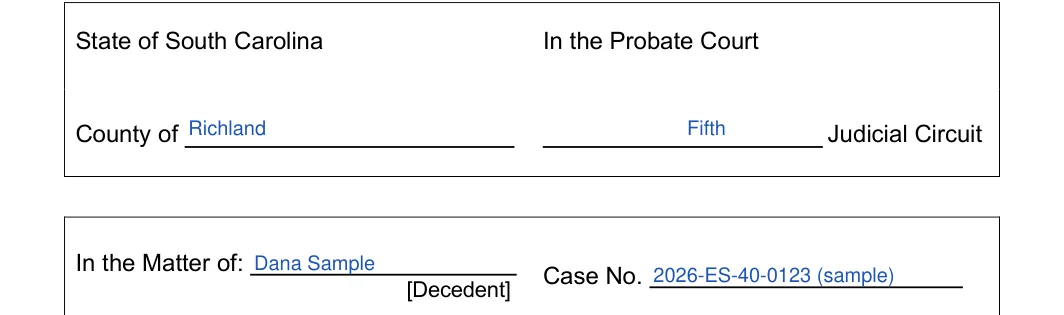
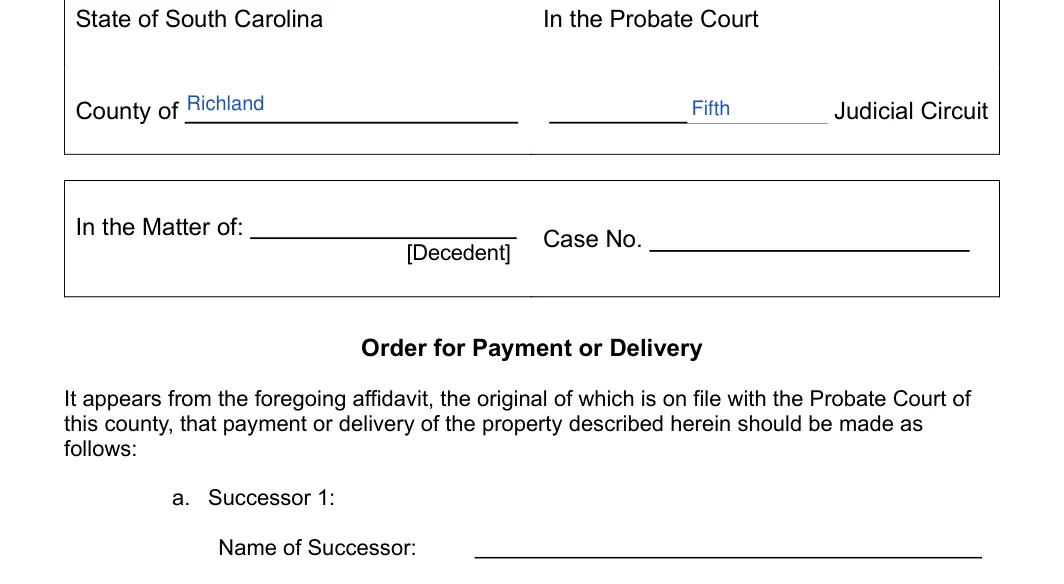
Court caption (page 1). Pick the county and the judicial circuit from the drop-down lists at the top of page 1, or write them in if you print the form. Write the decedent's name in the "In the Matter of" box. Leave the case number blank unless the probate court has already given you one. The county and circuit you pick also appear on the court's order on page 9. Step 1: sample entries, not a real document.
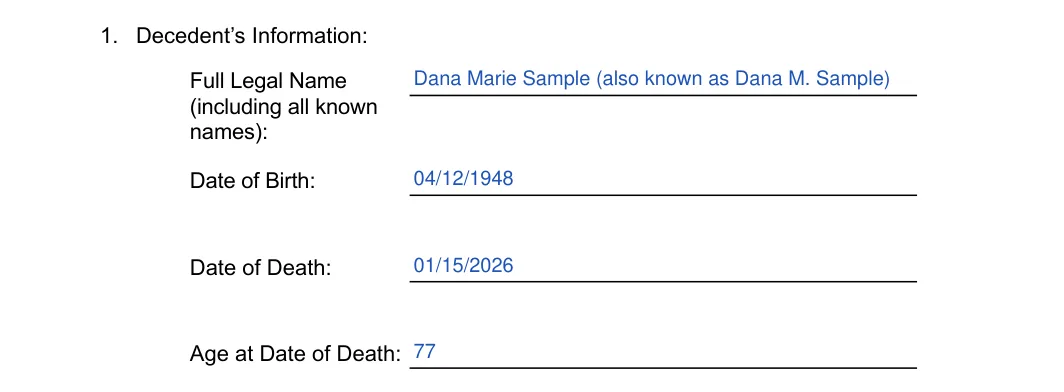
Item 1, Decedent's Information (page 1). Write the decedent's full legal name, including all known names, then the date of birth, the date of death and the age at the date of death. Step 2: sample entries, not a real document.
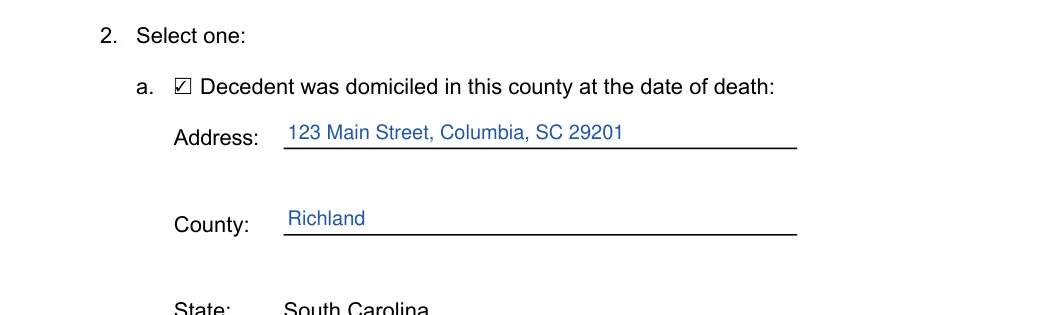
Item 2, where the decedent lived (pages 1 and 2). Check box a if the decedent was domiciled in this county at the date of death, and enter the address and the county. Check box b on page 2 instead if the decedent was not domiciled in South Carolina but had probate property in this county, and enter where the property was. If the address is a nursing home, prison or other residential facility, give the decedent's last address before entering it on the line below. Step 3: sample entries, not a real document.
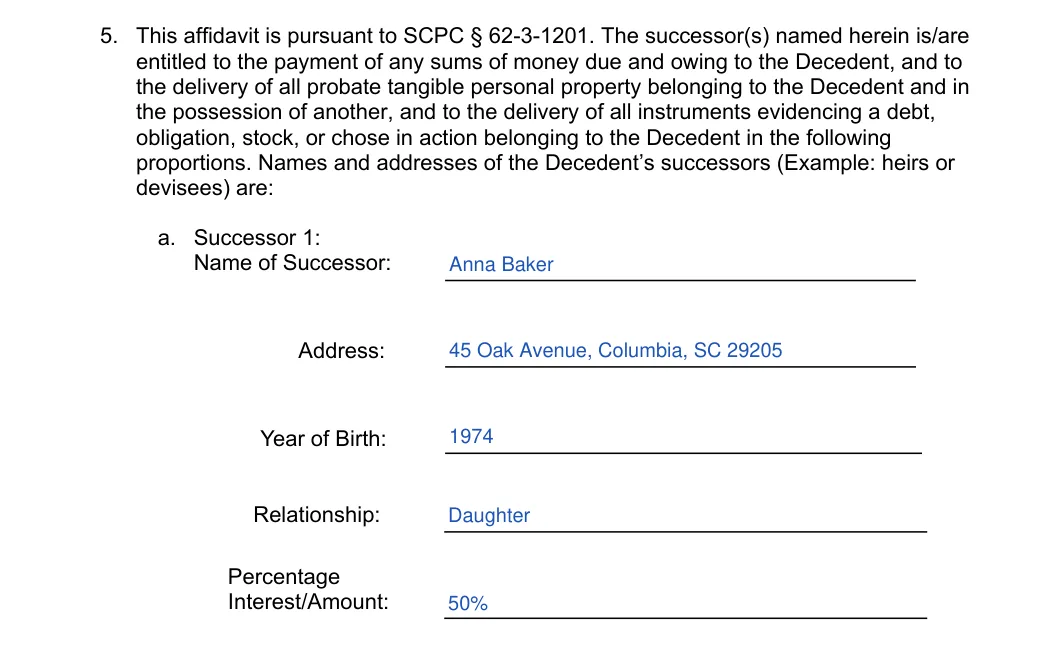
Items 3 to 5, successors (pages 2 to 5). Items 3 and 4 are printed statements: more than 30 days have passed since the death, and no application or petition to appoint a personal representative is pending or has been granted in any jurisdiction. Read them, then in item 5 enter each successor's name, address, year of birth, relationship and percentage interest or amount. The form has room for six successors (a to f) and a box on page 5 to check if you attach sheets for more. Its footnote says successors include anyone who paid reasonable funeral expenses, with proof of payment attached. Step 4: sample entries, not a real document.
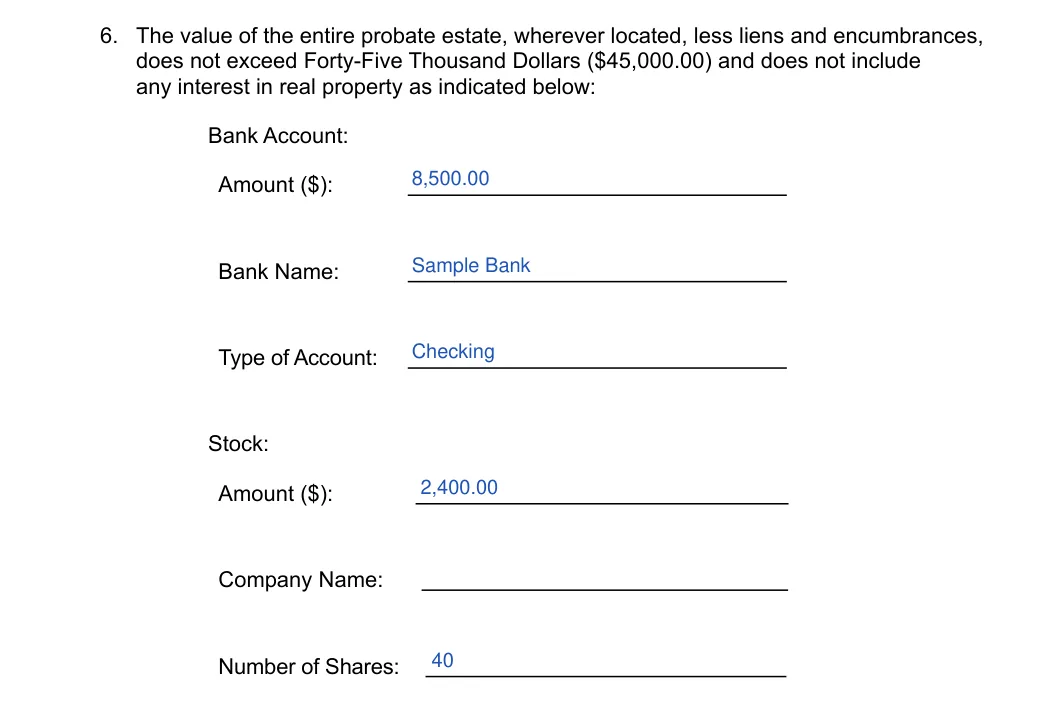
Item 6, bank account and stock (page 5). Item 6 states that the entire probate estate, wherever located, less liens and encumbrances, does not exceed $45,000 and includes no interest in real property. Under it, enter the amount, bank name and type of account for a bank account, then the amount, company name and number of shares for stock. Step 5: sample entries, not a real document.
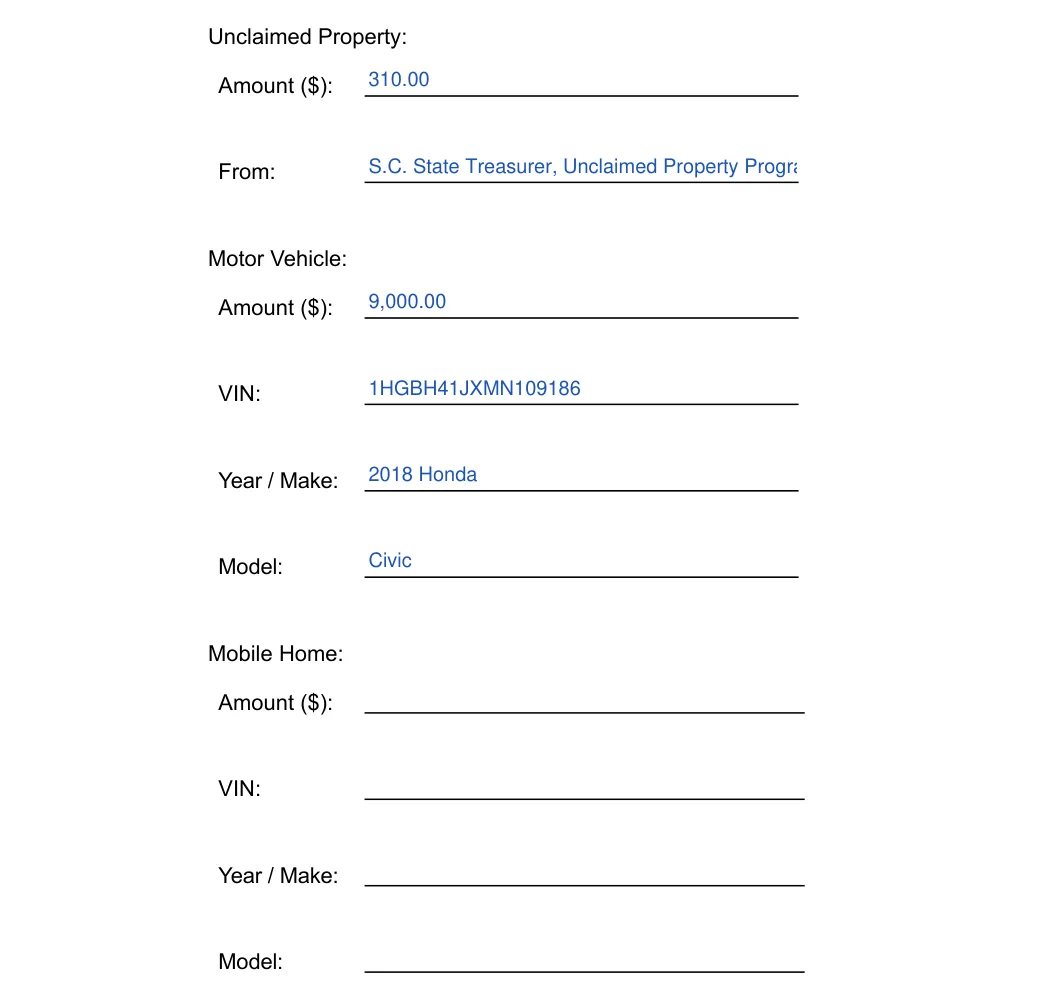
Item 6, unclaimed property, motor vehicle and mobile home (page 6). Enter the amount of any unclaimed property and who holds it, then the amount, VIN, year and make, and model of a motor vehicle and of a mobile home. Step 6: sample entries, not a real document.
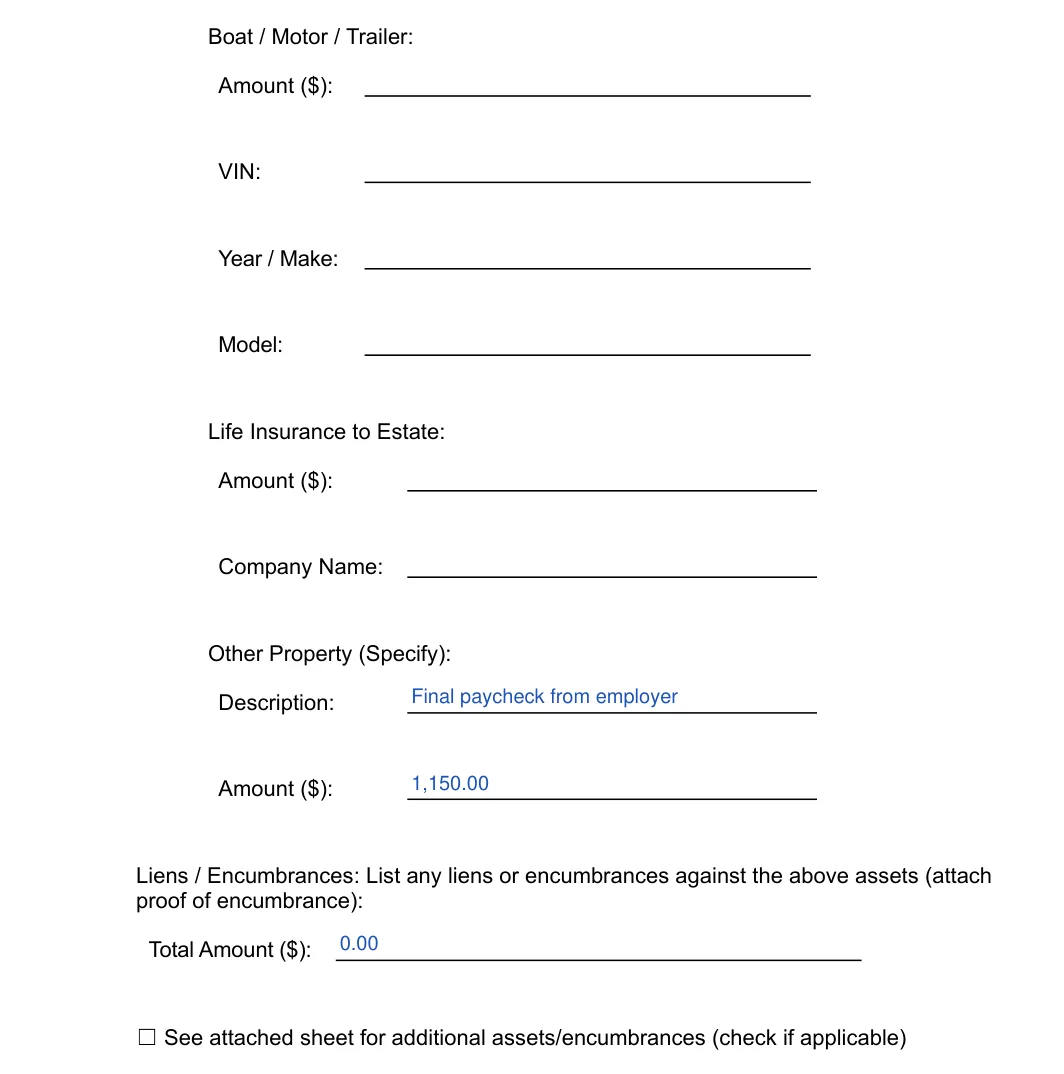
Item 6, boat, life insurance, other property and liens (page 7). Enter the same four details for a boat, motor or trailer, then the amount and company name for life insurance payable to the estate, and a description and amount for any other property. Enter the total of liens or encumbrances against these assets and attach proof of each one. Check the last box if you attach a sheet for more assets or encumbrances. In the fillable PDF the life insurance Company Name line is the same field as the stock Company Name line on page 5, so text typed in one shows in both. If the two companies differ, write the second one by hand or on an attached sheet. Step 7: sample entries, not a real document.
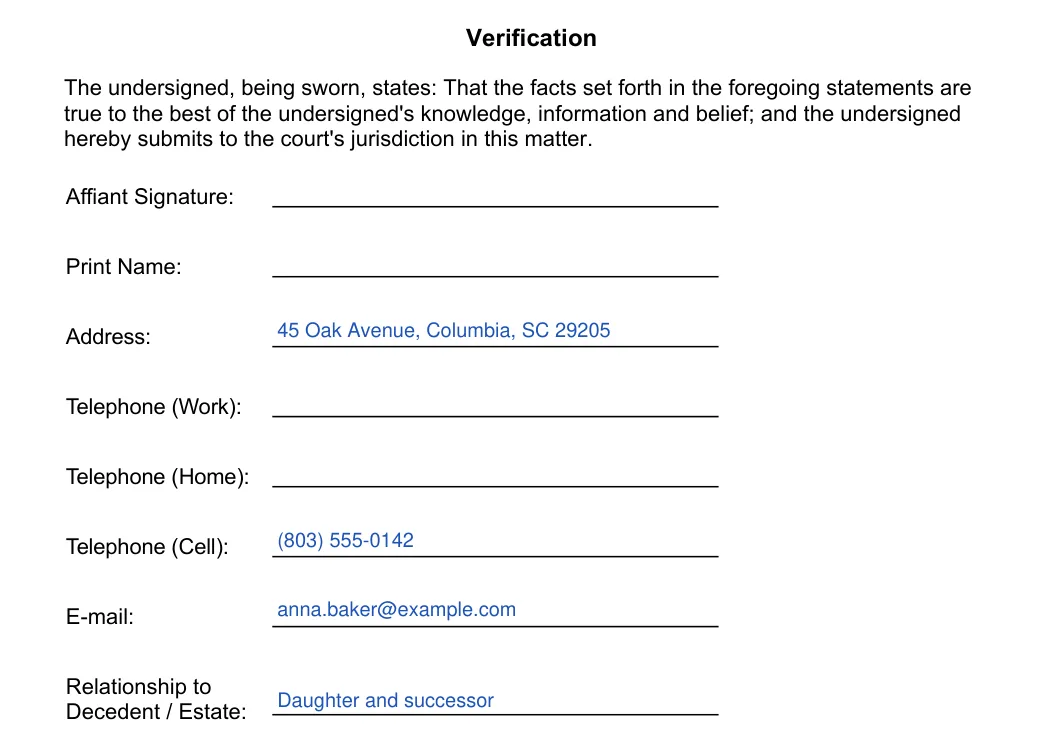
Verification and affiant details (page 8). By signing, the affiant swears that the statements are true and submits to the court's jurisdiction. Sign on the Affiant Signature line in front of a notary, print your name (the Print Name line has no fillable box, so write it by hand), and add your address, telephone numbers, email and relationship to the decedent or estate. Step 8: sample entries, not a real document.
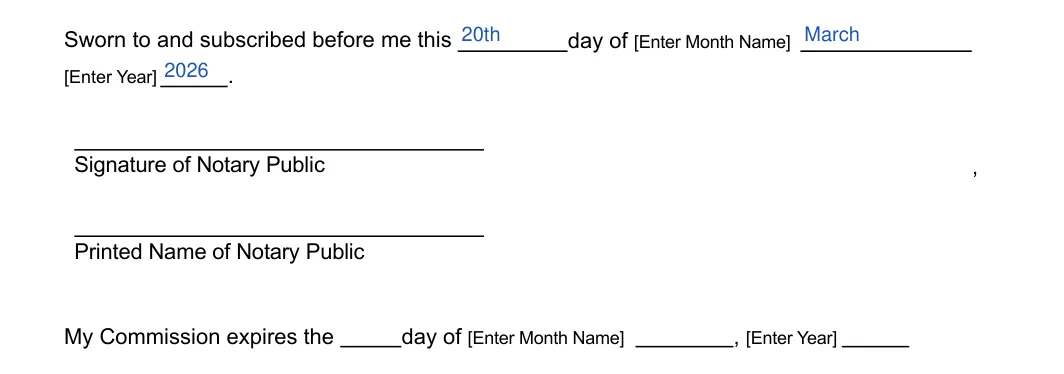
Notary block (page 8). The notary completes the "Sworn to and subscribed before me" date line, signs, prints their name and fills in the date the commission expires. Step 9: sample entries, not a real document.
Order for Payment or Delivery (pages 9 to 11). These pages are the court's order. They repeat the six successor blocks from item 5 and end with the probate judge's signature and date, after which the matter is closed. Ask the probate court clerk whether to copy the successor details from item 5 into the order before you file. Step 10: sample entries, not a real document.
Frequently Asked Questions
These answers summarize the main rules of S.C. Code Ann. § 62-3-1201 for this small estate affidavit process: the dollar limit, the 30-day wait, the filing court and the probate judge's approval.[1] The sections above give the details.
Do I need probate if the estate is small?
South Carolina has an affidavit process for small estates, and a qualifying estate can use it. The entire probate estate, wherever located, must be worth no more than $45,000 after liens and encumbrances, and 30 days must have passed since the decedent died.[1]
What is the threshold for small estate in SC?
The threshold is $45,000, and the statute counts the entire probate estate, wherever located, less liens and encumbrances.[1]
Does a small estate affidavit have to be filed?
Yes, the affidavit is filed in the probate court for the county of the decedent's domicile at the time of death, or in the county where the decedent's property is located if the decedent was not domiciled in South Carolina.[1]
What is the amount for a small estate affidavit in SC?
An estate of $45,000 or less, counted after liens and encumbrances, can use the affidavit[1], and item 6 of the form is where you list each asset and what it is worth.
Do You Need Probate For Small Estates In South Carolina?
The state has a separate affidavit route for small estates in S.C. Code Ann. § 62-3-1201, and it applies only when the estate meets every condition.[1]
The estate is worth $45,000 or less after liens and encumbrances.
At least 30 days have passed since the decedent died.
No request to appoint a personal representative is pending or has been granted.
The probate judge approves and countersigns the affidavit.
General information, not legal or tax advice.
Sources
This guide relies on the primary source listed below. Each bracketed number in the text above points to the matching entry in this list, so you can check the wording of the law yourself.
Mara has been practicing estate planning and trust law in California since 2003, taking pride in helping clients of all backgrounds and asset profiles form a complete and customized estate plan. Her specialties are: estate planning, wills and trusts, trust and probate administration.