
A South Carolina non-compete agreement is a written contract in which an employee or independent contractor promises not to compete with a business during the job and for a set number of years afterward. The template below also adds a non-solicitation promise, and the FormsPal builder creates the document for free.
Last Updated: October 2026. This guide is reviewed and updated regularly to reflect current South Carolina law. If you notice an error or outdated information, please contact us.
Build Your Document
Answer a few simple questions to make your document in minutes
Save and Print
Save progress and finish on any device, download and print anytime
Sign and Use
Your valid, lawyer-approved document is ready
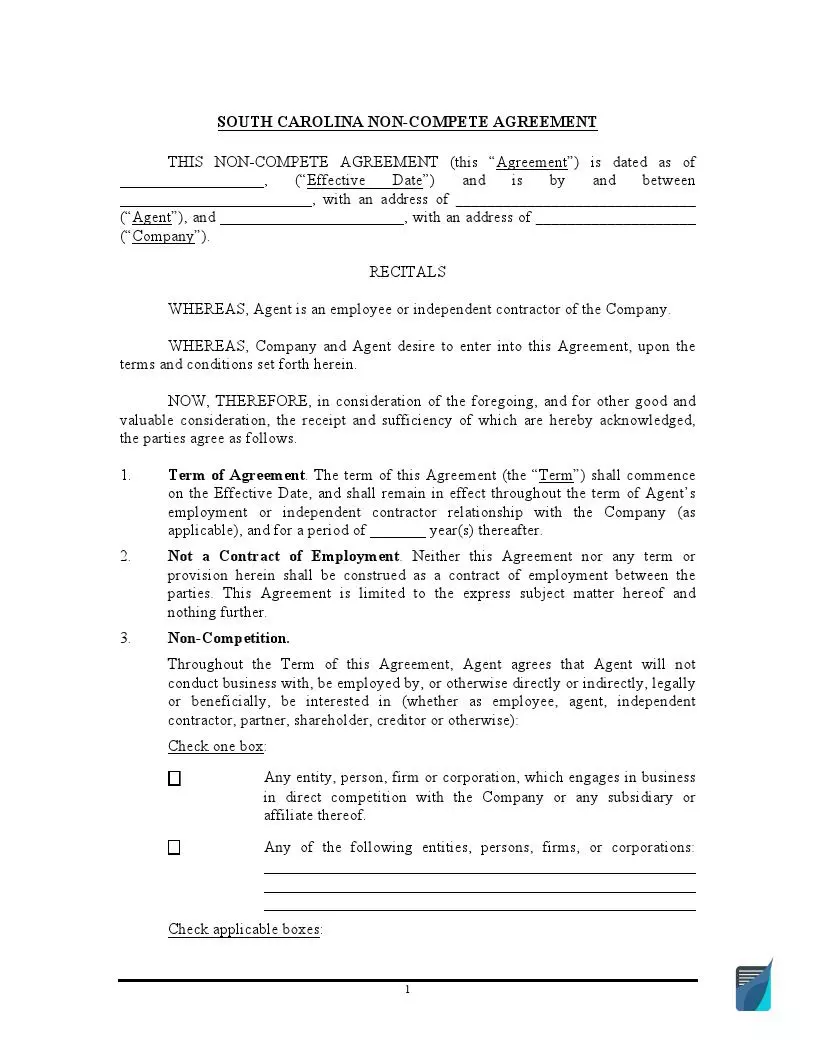
A non-compete agreement is a written promise by an employee not to work with a competitor of the employer for a set time. The FormsPal template is a South Carolina non-compete agreement between an employee or independent contractor and a company. It sets how long the promise lasts, which competitors it covers, a non-solicitation promise, and where a dispute may be heard.
This template covers competition and non-solicitation only. It has no confidentiality clause. To protect customer data, software details or other trade secrets, employers usually use a separate confidentiality agreement alongside it.
Employers most often ask for a non-compete from employees whose work gives them access to customers, pricing or confidential information. Independent contractors sometimes sign one too. Either way, the employer and the employee should both understand the terms before anyone signs.
South Carolina has no statute that sets the test for enforcing non-compete agreements. The test comes from court decisions, which are common law, not from a statute. So it helps to write the terms of your document clearly. The state has also not legislated these points:
In Milliken & Co. v. Morin (2012), the South Carolina Supreme Court restated its four-part test. A non-compete must be no greater than necessary to protect a legitimate business interest of the employer, not unduly harsh and oppressive in limiting the employee's efforts to earn a living, reasonable from the standpoint of sound public policy, and reasonably limited in time and place. The court also says non-competes are generally disfavored and are read strictly against the employer.[2]
One South Carolina statute does mention noncompetition covenants. Section 56-16-120 of the S.C. Code Ann. makes it unlawful to impose unreasonable restrictions on a motorcycle dealer or franchisee relative to noncompetition covenants, among other things.[1] You can read the full code on the South Carolina legislature website, linked in the Sources list below.
It is unlawful directly or indirectly to impose unreasonable restrictions on the motorcycle dealer or franchisee relative to transfer, sale, right to renew, termination, discipline, noncompetition covenants, ...
The rule names motorcycle dealers and franchisees. The template on this page is written for an employee or independent contractor and an employer.
Most problems with non-compete agreements come from vague or missing terms, not from the form itself. Both the employers and employees should read each clause before signing. These are the slips to avoid:
Do not leave a blank or a check box unanswered by accident. An empty term or place leaves both sides guessing what the promise covers.
If you download the PDF, you can fill in the blanks with the online PDF editor. Need a non-compete for another state? Start from the main non-compete agreement template. For a high-stakes contract, ask a South Carolina attorney to review it first.
Not on a motorcycle dealer or franchisee. Section 56-16-120 of the S.C. Code Ann. says it is unlawful to impose unreasonable restrictions on the motorcycle dealer or franchisee relative to transfer, sale, right to renew, termination, discipline, and noncompetition covenants.[1] The full text is on the South Carolina legislature website.
The non-compete clause limits who the employee may work with or be involved with, such as a competing business. The non-solicitation clause stops the employee from enticing away the employer's employees, contractors, customers or vendors. The template has both.
Yes. The template has an optional box that limits the promise to a geographic area you describe. Two more boxes say whether the promise applies to the employee's online business.
General information, not legal or tax advice.

