
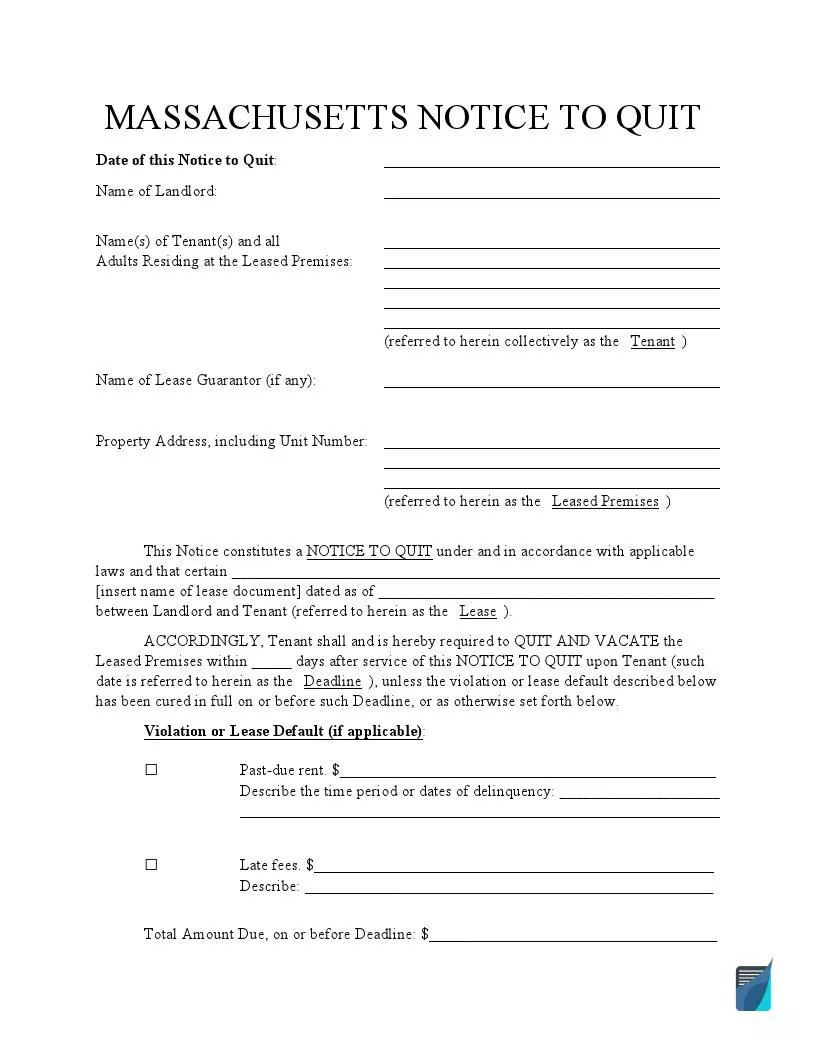
A Massachusetts eviction notice is a written notice a landlord serves on a tenant to end a tenancy for nonpayment of rent, a lease violation, or without cause, before filing an eviction case in court.
Last Updated: September 2026. This guide is reviewed and updated regularly to reflect current Massachusetts law. If you notice an error or outdated information, please contact us.
Build Your Document
Answer a few simple questions to make your document in minutes
Save and Print
Save progress and finish on any device, download and print anytime
Sign and Use
Your valid, lawyer-approved document is ready
Massachusetts law treats most residential tenancies as estates at will and sets the notice period a landlord must use based on the reason for eviction. The wrong notice period is one of the most common reasons a court throws out an eviction case.
Use our builder above to create a Massachusetts eviction notice, or start from our general eviction notice template for another state.
A Massachusetts eviction notice is also called a notice to quit or a notice to vacate. All three terms describe the same document.
Massachusetts eviction law sets a required notice period before a landlord can ask a court for possession, and the length depends on why the tenancy is ending. A notice that skips required language or uses the wrong notice period cannot support a valid court case.
For nonpayment of rent, a landlord must give the tenant fourteen days' written notice to quit. That notice must also explain the tenant's cure right. If the tenant has not received a nonpayment notice within the past twelve months, the tenant may keep the tenancy by paying or tendering the full rent due within ten days of receiving the notice.[1]
If the landlord leaves that language out, the deadline is extended. The tenant remains entitled to pay or tender the rent pursuant to this section until the day the answer is due in any court action to recover possession.[1]
| Notice for Nonpayment of Rent | 14 days |
| Right to Cure After Notice | 10 days (once every 12 months) |
| Notice to End a Tenancy at Will (No Cause) | 3 months |
| State Laws | Mass. Gen. Laws ch. 186, Sections 12 and 14 |
Massachusetts landlords use three notice types, and each carries its own notice period. A landlord ending a tenancy at will without cause must give a longer notice than a landlord evicting for nonpayment of rent or a lease violation.
Evicting a tenant in Massachusetts requires a court order. A landlord serves the correct notice, files a summary process case if the tenant does not leave, and gets a judgment before a sheriff or constable removes the tenant.
If the tenant missed a rent payment because a federal, state, or local agency was late sending a benefit check other than a salary payment, the court in any action for possession must continue the hearing. It must do so not less than seven days, in order to furnish notice of the action to the appropriate agency.[1]
A Massachusetts eviction case is formally called a summary process case, and it uses a small set of court forms. The landlord starts the case by filing a summons and complaint, and the tenant may respond with an answer that raises any available defenses before the scheduled court date.
Check with the district court or housing court in your county for the current forms and filing procedure.
A landlord may not force a tenant out by self-help. State law limits what a landlord may do outside the legal process to retake the premises, cut off services, or take control of the tenant's belongings.[2]
Common mistake: shutting off a tenant's utilities, changing the locks, or removing a tenant's belongings without a court order is illegal in Massachusetts, even if the tenant is behind on rent.[2]
Any lessor or landlord who directly or indirectly interferes with the furnishing by another of such utilities or services, or who transfers the responsibility for payment for any utility services to the occupant without his knowledge or consent, or any lessor or landlord who directly or indirectly interferes with the quiet enjoyment of any residential premises by the occupant, or who attempts to regain possession of such premises by force without benefit of judicial process, shall be punished by a fine of not less than twenty-five dollars nor more than three hundred dollars, or by imprisonment for not more than six months.

General information, not legal or tax advice.
