An Illinois small estate affidavit is a sworn statement that transfers a deceased person's (the decedent's) personal property under 755 ILCS 5/25-1. Illinois allows it when no letters of office are outstanding, no petition for letters is pending, and the personal estate does not exceed $150,000, not counting registered motor vehicles.[1] The statute prints the affidavit form itself.[2] You can build your Illinois small estate affidavit form online with FormsPal or download the official PDF, form CCP 0248 from the Clerk of the Circuit Court of Cook County.
Last Updated: October 2026. This guide is reviewed and updated regularly to reflect current Illinois law. If you notice an error or outdated information, please contact us.
Create a free high quality Illinois Small Estate Affidavit online now!
Build Your Document
Answer a few simple questions to make your document in minutes
Save and Print
Save progress and finish on any device, download and print anytime
Sign and Use
Your valid, lawyer-approved document is ready
... or download your Illinois Small Estate Affidavit Form as a PDF file
Illinois Small Estate Affidavit Laws and Requirements
Illinois sets the rules for the small estate affidavit in 755 ILCS 5/25-1. A person can use the affidavit to transfer personal property in a decedent's estate. Three conditions apply: no letters of office are outstanding, no petition for letters is pending, and the decedent's personal estate stays within $150,000, not counting registered motor vehicles.[1]
Excluding motor vehicles registered with the Secretary of State, the decedent's entire personal estate passing to any party either by intestacy or under a will does not exceed $150,000.
The affiant (the person who signs the affidavit) states that no letters of office are outstanding. The affiant also states that no petition for letters is pending in Illinois or in any other jurisdiction, to the affiant's knowledge.[1]
Motor vehicles registered with the Secretary of State sit outside the $150,000 figure. The form lists each one by make, body type, year and vehicle identification number.[2]
The affidavit also carries these statements from the affiant:
The affiant has attached a copy of the death certificate.[1]
The affiant must pay all valid claims against the decedent's estate from the estate before any distribution is made to an heir or legatee (a person who receives property under a will).[1]
By signing, the affiant agrees to indemnify and hold harmless the decedent's creditors, heirs, legatees and others who rely on the affidavit. The promise covers any loss caused by the affiant's act or omission, up to the amount lost.[1]
The statement is made under the penalties of perjury.[1]
If the affiant does not live in Illinois, the affidavit must give the name, address and phone number of a person the affiant names as agent for service of process. A nonresident affiant also submits to the jurisdiction of Illinois courts for all matters related to preparing or using the affidavit.[1]
Under 755 ILCS 5/25-1(b), if no agent is named, or service on the named person cannot be made, Illinois law recognizes the clerk of the circuit court as the affiant's agent for service of process.[1]
Create a free high quality Illinois Small Estate Affidavit online now!
Filling Out the Illinois Small Estate Affidavit Form
The PDF on this page is form CCP 0248, Small Estate Affidavit, from the Clerk of the Circuit Court of Cook County, marked (01/08/26) CCP 0248 at the top of each page. It runs 6 pages, and the 11 steps below follow its numbered paragraphs in order. The form says it is to be used only when the decedent died on or after August 15, 2025. If the death was earlier, ask the circuit clerk which version of the affidavit applies. Fill it in with our online PDF editor, or print it and write the answers by hand.
Cook County issued this form, but its paragraphs repeat, nearly word for word, the small estate affidavit that the statute itself sets out in 755 ILCS 5/25-1(b).[2] The statute lets that affidavit be used to transfer a decedent's personal property, so this form can serve for a decedent from any Illinois county.[1] Other circuit clerks may offer their own print of the same affidavit, so if the decedent lived outside Cook County, ask that county's circuit clerk whether to use their version or this one. One line is specific to Cook County. Paragraph 1c names the Clerk of the Circuit Court of Cook County as your agent for service of process when you name no agent or your agent cannot be served. The statute's own form leaves that county blank, and subsection (f), reprinted on page 6, names the clerk of the circuit court of the county or judicial circuit where the decedent lived.[1]
The screenshots under each step show form CCP 0248, the official Cook County form, filled with sample entries in blue, so you can see where each answer goes. The names, addresses, dates and amounts are examples only.
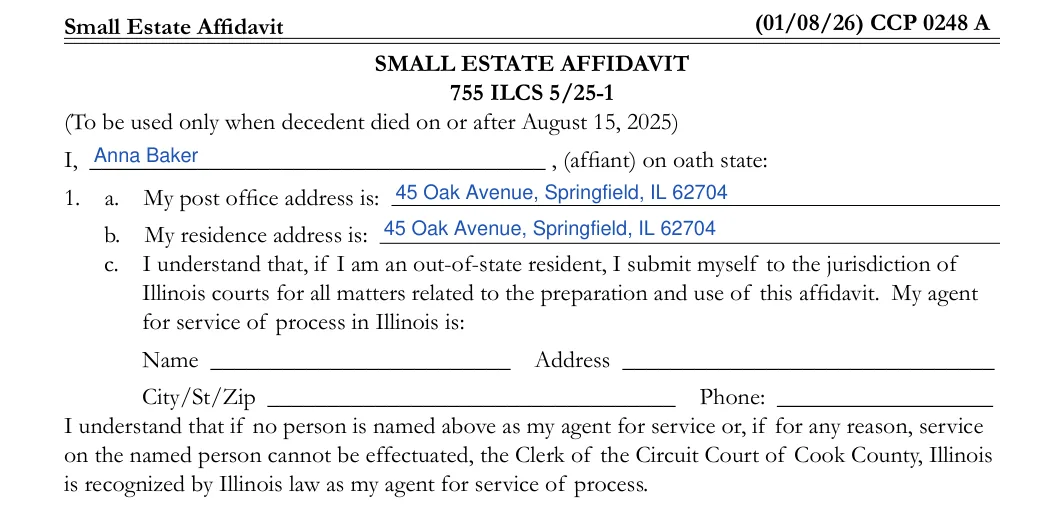
Affiant, addresses and agent for service (paragraph 1, page 1). Write your name as the affiant on the "I," line, then your post office address in 1a and your residence address in 1b. Paragraph 1c is where an affiant who lives outside Illinois accepts the jurisdiction of Illinois courts and names an agent for service of process in Illinois, with the agent's name, address, city, state, ZIP code and phone number. The sample affiant lives in Illinois, so the sample leaves those lines blank. The printed sentence under those lines is the Cook County line described above. Step 1: sample entries, not a real document.
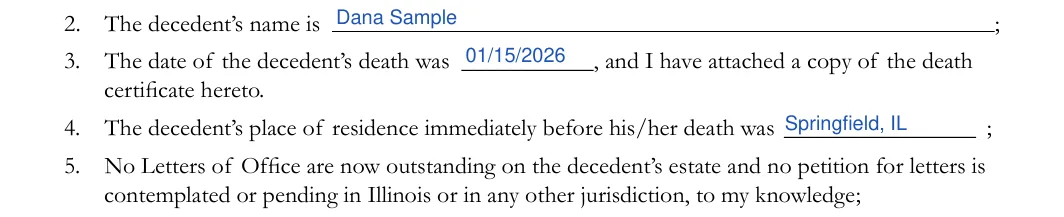
Decedent, date of death and residence (paragraphs 2 to 5, page 1). Enter the decedent's name, the date of death and the place where the decedent lived immediately before death. Paragraph 3 says you have attached a copy of the death certificate, so attach one. Paragraph 5 is a printed statement that no letters of office are outstanding and no petition for letters is contemplated or pending in Illinois or anywhere else, to your knowledge. Step 2: sample entries, not a real document.
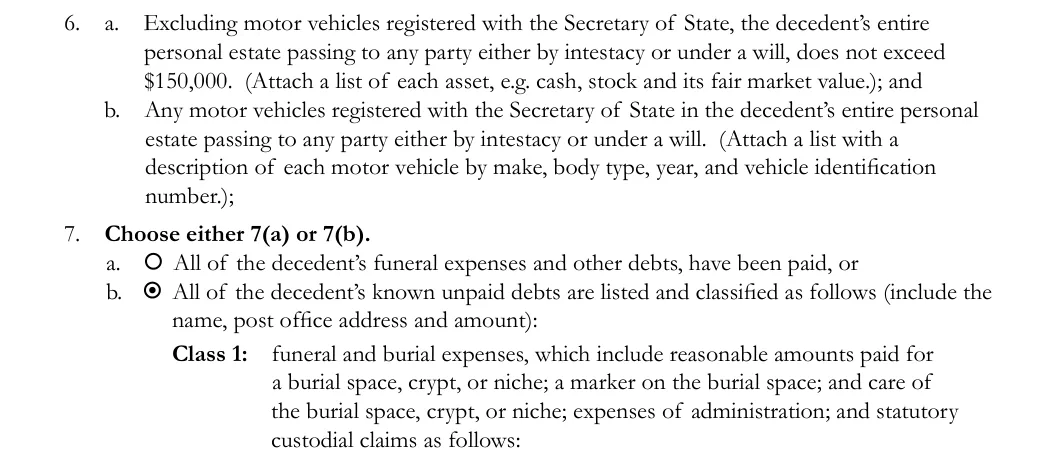
Assets, vehicles and the paragraph 7 choice (paragraphs 6 and 7, page 1). Paragraph 6a states that the decedent's entire personal estate, excluding motor vehicles registered with the Secretary of State, does not exceed $150,000. The form has no lines for the assets, so attach a list of each asset, such as cash or stock, with its fair market value. For 6b, attach a list that describes each registered motor vehicle by make, body type, year and vehicle identification number. Then choose 7(a) if all of the decedent's funeral expenses and other debts have been paid, or 7(b) if you list the known unpaid debts. The sample chooses 7(b). Step 3: sample entries, not a real document.
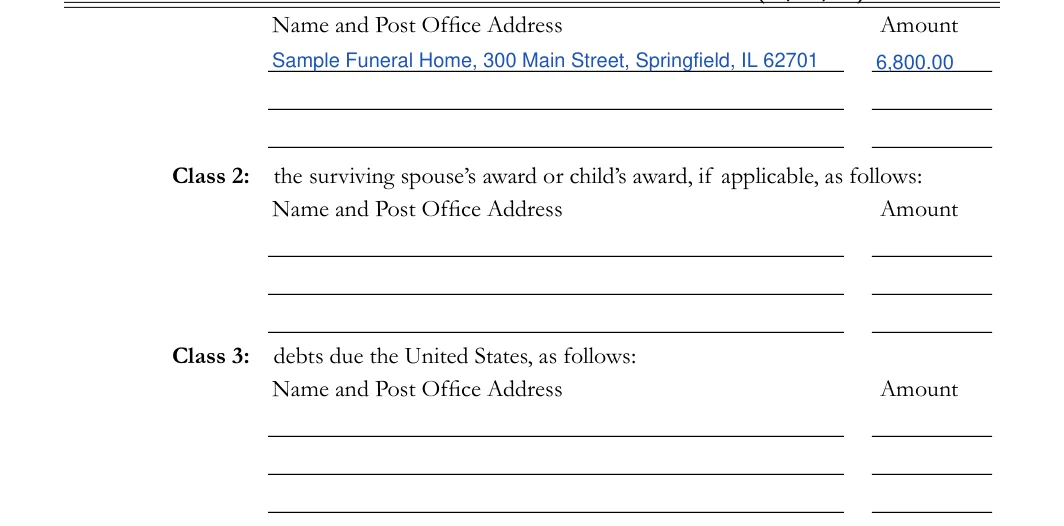
Unpaid debts in Classes 1 to 3 (paragraph 7, pages 1 and 2). If you chose 7(b), give the name, post office address and amount of each debt under its class. Class 1 covers funeral and burial expenses, expenses of administration and statutory custodial claims. Class 2 is the surviving spouse's award or child's award, and Class 3 is debts due the United States. Each class has three lines, and the Class 1 lines are at the top of page 2. Step 4: sample entries, not a real document.
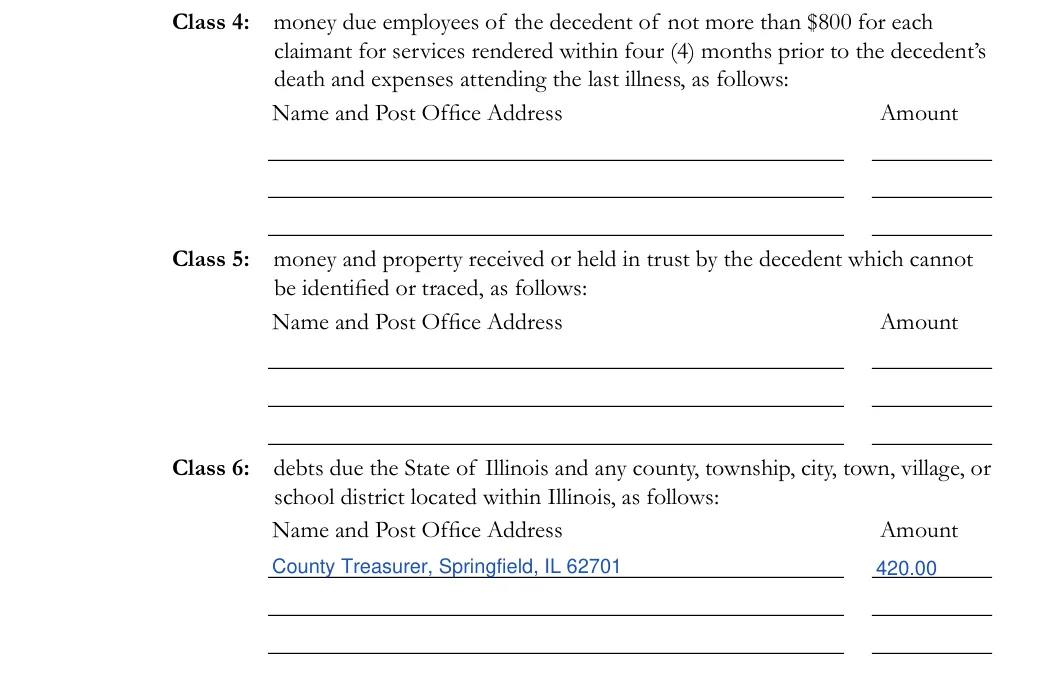
Unpaid debts in Classes 4 to 6 (paragraph 7, page 2). Class 4 is money due the decedent's employees, not more than $800 for each claimant, for services in the four months before the death, and expenses of the last illness. Class 5 is money and property the decedent received or held in trust that cannot be identified or traced. Class 6 is debts due the State of Illinois or any county, township, city, town, village or school district in Illinois. Step 5: sample entries, not a real document.
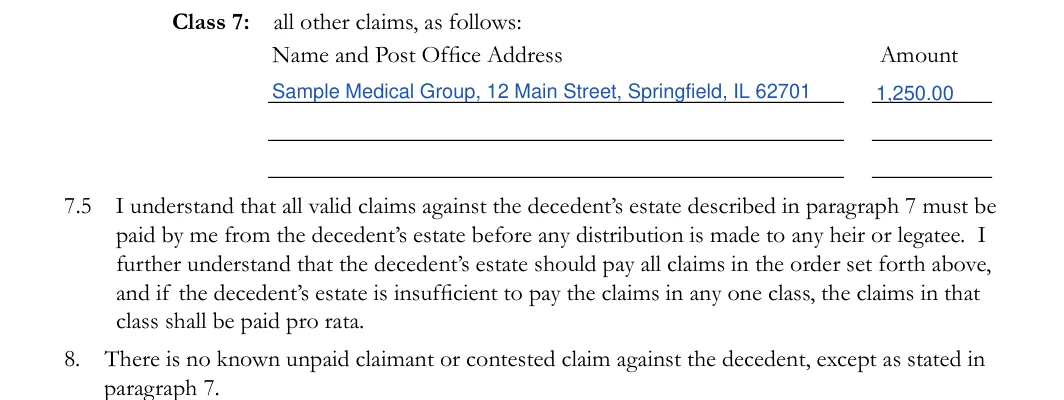
Class 7 and paragraphs 7.5 and 8 (page 3). List all other claims under Class 7. Paragraph 7.5 says you must pay all valid claims from the estate before anything goes to an heir or legatee, in the order of the classes. If the estate cannot pay every claim in one class, the claims in that class are paid pro rata (in proportion to their size). Paragraph 8 says there is no other known unpaid claimant or contested claim. Step 6: sample entries, not a real document.
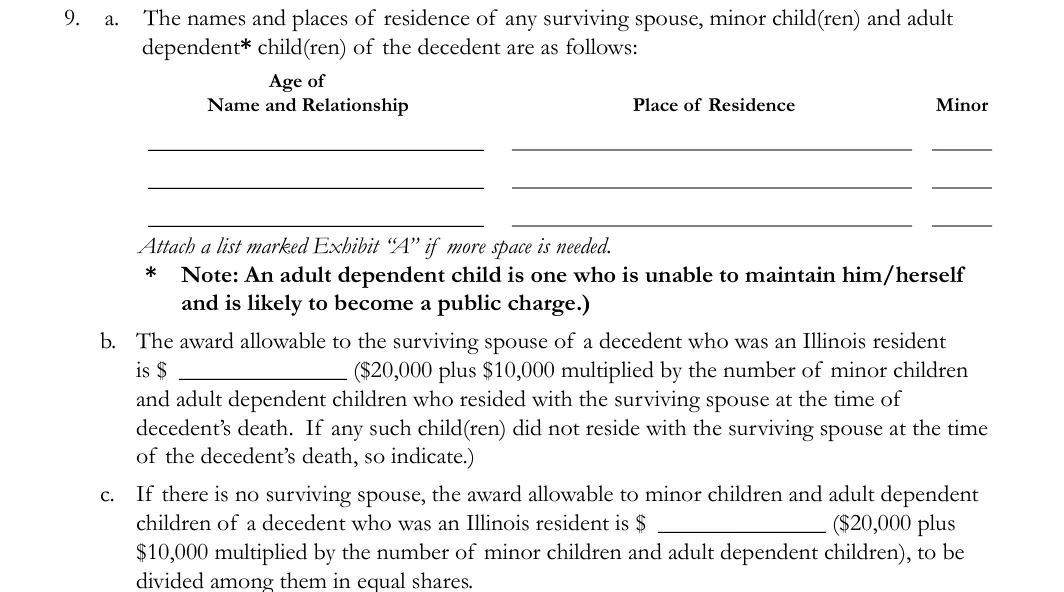
Surviving spouse, children and awards (paragraph 9, page 3). In 9a, list any surviving spouse, minor children and adult dependent children, with name and relationship, place of residence and, for a minor, age. The form defines an adult dependent child as one who is unable to maintain himself or herself and is likely to become a public charge. In 9b, enter the award for the surviving spouse of a decedent who was an Illinois resident: $20,000 plus $10,000 for each minor or adult dependent child who lived with the spouse at the time of death. If there is no surviving spouse, 9c gives the children's award instead: $20,000 plus $10,000 for each minor or adult dependent child, divided equally among them. Attach a list marked Exhibit A if you need more room. The sample decedent left none of these family members, so the lines are blank. Step 7: sample entries, not a real document.
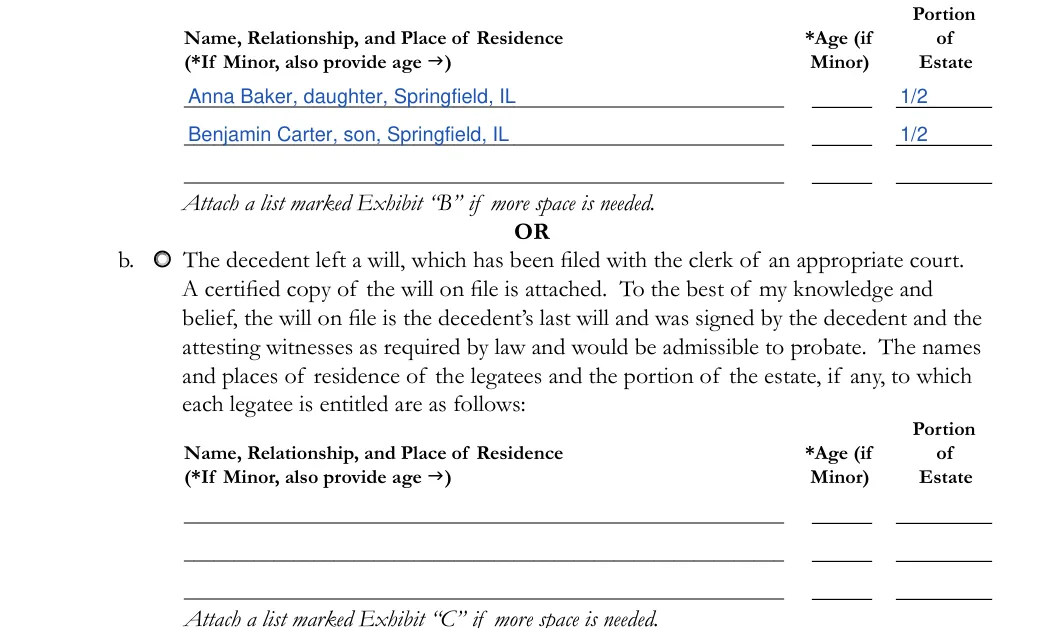
Heirs or legatees (paragraph 10, pages 3 and 4). Choose 10(a) if the decedent left no will, and list each heir's name, relationship and place of residence, the age of a minor, and the heir's portion of the estate. Choose 10(b) if the decedent left a will that has been filed with the clerk of an appropriate court, attach a certified copy of the will, and list the legatees the same way. Exhibits B and C take extra names. The sample chooses 10(a), whose button sits at the bottom of page 3. Step 8: sample entries, not a real document.
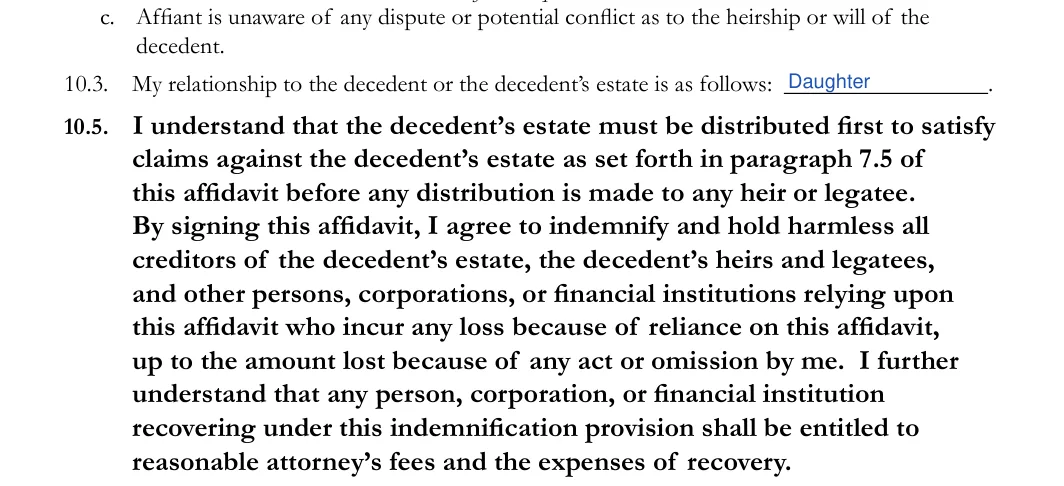
No dispute, your relationship and the 10.5 statement (page 4). Paragraph 10c says you know of no dispute or potential conflict about the heirship or the will. In 10.3, write your relationship to the decedent or the estate. Paragraph 10.5, printed in bold, says the estate must pay claims first. By signing, you agree to indemnify the estate's creditors, the heirs and legatees, and others who rely on the affidavit, up to the amount lost because of your act or omission, and anyone who recovers under that promise is entitled to reasonable attorney's fees and the expenses of recovery. Step 9: sample entries, not a real document.
Who receives the property (paragraph 11, pages 4 and 5). After the debts listed in paragraph 7 are paid, list each person who receives the remaining property described in paragraph 6, with the specific sum or property for each. Attach a list marked Exhibit D if you need more room. Step 10: sample entries, not a real document.
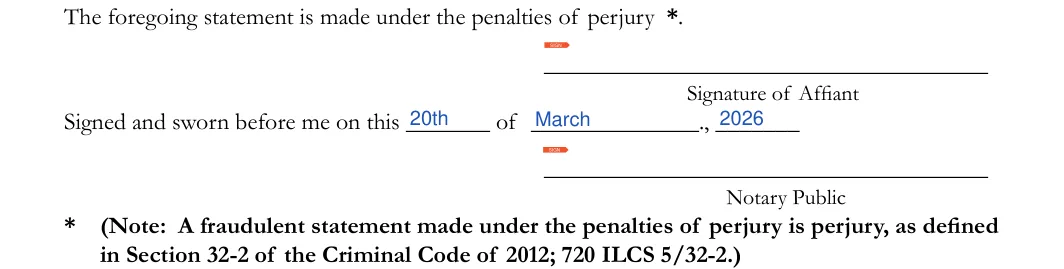
Signature and notary (page 5). The statement is made under the penalties of perjury. Sign on the Signature of Affiant line in front of a notary public, who completes the "Signed and sworn before me" date and signs. The rest of page 5 and all of page 6 reprint subsections (c) to (j) of 755 ILCS 5/25-1 and have nothing to fill in. Step 11: sample entries, not a real document.
Frequently Asked Questions
The answers below cover the Illinois small estate threshold and exemption. Both rest on 755 ILCS 5/25-1, which says the decedent's personal estate must not exceed $150,000, not counting registered motor vehicles.[1]
What is the small estate threshold in Illinois?
The small estate threshold in Illinois is $150,000. The decedent's entire personal estate passing to any party by intestacy or under a will must not exceed that amount, not counting motor vehicles registered with the Secretary of State.[1]
What size estate requires probate in Illinois?
For the small estate affidavit, the limit is $150,000 in personal property, excluding registered motor vehicles. An estate above that figure does not meet the statute's condition for using the affidavit.[1]
What is the small estate exemption in Illinois?
The affidavit statute asks for two things together. No letters of office may be outstanding and no petition for letters may be pending, and the personal estate must stay within $150,000, excluding registered motor vehicles.[1]
General information, not legal or tax advice.
Sources
Unless noted otherwise, the sources below are from the Illinois Compiled Statutes.
Mara has been practicing estate planning and trust law in California since 2003, taking pride in helping clients of all backgrounds and asset profiles form a complete and customized estate plan. Her specialties are: estate planning, wills and trusts, trust and probate administration.