
A Maryland prenuptial agreement is a written contract that two people sign before they marry. It records what each person owns and owes. It also sets out how property, debt, and spousal support will be handled if the marriage ends. Maryland law will not enforce a promise made in exchange for marriage unless that promise is in writing and signed.[2]
Last Updated: September 2026. This guide is reviewed and updated regularly to reflect current Maryland law. If you notice an error or outdated information, please contact us.
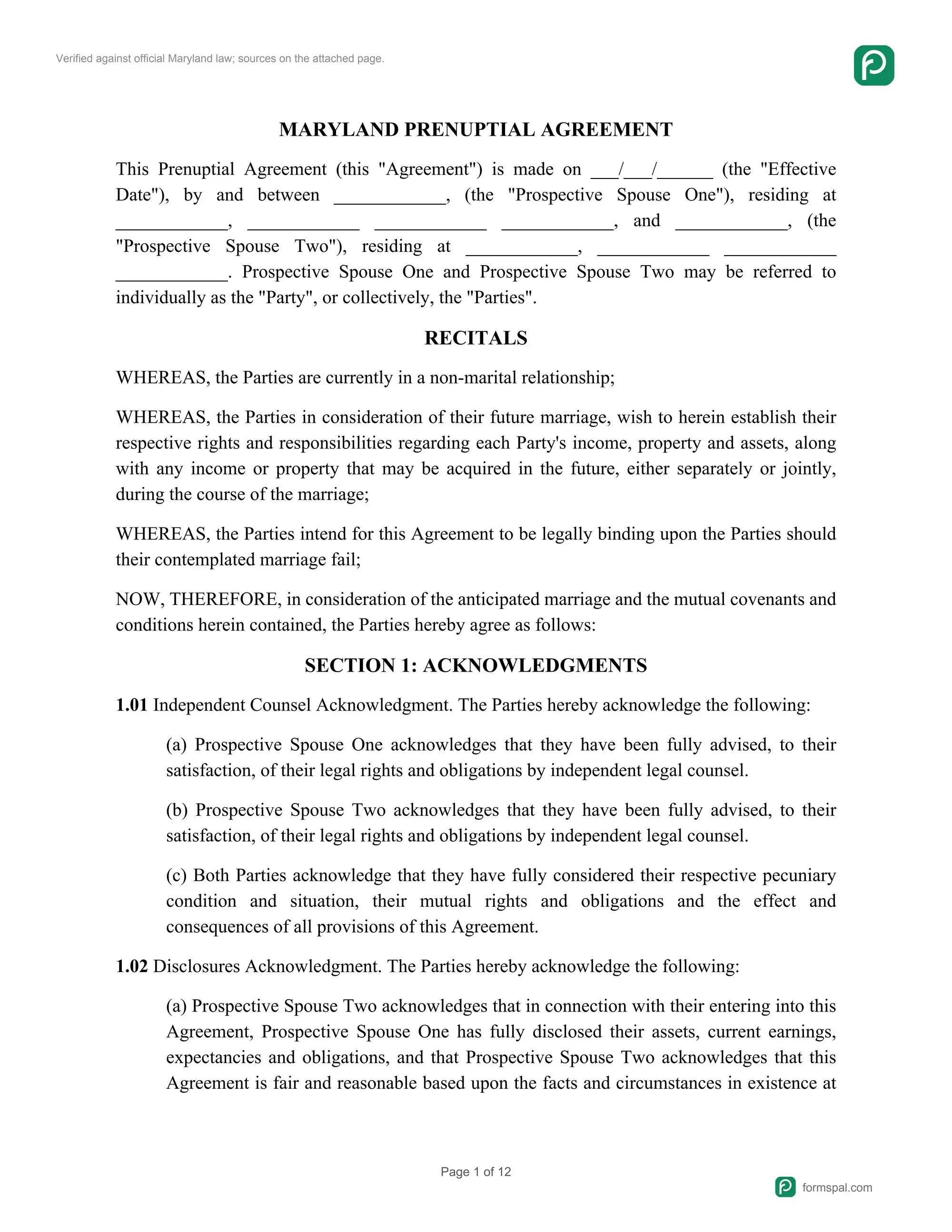
Build Your Document
Answer a few simple questions to make your document in minutes
Save and Print
Save progress and finish on any device, download and print anytime
Sign and Use
Your valid, lawyer-approved document is ready
A prenuptial agreement cannot settle child custody or child support, because those decisions stay with the court. Download the Maryland form above, or start from the general prenuptial agreement template and adapt it to your own situation.
These agreements matter in two situations. If the marriage ends in divorce, it controls how your property and debt are split. If one spouse dies first, it can also show what the two of you agreed about inheritance rights.
Two sections of the Maryland code control whether a prenuptial agreement holds up. Under the Md. Code, Cts. & Jud. Proc., an agreement made in exchange for marriage must be in writing. It also has to be signed by the party it is being enforced against.[2] Under the Md. Code, Est. & Trusts, a waiver of a surviving spouse's inheritance rights must be written and signed too.[1]
Put the agreement in writing. Maryland will not enforce a promise made in exchange for marriage unless it is written and signed by the party being held to it.[2] Both parties should sign, because each of them is giving something up. An oral agreement is worth nothing in a Maryland court.
Maryland's rule here is narrow and specific. No action may be brought to charge a person on an agreement made on consideration of marriage. The agreement, or a memorandum of it, has to be in writing and signed by the party to be charged.[2] A prenup is that kind of agreement, because each promise in it is made in return for the marriage.
Before you sign, each of you should disclose your assets, debts, and income in full. Courts look at whether both people understood what they were giving up. An agreement without that disclosure is the easiest kind to attack.
Notarization is not required in Maryland, and neither is a witness. The statute asks only for a writing and a signature.[2] A notary confirms identity, not the content of the agreement. Notarizing it is still worth doing, because it makes the signatures much harder to dispute later.
The agreement takes effect when the parties marry. Before the wedding it has no force, and if the marriage never happens the agreement never starts. If you want to change a term after signing, write the change down and have both spouses sign it.
Popular Local Prenuptial Agreement Forms
A Maryland judge generally respects an agreement the two of you negotiated. But the judge can set it aside, even when the paperwork was done correctly. Either spouse can challenge the agreement on any of these grounds:
The agreement also ends if the marriage is annulled or declared void.
A prenuptial agreement covers money and property. You can use it to fix what belongs to whom, and what each of you walks away with. The agreement can deal with:
Maryland gives a surviving spouse the right to claim a share of the deceased spouse's estate. That claim is called the right of election, or the elective share. A written agreement can give it up.
The right of election may be waived before or after the marriage. The waiver has to be a written contract, agreement, or waiver, signed by the spouse who is giving the right up.[1]
Be careful with broad wording. A waiver of "all rights" in the other spouse's property sweeps in far more than most people expect.
Unless the waiver provides to the contrary, a waiver of "all rights", or equivalent language, in the property or estate of a present or prospective spouse or a complete property settlement entered into after or in anticipation of separation or divorce is a waiver of all rights of family allowance and elective share by each spouse in the property of the other and the right to letters under § 5-104 of this article, and is an irrevocable renunciation by each spouse of all benefits that would otherwise pass to the spouse from the other by intestate succession, by elective share, or by virtue of a will or revocable trust of the present or prospective spouse executed before the waiver or property settlement.
In plain terms, a broad waiver can wipe out the family allowance and the elective share. It can also remove the right to be appointed to administer the estate. And it can cancel anything the other spouse would have inherited under an earlier will or revocable trust. If you only mean to protect one specific asset, name that asset and keep the wording narrow.
Work through the agreement in the months before the wedding, not in the week of it. Maryland asks only for a writing signed by both of you, so the paperwork itself is simple.[2] The part that takes time is listing what each of you owns and owes, then agreeing on what happens to it.
Prenuptial agreements cannot decide child custody or child support. Maryland courts keep those questions for the time of the divorce, because nobody can predict years ahead what a child will need. Clauses that try to fix custody or support in advance are disregarded. These agreements also cannot cover personal duties inside the marriage, or anything that runs against public policy.

Yes. Maryland courts enforce a prenuptial agreement that is in writing and signed by the spouse it is being used against.[2] Enforcement is not automatic, though. A judge can still refuse to apply the agreement. Fraud, duress, coercion, and unconscionable terms are the usual reasons.
Yes. Maryland does not require a lawyer to draft a prenuptial agreement, and it does not require a notary or a witness. The statute asks for a writing signed by the party being held to it.[2] A free Maryland prenuptial agreement template is enough for a straightforward situation. Bring in a lawyer when a business, a trust, or children from an earlier marriage are involved.
No. Maryland is an equitable distribution state, which means a judge divides marital property fairly rather than in half. Fair can still mean an even split, but nothing guarantees it. Property you owned before the wedding, plus gifts and inheritances you received, is usually treated as separate rather than marital. A prenuptial agreement lets the two of you decide the division instead of leaving it to a judge.
Other Prenuptial Agreement Forms by State
