
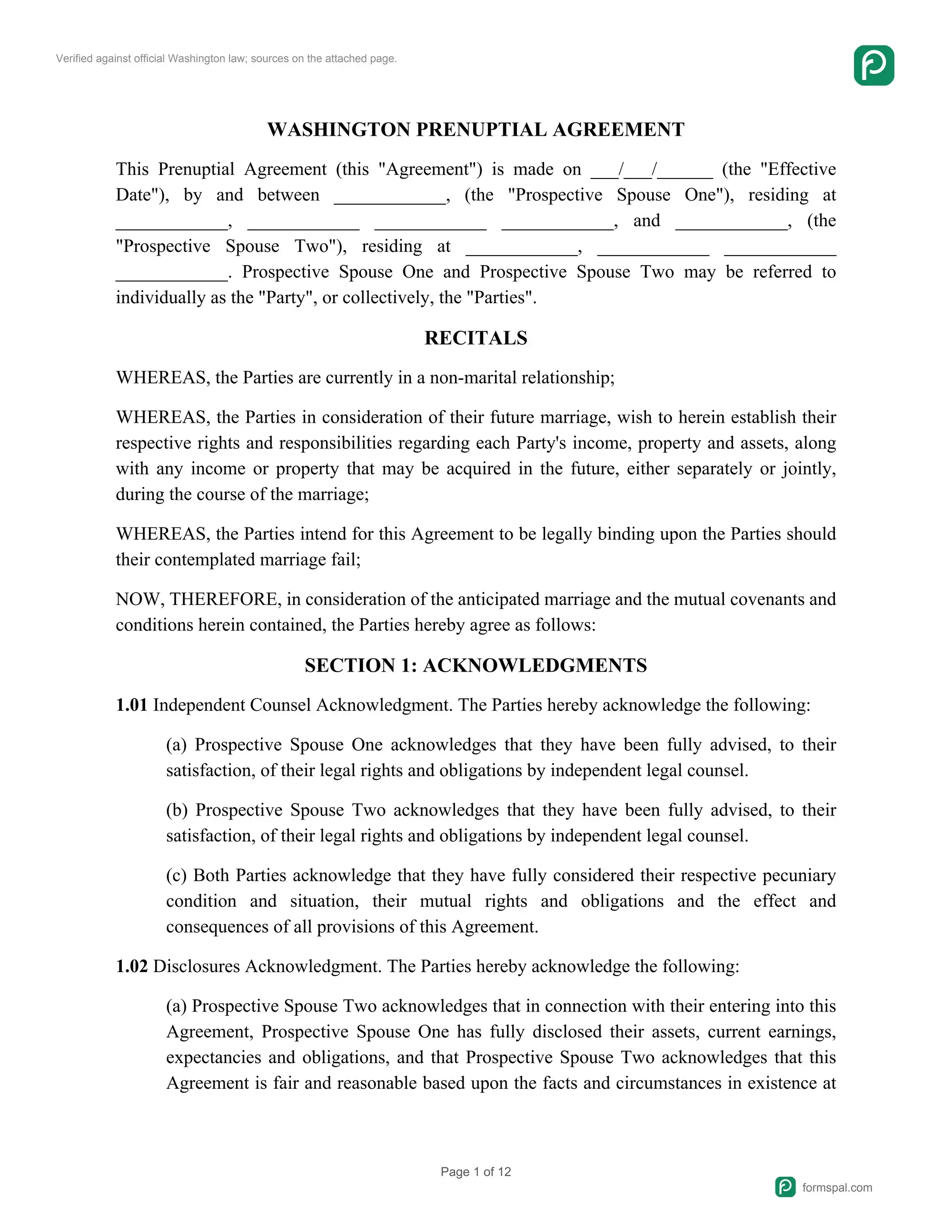
A Washington prenuptial agreement is a written contract two people sign before they marry that sets out how their property, debts, and spousal support will be handled if the marriage ends. State law treats it as an agreement made upon consideration of marriage, so it is void unless it is in writing and signed by the spouse to be held to it.
You can use it to decide which assets stay separate, which become community property, and whether either spouse pays support. You cannot use it to bind a court on child custody or child support. Our free prenuptial agreement template covers the Washington requirements, and the builder above fills it in for you.
Build Your Document
Answer a few simple questions to make your document in minutes
Save and Print
Save progress and finish on any device, download and print anytime
Sign and Use
Your valid, lawyer-approved document is ready
Washington prenuptial agreements are signed by two people planning to marry. They record how the couple's property will be divided if the marriage ends in divorce or in the death of one partner.
The contract has to be signed before the marriage begins. It is not a mandatory document, but it is worth completing if one or both partners:
Nobody can force you to sign one. Both parties must sign of their own free will, without coercion. Couples who later change their minds can amend or cancel the agreement.
You may see this contract called a premarital agreement, an antenuptial agreement, or just a prenup. Washington statutes call it an agreement made upon consideration of marriage, and the community property chapter names prenuptial and postnuptial agreements directly. All of these describe the same document.
Washington has not adopted the Uniform Premarital Agreement Act, so no single statute sets out how to write a prenup. Two parts of state law still control the result. The statute of frauds makes an agreement made in consideration of marriage void unless it is written and signed, and the community property chapter lets spouses waive property rights by signed written agreement.
Washington courts fill the remaining gap with case law. The leading decision is In re Marriage of Matson, which set the two-part legal test judges still apply when one party challenges these agreements.
Two formalities are mandatory. The agreement must be in writing, and it must be signed by the party you want to hold to it. Section 19.36.010 of the Revised Code of Washington lists an agreement made upon consideration of marriage among the promises that are void without a signed writing.[1]
any agreement, contract, and promise shall be void, unless such agreement, contract, or promise, or some note or memorandum thereof, be in writing, and signed by the party to be charged therewith, or by some person thereunto by him or her lawfully authorized, that is to say: ... (3) every agreement, promise, or undertaking made upon consideration of marriage, except mutual promises to marry
State law does not require a notary or witnesses for a prenup. Notarizing it anyway is still useful, because it creates independent proof of who signed and when if the contract is challenged years later.
Popular Local Prenuptial Agreement Forms
Courts look hardest at what each party knew before signing. Both people should have a full picture of the other's income, assets, and debts, plus a real chance to read the contract and take independent legal advice. A note from each attorney confirming they advised their own client helps on this point.
Two further points affect how far the agreement reaches:
If one party is unhappy with the agreement and challenges it during the divorce, a judge decides whether to honor it. The court can decline to enforce some or all of the terms.
Judges work through two legal questions in order:
Check that a clause is both fair and legal before you add it. Terms that commonly appear in prenuptial agreements include:
Chapter 26.16 of the Revised Code of Washington sets the default rule. Property that either party acquires after the marriage is community property, which means both of them own it.[4] Prenuptial agreements matter here because they can move assets out of that default and into separate ownership.
Yes. A Washington prenuptial agreement is enforceable when it is in writing, signed by the spouse being held to it, substantively fair, and entered into voluntarily after both spouses disclosed their finances. Because Washington has no premarital agreement act, judges test these agreements under case law rather than a checklist in the statute, and they will set aside one that fails the test.
In practice, agreements fail for a small number of recurring legal reasons. Section 19.36.010 of the Revised Code of Washington supplies the first, a missing signed writing.[1] The rest come from how the contract was made:
A prenup works by replacing Washington's default property rules with the terms you choose. Washington State is a community property state, so without an agreement most of what you build during the marriage belongs to both of you. Signing a prenuptial agreement lets you decide instead which assets stay separate, which are shared, and whether either spouse pays support.
The Revised Code of Washington addresses these agreements directly in one place. Section 26.16.250 lets both spouses or both domestic partners waive, modify, or relinquish any quasi-community property right by signed written agreement, and it names prenuptial agreements as one way to do it.[2]
Both spouses or both domestic partners may waive, modify, or relinquish any quasi-community property right granted or created by this chapter by signed written agreement, wherever executed, before or after June 11, 1986, including without limitation, community property agreements, prenuptial and postnuptial agreements, or agreements as to status of property.
Quasi-community property is property one party acquired while living outside the state that would have counted as community property had it been acquired here. It matters if you move to Washington State already owning assets from somewhere else.
No. Washington is a community property state, which is not the same as an automatic 50/50 split. A judge dividing property in a Washington divorce must reach a result that is just and equitable after weighing the factors the statute lists, and that can mean an uneven division.[3]
Section 26.09.080 of the Revised Code of Washington directs the court to consider all relevant factors, including:
A prenuptial agreement does not remove that duty. What it does is put the couple's own allocation in front of the judge, who measures it against what a court would otherwise have done and then decides whether to enforce it.
Some terms will not bind a Washington court no matter how carefully they are drafted. Child custody and child support are the clearest examples. You may write them into the agreement, but if a parent challenges those terms the judge decides custody and support independently and is free to ignore what the spouses agreed.
A one-sided agreement is not automatically void, but it is the kind a court examines most closely. If the terms are not fair on their face, the judge moves on to ask whether both parties made full financial disclosure and signed freely.
Getting a prenup in Washington State takes four steps. You draft the agreement, exchange full financial disclosures, each take independent legal advice if you want it to hold up, and then sign it before the wedding. Order matters here, because an agreement signed before the disclosures are exchanged is the kind a court later unwinds.
You can build the document from the free Washington prenuptial agreement form at the top of this page. If you are already married, the same rules run through a Washington marital settlement agreement instead.
Last Updated: September 2026 - This guide is reviewed and updated regularly to reflect current Washington law. If you notice an error or outdated information, please contact us.

Other Prenuptial Agreement Forms by State
Unless noted otherwise, the sources below are from the Revised Code of Washington.