
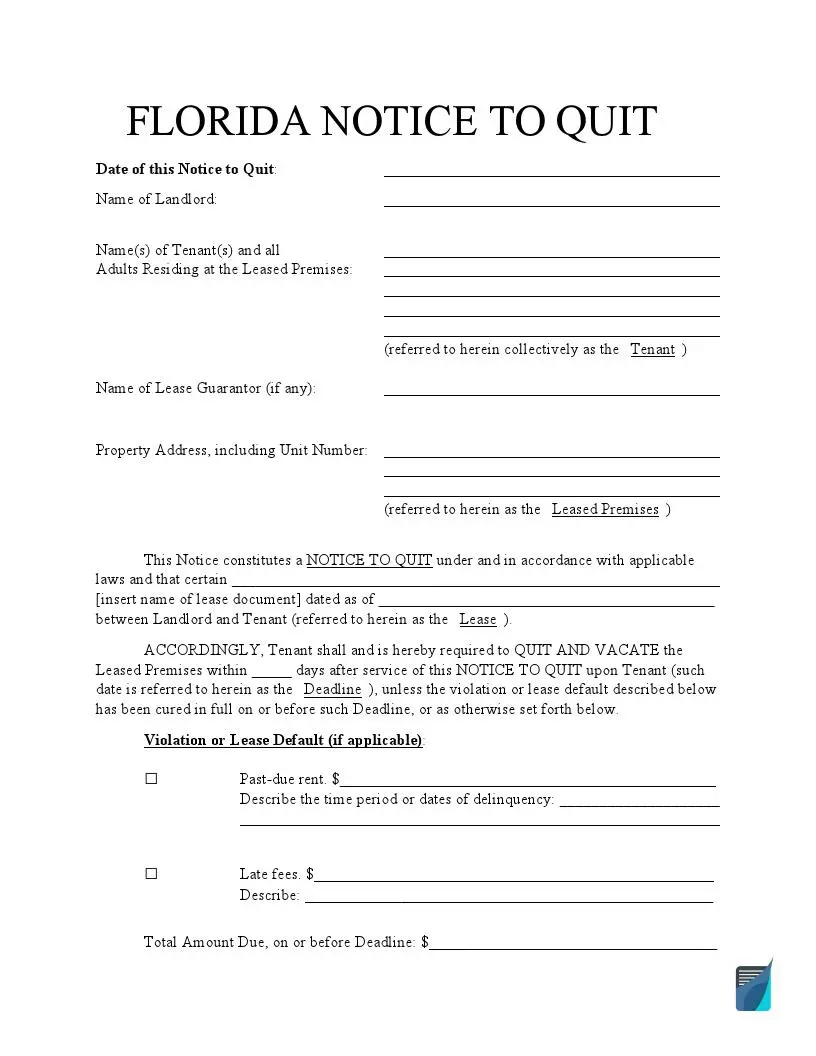
A Florida eviction notice is a written notice a landlord serves on a tenant to end a tenancy for nonpayment of rent, a lease violation, or another lawful reason, before the landlord can file an eviction case in court. The notice states the type of breach and gives the tenant a set number of days to pay the rent owed or fix the problem.
Last Updated: October 2026. This guide is reviewed and updated regularly to reflect current Florida law. If you notice an error or outdated information, please contact us.
Build Your Document
Answer a few simple questions to make your document in minutes
Save and Print
Save progress and finish on any device, download and print anytime
Sign and Use
Your valid, lawyer-approved document is ready
It also explains what happens if the tenant does not respond. Florida law sets the notice periods, and the eviction notice template below covers rent and lease-violation notices for residential and commercial tenants.
In practice, landlords state the reason for the eviction in the written notice. A tenant can raise a defense in court where Florida law allows one.
Florida Statutes Chapter 83, Part II sets the rules landlords and tenants must follow to end a residential tenancy. Before filing an eviction case in court, a landlord must give written notice and a set number of days to fix the problem. For nonpayment of rent the notice period is 3 days, excluding Saturday, Sunday, and legal holidays. For most lease violations the tenant has 7 days to cure.[1]
Under Fla. Stat. § 83.56(4), the notice must be mailed, handed to the tenant, e-mailed as allowed by § 83.505, or, if the tenant is absent from the premises, left at the residence.[1]
| Rent Grace Period | As stated in the lease |
| Notice of Non-Payment | 3 days[1] |
| Notice of Non-Compliance | 7 days[1] |
| State Laws | Fla. Stat. §§ 83.56[1], 83.67[2] |
Florida landlords use different eviction notices depending on why the tenancy is ending. A 3-day notice covers nonpayment of rent, a 7-day notice covers a lease violation the tenant can fix, and a 30-day notice ends a month-to-month or quarter-to-quarter tenancy without a stated cause. The correct notice sets the clock for how long the tenant has to respond before the landlord can file in court.
Count the exact notice period with FormsPal’s deadline calculator, which counts calendar and business days.
No. A landlord cannot force a tenant out without a court order. Under Fla. Stat. § 83.67, a landlord may not prevent a tenant from reasonably accessing the rental unit by changing the locks, using a bootlock, or any similar device.[2] A landlord also cannot shut off utilities or remove a tenant’s belongings to retake the unit outside the legal eviction process.
Even after serving a notice, a Florida landlord cannot lock out a tenant, shut off utilities, or remove belongings without going through the court process.
Accepting rent after serving an eviction notice can affect a landlord’s case. If a landlord accepts full rent while knowing about the tenant’s violation, the landlord waives the right to terminate the lease or sue for that violation, though not for any later or continuing violation. Accepting partial rent works differently. A landlord who accepts partial rent does not waive the right to terminate the agreement or bring a civil action for that nonpayment.[1]
If a landlord accepts partial rent after posting a 3-day notice, Florida law requires the landlord to do one of the following before the case can proceed[1]:
The waiver rule above does not apply to the part of rent paid as a government rent subsidy. For that portion, the landlord’s right to act is waived only if an eviction case is not filed within 45 days of the landlord learning about the violation.[1]
Notice and cure rules work both ways in Florida. If a landlord materially fails to meet its duties or the lease terms, and the problem continues for 7 days after the tenant delivers written notice stating the intent to terminate, the tenant may terminate the rental agreement.[1]
If the unit becomes uninhabitable because of the landlord’s failure and the tenant moves out, the tenant owes no rent for the period the unit remained uninhabitable. If the tenant stays and the problem does not make the unit uninhabitable, the rent for that period is reduced in proportion to the loss in rental value.[1]
If the rental agreement ends, Florida law requires the landlord to follow the statutory process for handling the tenant’s security deposit.[1]
Filing for eviction in Florida follows a set court process that begins once the notice period ends without the tenant paying, curing the violation, or moving out. In practice, that process generally includes the steps below, though the exact timeline varies by county and case.
When a tenant does not respond to the eviction notice, the landlord moves the case to court using a set of standard forms. Each form covers a different stage or type of claim, from the initial complaint to the final writ that authorizes removing the tenant. FormsPal does not provide these court forms directly. Check with the county clerk of court for the current version of each one.


Yes. Florida law lets a landlord give a 3-day eviction notice for nonpayment of rent. Under Fla. Stat. § 83.56, if the tenant does not pay within 3 days after the landlord delivers a written demand, not counting Saturday, Sunday, or legal holidays, the landlord may terminate the rental agreement.[1] The demand must be in writing, and this 3-day requirement cannot be waived in the lease.
General information, not legal or tax advice.
Unless noted otherwise, the sources below are from the Fla. Stat..