
Updated:
A Florida 30 day notice to vacate is a written notice that ends a month-to-month tenancy. Fla. Stat. § 83.57 sets at least 30 days' notice before a monthly period ends for month-to-month tenancies.[1] The tenant signs this form, and this page covers notice periods, each field and delivery.
Key facts
Build Your Document
Answer a few simple questions to make your document in minutes
Save and Print
Save progress and finish on any device, download and print anytime
Sign and Use
Your valid, lawyer-approved document is ready
A Florida month-to-month tenancy ends with not less than 30 days' notice prior to the end of any monthly period, when the tenancy is from month to month (Fla. Stat. § 83.57).[1] The notice period depends on how often the tenancy renews, not on the reason for leaving.
When the tenancy is from month to month, by giving not less than 30 days' notice prior to the end of any monthly period
Fla. Stat. § 83.57 sets one period for each kind of tenancy without a specific term, when the tenancy renews by the week, month, quarter or year.
| Tenancy type | Notice required | Source |
|---|---|---|
| When the tenancy is from week to week | Not less than 7 days' notice prior to the end of any weekly period[1] | Fla. Stat. § 83.57 |
| When the tenancy is from month to month | Not less than 30 days' notice prior to the end of any monthly period[1] | Fla. Stat. § 83.57 |
| When the tenancy is from quarter to quarter | Not less than 30 days' notice prior to the end of any quarterly period[1] | Fla. Stat. § 83.57 |
| When the tenancy is from year to year | Not less than 60 days' notice prior to the end of any annual period[1] | Fla. Stat. § 83.57 |
The form itself is worded for a month-to-month tenancy. A week-to-week tenancy needs a shorter notice and a year-to-year tenancy needs a longer one.
The termination date on the notice is the last day of a monthly period, counted back from that day to the delivery date. Count back at least 30 days from the last day of the monthly period you want the tenancy to end.
Example only: a tenancy whose monthly period runs from the 1st to the last day of the month, ending on June 30, would need the notice delivered on or before May 31. A notice delivered on June 5 would point to the end of the July period instead.
A delivery date that leaves less than the full period moves the termination date to the end of the next monthly period, so the notice should name that later date. Our deadline calculator helps with the count.
Not sure which notice you need? Browse our Florida eviction notice forms or the full set of eviction notice forms.
The form details below apply when the tenancy is from month to month under Fla. Stat. § 83.57.
| Document Name | Florida 30-Day Notice to Vacate Form |
| Other Names | Florida 30-Day Eviction Notice Form, Florida Thirty-Day Notice to Vacate |
| Relevant Laws | Florida Statutes, Section 83.57 |
| Avg. Time to Fill Out | 11 minutes |
| # of Fillable Fields | 39 |
| Available Formats | Adobe PDF |
The 30 day notice to vacate ends a tenancy without a reason, while Florida's shorter notices answer unpaid rent or a broken lease term under Fla. Stat. § 83.56, each only when its condition is met.[2] A "30 day eviction notice" search often means one of these other notices.
| Notice | When it applies | Period | Source |
|---|---|---|---|
| 30 day notice to vacate | When the tenancy is from month to month | Not less than 30 days' notice prior to the end of any monthly period | Fla. Stat. § 83.57 |
| 3 day notice for unpaid rent | If the tenant fails to pay rent when due, after the landlord delivers a written demand for payment of the rent or possession of the premises | 3 days, excluding Saturday, Sunday, and legal holidays | Fla. Stat. § 83.56 |
| 7 day notice to cure a lease violation | If the noncompliance is not corrected within 7 days from the date that the written notice is delivered, the landlord shall terminate the rental agreement | 7 days from delivery | Fla. Stat. § 83.56 |
| Tenant's 7 day notice to the landlord | If the landlord materially fails to comply with s. 83.51(1) or material provisions of the rental agreement after the tenant's written notice | 7 days after delivery of the tenant's notice | Fla. Stat. § 83.56 |
The 3 day notice is a landlord's written demand: if the tenant fails to pay rent when due and the default continues for 3 days, excluding Saturday, Sunday, and legal holidays, after its delivery, the landlord may terminate the rental agreement (Fla. Stat. § 83.56).[2] Legal holidays for the purpose of that section are court-observed holidays only (Fla. Stat. § 83.56).[2]
The tenant's 7 day notice specifies the landlord's noncompliance and the tenant's intention to terminate: if the landlord materially fails to comply with s. 83.51(1) or material provisions of the rental agreement within 7 days after its delivery, the tenant may terminate the rental agreement (Fla. Stat. § 83.56).[2] This notice differs from the 30 day notice, which needs no reason at all.
The same section adds that, if the landlord's failure to comply renders the dwelling unit untenantable and the tenant vacates, the tenant shall not be liable for rent during the period the dwelling unit remains uninhabitable (Fla. Stat. § 83.56).[2]
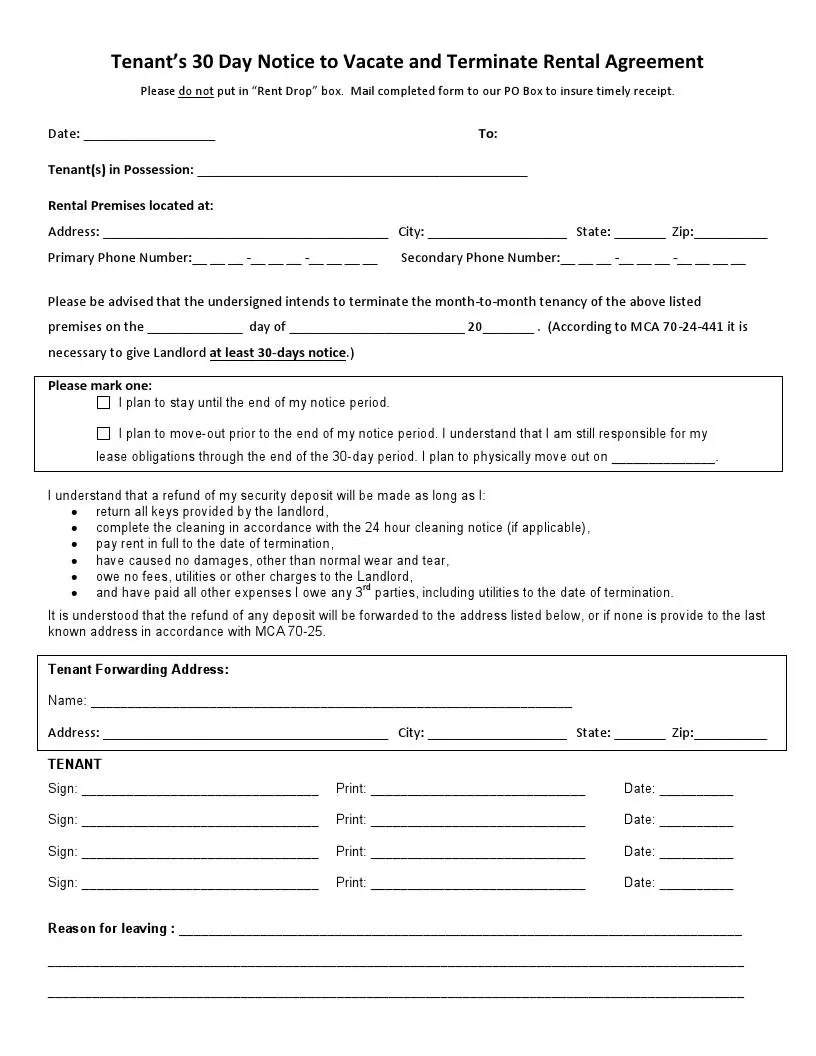
The Florida notice to vacate holds these parts on one page, each one a fact the landlord needs to close out the tenancy.
The form's "Please Mark One" part lets the tenant move out early and asks for the move-out date. It also states that you remain responsible for your lease obligations through the end of the 30-day period. The first box instead says the tenant stays until the end of the period.
The forwarding address block gives the landlord where to send any deposit refund, as the form itself states. The security deposit conditions printed below the boxes are for you to read and have no fields.
Fla. Stat. § 83.56 adds that, if the rental agreement is terminated under that section, the landlord shall comply with s. 83.49(3).[2]
The Florida 30-day notice to vacate is filled in from top to bottom in five steps, then printed and signed by each tenant.
The screenshots under each step show the FormsPal Florida 30-day notice to vacate template filled with sample entries in blue, so you can see where each answer goes. The names, addresses, dates and amounts are examples only.

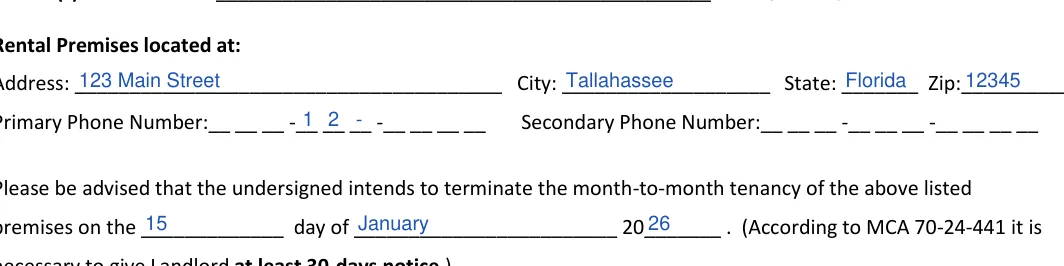


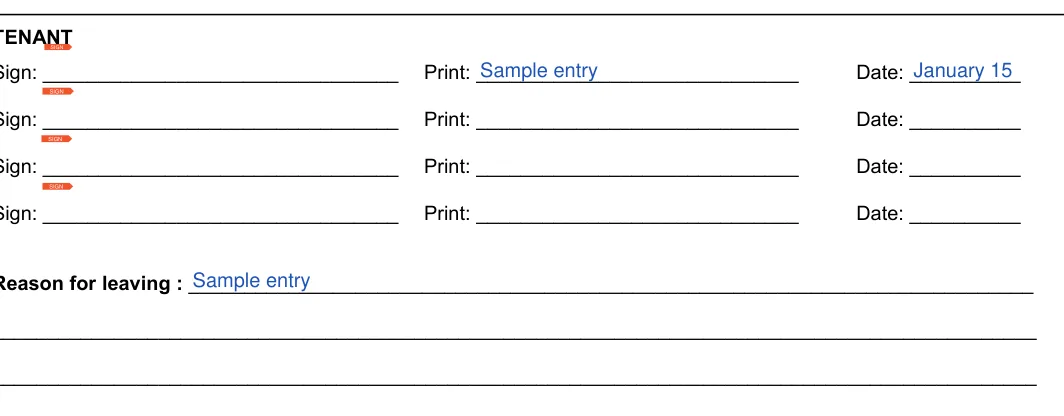
The notice to vacate is delivered in writing by the tenants to the landlord, and the count runs from the delivery date. The delivery methods of Fla. Stat. § 83.56(4) apply to the written notices required by subsections (1) to (3) of § 83.56, a list that does not include this § 83.57 notice.[2]
The safest delivery is one the tenant can prove later, such as a hand delivery with a signed and dated receipt, or a mail service that gives a delivery receipt. The lease may also set its own notice terms, such as an address for notices, and those terms are worth following.
If you also need a lease for the next home, see our Florida month-to-month lease agreement. To end a lease by agreement instead, see our Florida lease termination letter.
This form is the tenant's own notice to the landlord, so this section is about the other path: a landlord who ends the tenancy uses a landlord's notice, such as one of our Florida eviction notice forms, and the steps below follow that notice, not this form.
A landlord's notice is not a lockout: a landlord of any dwelling unit governed by that part shall not prevent the tenant from gaining reasonable access to the dwelling unit by any means, including changing the locks or using any bootlock or similar device (Fla. Stat. § 83.67).[3]
If the rental agreement is terminated and the tenant does not vacate the premises, the landlord may recover possession of the dwelling unit as Section 83.59 provides.[4]
The clerk's filing fee for a removal of tenant action is $180 (Fla. Stat. § 34.041(1)(a)).[6] When the clerk issues a writ, the writ commands the sheriff to put the landlord in possession after 24 hours' notice conspicuously posted on the premises, and Saturdays, Sundays, and legal holidays do not stay the 24-hour notice period (Fla. Stat. § 83.62(1)).[5]
Paying or accepting rent with actual knowledge of a noncompliance can waive the right to end the rental agreement for that noncompliance, if the rules of Fla. Stat. § 83.56 apply.[2]
No self-help eviction is allowed: a landlord shall not prevent the tenant from gaining reasonable access to the dwelling unit by any means, including changing the locks or using any bootlock or similar device (Fla. Stat. § 83.67).[3]
A month-to-month tenancy ends with not less than 30 days' notice prior to the end of any monthly period, when the tenancy is from month to month (Fla. Stat. § 83.57).[1]
The current text of Fla. Stat. § 83.57 sets no 15 day period: when the tenancy is from month to month, it calls for not less than 30 days' notice prior to the end of any monthly period.[1] A form that gives 15 days for a month-to-month tenancy does not match that text.
The e-mail method of Fla. Stat. § 83.56(4) covers only the written notices required by subsections (1) to (3) of § 83.56, and this 30 day notice falls under § 83.57 instead.[2] A tenant is safer with a delivery the tenant can prove, such as a hand delivery against a signed receipt, unless the lease sets e-mail as a notice method.
Not by itself. Under Fla. Stat. § 83.56, a landlord who accepts partial rent after posting a 3-day notice keeps the right to end the rental agreement only if the landlord gives the tenant a receipt stating the date, the amount received and the balance due before filing for possession, places the partial rent in the registry of the court upon filing, or posts a new 3-day notice reflecting the new amount due.[2]
No for the notices of subsections (1) to (3) of Fla. Stat. § 83.56: those notice requirements may not be waived in the rental agreement.[2]

General information, not legal or tax advice.
Unless noted otherwise, the sources below are from the Florida Statutes.
