
A Michigan durable power of attorney is a written document that lets a principal appoint an agent, someone the principal trusts, to manage the principal’s finances. This Michigan power of attorney form stays in effect even if the principal becomes incapacitated, unless the document itself says otherwise.
Last Updated: October 2026. This guide is reviewed and updated regularly to reflect current Michigan law. If you notice an error or outdated information, please contact us.
Build Your Document
Answer a few simple questions to make your document in minutes
Save and Print
Save progress and finish on any device, download and print anytime
Sign and Use
Your valid, lawyer-approved document is ready
People use this document to plan ahead for illness, an extended absence, or old age. The agent can handle banking, manage real estate, pay taxes, and deal with other financial and insurance matters on the principal’s behalf.
A durable power of attorney form only covers financial and property matters, not health care decisions. For medical decisions, see the other Michigan power of attorney forms available, including a medical power of attorney.
A Michigan durable power of attorney must meet a short list of signing requirements under the Uniform Power of Attorney Act to be valid.[2] The principal must sign it, or have another person sign it in the principal’s conscious presence at the principal’s direction.[2.1] To be durable, the signed document must then be either notarized or witnessed.[2.2]
FormsPal’s Michigan durable power of attorney template includes an acknowledgment for a notary public. If you use two witnesses instead of a notary, you will need to add witness signature lines yourself, since Michigan law allows either method but the template’s acknowledgment section only covers notarization.[2.2]
Michigan also provides a statutory power of attorney form under Mich. Comp. Laws § 556.401, which contains language defining the agent’s authority under the Uniform Power of Attorney Act.[4] FormsPal’s template is a separate document you may use instead of the statutory form.
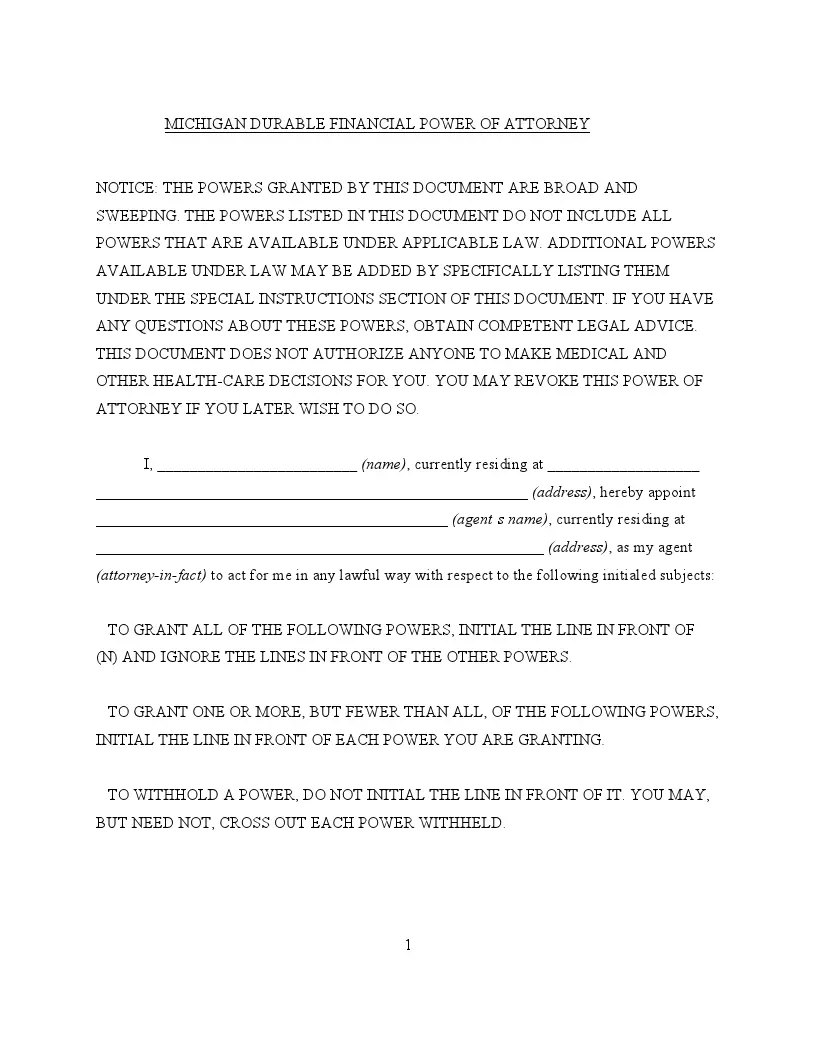
The process of filling out the DPOA form in Michigan is simple and quick. The form itself comprises five pages. The Michigan statutory power of attorney law lists the subjects an agent may act on, and FormsPal’s template lets you grant your agent the same categories of financial authority[4]:
You can also specify other decisions your agent will be able to make. Before you create the document and sign it, read all the statements carefully and think twice before you choose the agent. Check the relevance of all the statements you chose and continue with filling out the DPOA form.
| Document Name | Michigan Durable Power of Attorney Form |
| Other Names | Michigan Financial Durable Power of Attorney, MI DPOA |
| Relevant Laws | Mich. Comp. Laws § 556.205 |
| Signing Requirements | Notary Public or Two Witnesses |
| Avg. Time to Fill Out | 10 minutes |
| # of Fillable Fields | 37 |
| Available Formats | Adobe PDF |
Popular Local Durable POA Forms
Durable POA documents are frequently in each and every state. Check some other popular Durable POA forms frequently searched for by people.
A Michigan power of attorney terminates automatically when the principal dies or when the principal revokes the power of attorney. It also terminates when an event occurs that, according to the terms of the power of attorney, terminates the power. For a power of attorney intended only for a specified, limited purpose, it terminates once that specified purpose of the power is accomplished. If the document is not durable, the principal’s incapacity ends it too.[3]
An agent’s own authority can end separately from the document itself. It ends when any of the following happens[3]:
Sometimes an agent becomes unavailable. If the principal revokes that agent’s authority, or the agent dies, becomes incapacitated, or resigns, and the document does not name another agent, the whole power of attorney ends instead of just that agent’s authority. Unless the document says otherwise, an agent’s authority stays exercisable no matter how much time has passed since you signed it.[3]
Ending a power of attorney is not always effective right away in practice. Ending an agent’s authority, or the power of attorney itself, is not effective against the agent or another person unless they have actual knowledge of it. If they act in good faith without that knowledge, their act still binds the principal and the principal’s successors, unless the act is otherwise invalid or unenforceable.[3]
The same protection applies to incapacity. If the power of attorney is not durable, the principal’s incapacity does not revoke or terminate it. That protection extends to an agent or other person that, without actual knowledge of the incapacity, acts in good faith in reliance on the power.[3] Tell your agent and anyone your agent deals with as soon as you revoke a power of attorney.
Signing a new power of attorney does not revoke one you executed earlier, unless the new document states that the earlier one, or all other powers of attorney, are revoked.[3] If you want to change your agent or the powers you have granted, sign a new power of attorney that names the new agent or powers, and state that it revokes the old one.
A few mistakes come up often with Michigan powers of attorney. Avoiding them keeps your document valid and reduces confusion for your agent, your successor agent, and anyone who relies on the document later.
Follow these steps in order to fill out your Michigan durable power of attorney form. Start by naming yourself and your agent, then initial the powers you want to grant and review the pre-drafted special instructions. Choose an effective date, name a successor agent in case your first choice cannot serve, then sign, date, and have it notarized.
Enter your full name and address as the principal, then enter your agent’s full name and address. Your agent will act for you in the subjects you initial in the next section.

Initial the line for each subject you want to include in your agent’s authority, or initial the line that grants all of the powers at once. Leave a subject blank to withhold that power from your agent. The form lists these subjects:

The form includes several pre-drafted special instructions. Read each one carefully, and cross out or adjust any that do not match what you want your agent to do.

State whether the power of attorney is effective immediately or on a different date or condition you specify. If you do not state otherwise, it takes effect immediately.

If your agent is unable or unwilling to serve, name a successor agent and their address so someone can still manage your property and finances for you.
Sign and date the form as the principal.

Take the signed form to a notary public. The notary confirms your identity and completes the acknowledgment section. Michigan law also allows two witnesses to sign instead of a notary, but FormsPal’s template only includes the notarized signature block.[2.2]


Download the free Michigan durable power of attorney form below as a PDF, or use FormsPal’s online builder to answer a few questions and create a ready-to-sign copy in minutes. Print it, then follow the signing steps above to make it valid under Michigan law.
A Michigan durable power of attorney is a document that lets a principal appoint an agent to manage the principal’s finances, and it keeps working if the principal becomes incapacitated. A power of attorney executed in Michigan is durable unless it expressly says the principal’s incapacity ends it.[1] The Michigan Uniform Power of Attorney Act, Mich. Comp. Laws §§ 556.201 to 556.505, sets the rules for these documents.[4]
This form is a common part of financial planning for illness, disability, or old age. It is a legal document, so read it carefully before you sign it, and get legal advice if anything is unclear.
This page is general information about Michigan durable power of attorneys, not legal advice. For advice on your situation, talk to a Michigan attorney.
Unless noted otherwise, the sources below are from the Mich. Comp. Laws.
