
A Texas durable power of attorney (DPOA) is a written document that lets a principal name an agent to handle financial and property matters, with the agent's authority continuing even after the principal becomes incapacitated. The agent's authority survives the principal's incapacity only when the document includes the statutory durability language Texas law requires.[1.1] Without that language, the authority ends the moment the principal can no longer manage their own affairs.
Last Updated: September 2026. This guide is reviewed and updated regularly to reflect current Texas law. If you notice an error or outdated information, please contact us.
Build Your Document
Answer a few simple questions to make your document in minutes
Save and Print
Save progress and finish on any device, download and print anytime
Sign and Use
Your valid, lawyer-approved document is ready
An agent named under this document can manage bank accounts, pay bills, handle real estate, and make other financial decisions for the principal, but the document does not cover health care choices, which Texas handles through a separate form. It ends when the principal dies or revokes it.[1.6]
This document must be signed by the principal, or by another adult the principal directs to sign in the principal's presence. It must also be notarized before a notary public or another officer authorized to take acknowledgments and administer oaths. The document also must state that it continues despite the principal's later disability or incapacity, using the wording Texas law sets out or similar words showing that intent.[1.1]
Follow these steps to sign a Texas durable power of attorney correctly:
Contains: (a) the words: “this power of attorney is not affected by subsequent disability or incapacity of the principal”; or “this power of attorney becomes effective on the disability or incapacity of the principal”; or (b) words similar to those of paragraph (a) that clearly indicate that the authority conferred on the agent shall be exercised notwithstanding the principal's subsequent disability or incapacity.
Unless the power of attorney defines it differently, Texas law considers the principal incapacitated once a physician certifies in writing, after the date the document was executed and based on a medical examination.[1.8] The physician must find that the principal is mentally incapable of managing the principal's financial affairs.
Texas law also provides a statutory durable power of attorney form under Section 752.051 of the Estates Code.[2]
Choose someone you trust completely as your agent. Because a durable power of attorney keeps working even after you become incapacitated, you may not be in a position to review the agent's decisions once they matter most.
Common mistake: If you use this power of attorney for a real estate transaction requiring a recorded deed or deed of trust, you must record it with the county clerk in the county where the property is located. Texas law sets the deadline at the 30th day after the instrument is filed for recording.[1.7]
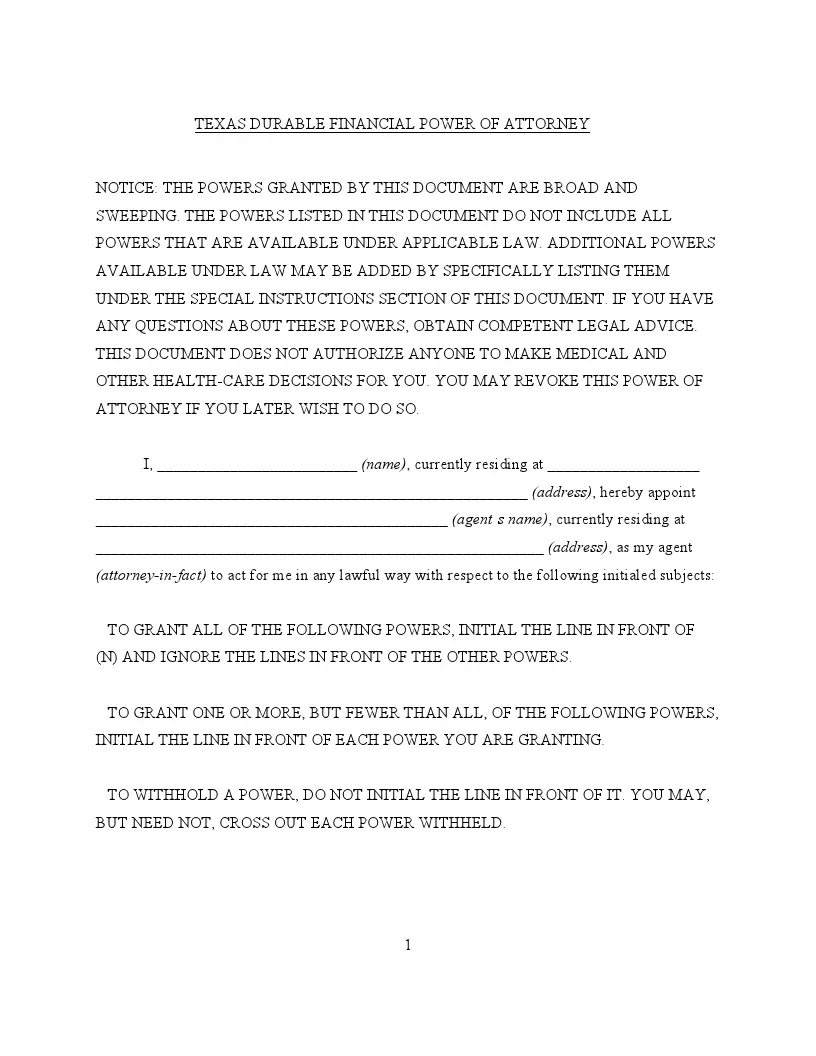
This form is usually several pages long, and FormsPal's version runs eight pages. While completing it, you choose which financial powers to give your agent, which may include:
You can also list other responsibilities you want your agent to handle on your behalf. Read the form carefully and decide which powers matter most to you before you sign. For federal tax matters specifically, FormsPal's IRS power of attorney form may fit better.
Texas's statutory form also lets you customize a few common choices.[2] You can name co-agents, who may act independently of each other unless you say they must act together. You can also decide whether your agent receives compensation for serving, and whether your agent may make gifts on your behalf, though a gift to any one person cannot exceed the annual federal gift tax exclusion for that year.
If an agent violates the Durable Power of Attorney Act or acts beyond the authority you granted, the agent may be liable for damages caused by the violation. The agent can also be prosecuted for misapplying fiduciary property under Chapter 32 of the Texas Penal Code.[2]
| Document Name | Texas Durable Power of Attorney Form |
| Other Names | Texas Financial Durable Power of Attorney, TX DPOA |
| Relevant Laws | Texas Statutes, Estates Code, Title 2, Chapters 751 and 752 |
| Signing Requirements | Notary Public |
| Avg. Time to Fill Out | 10 minutes |
| # of Fillable Fields | 37 |
| Available Formats | Adobe PDF |
A DPOA is different from a general power of attorney, which typically ends once the principal becomes incapacitated, and from a medical power of attorney, which covers health care decisions instead of financial ones. If you need coverage that ends at incapacity rather than continuing through it, see FormsPal's Texas general power of attorney form instead. People often set up a DPOA alongside the rest of an estate plan, so an agent can keep finances running during an illness, injury, or period of cognitive decline.
A person accepts appointment as agent under a DPOA by exercising authority, performing duties as agent, or through other conduct that shows acceptance. Once an agent accepts, Texas law treats the agent as a fiduciary who must act only within the powers granted and account for actions taken.[1.2][1.3]
The agent must timely inform the principal of each action taken under the power of attorney.[1.4] The agent must also keep records of every action taken or decision made while acting as agent.[1.5]
Download FormsPal's free Texas DPOA template below, fill it out online using our step-by-step builder, and print or sign the finished document once you are ready to have it notarized before a notary public.
Yes. A Texas durable power of attorney must be notarized. State law requires it to be acknowledged, either by the principal or by another adult the principal directs to sign, before a notary public or another officer authorized to take acknowledgments and administer oaths. A document that skips this step will not meet Texas's signing requirements.[1.1]
If you are unfamiliar with how notarization works in Texas, see FormsPal's Texas notary acknowledgment guide.
A DPOA ends when the principal dies or revokes the agent's authority. Unless the document says otherwise, a lapse of time since signing does not end the agent's authority on its own. The agent may keep acting until one of the following happens:[1.6]
This page is general information about Texas power of attorney law, not legal advice. For advice on your situation, talk to a Texas attorney.
Unless noted otherwise, the sources below are from the Texas Family Code, published by the Texas Legislature Online.
