
Updated:
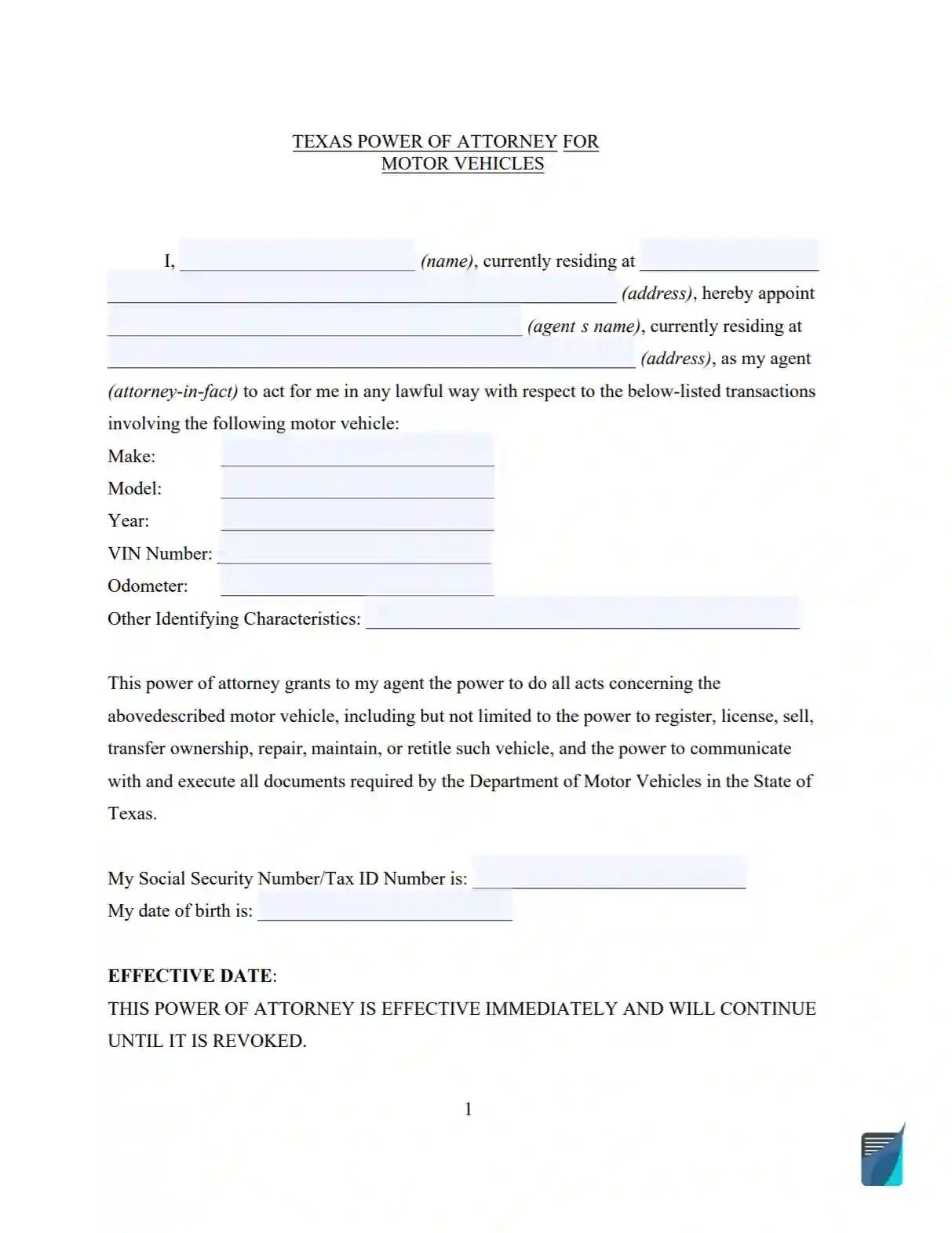
A Texas motor vehicle power of attorney (POA) is a legal document that lets a vehicle owner name someone to act for them in a vehicle transaction. The Texas form is called VTR-271. It is one type of power of attorney form, and our guide to Texas POA forms lists the others. You can download the official VTR-271 from this page, or create a vehicle POA online with Create My Document and print it.
Build Your Document
Answer a few simple questions to make your document in minutes
Save and Print
Save progress and finish on any device, download and print anytime
Sign and Use
Your valid, lawyer-approved document is ready
A vehicle power of attorney is a short document that lets another person or an entity act for the owner with a specific vehicle. The owner is the principal, also called the grantor. The person who receives the authority is the attorney, also called the grantee. The form on this page uses the terms grantor and grantee.
Every state has its laws that govern these documents. The Texas Durable Power of Attorney Act does not apply to powers of attorney created on forms that government agencies prescribe for governmental purposes. The TxDMV Form VTR-271 sets out its own signing rules.[2][1] Sometimes public authorities of the state recommend a vehicle POA template.
A vehicle POA usually contains:
Texas Transportation Code Section 501.076 sets out a limited power of attorney for one situation. An owner with a contractual option to transfer vehicle ownership in full or partial satisfaction of what is owed on it may sign one so an agent can complete and sign title transfer documents for the owner. This section does not affect powers of attorney used in other title transfers.[3] TxDMV does not require notarization for limited powers of attorney used to transfer vehicle ownership. For a title transfer, TxDMV forms also need no notarization unless a form specifically requires it.[4] The vehicle owner signs Form VTR-271 as grantor. Original signatures in black or blue ink are required, and no alterations are allowed.[1]
In Texas, a vehicle POA form is also referred to as the VTR-271 Form.
This table summarizes Texas Form VTR-271, the official TxDMV form this page hands out. It shows the document name, the state form name, the average time to fill out the form and the available format, and links to the state agency.
| Document Name | Texas Motor Vehicle Power of Attorney Form |
| State Form Name | Texas Form VTR-271 |
| Relevant Link | Texas Department of Motor Vehicles |
| Avg. Time to Fill Out | 7 minutes |
| # of Fillable Fields | 16 |
| Available Formats | Adobe PDF |
The steps below follow Texas Form VTR-271, the official TxDMV form this page hands out. The form fits on one page and has three blocks to fill in: the vehicle, the people involved and the signature.
The screenshots under each step show Texas Form VTR-271 filled with sample entries in blue, so you can see where each answer goes. The names, addresses, dates and amounts are examples only.


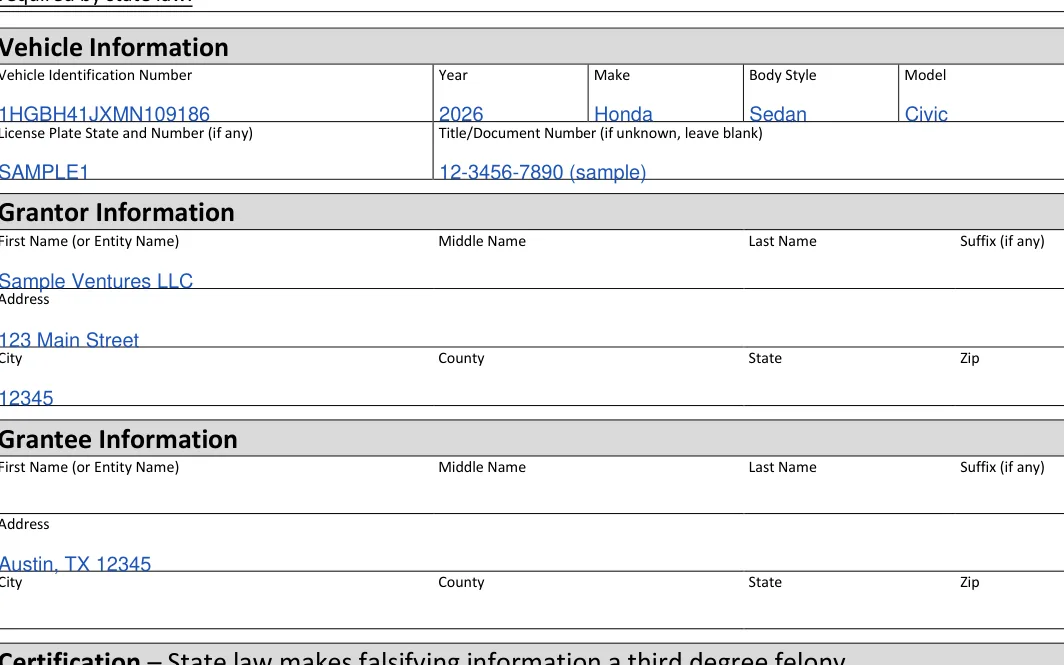


Once every field is filled in, print the form and read it through with the person you named as grantee. Check that the names on the form match the names on your IDs, and that the vehicle details match the title.
It is a document in which a vehicle owner, the grantor, names another person or an entity, the grantee, to act for them in a vehicle transaction. The Texas version is called Form VTR-271.
It has spaces for these details:
The grantor is the vehicle owner who gives the authority. The grantee is the person or entity the owner names to act for them.
Yes. Select Create My Document at the top of this page, answer a few questions, then download or print the finished form. You can also download the PDF and fill it in with the PDF editor.
Check that the vehicle details match the title, that the names match the IDs, and that the date is filled in. Then keep a signed copy with your vehicle documents.
General information, not legal or tax advice.
